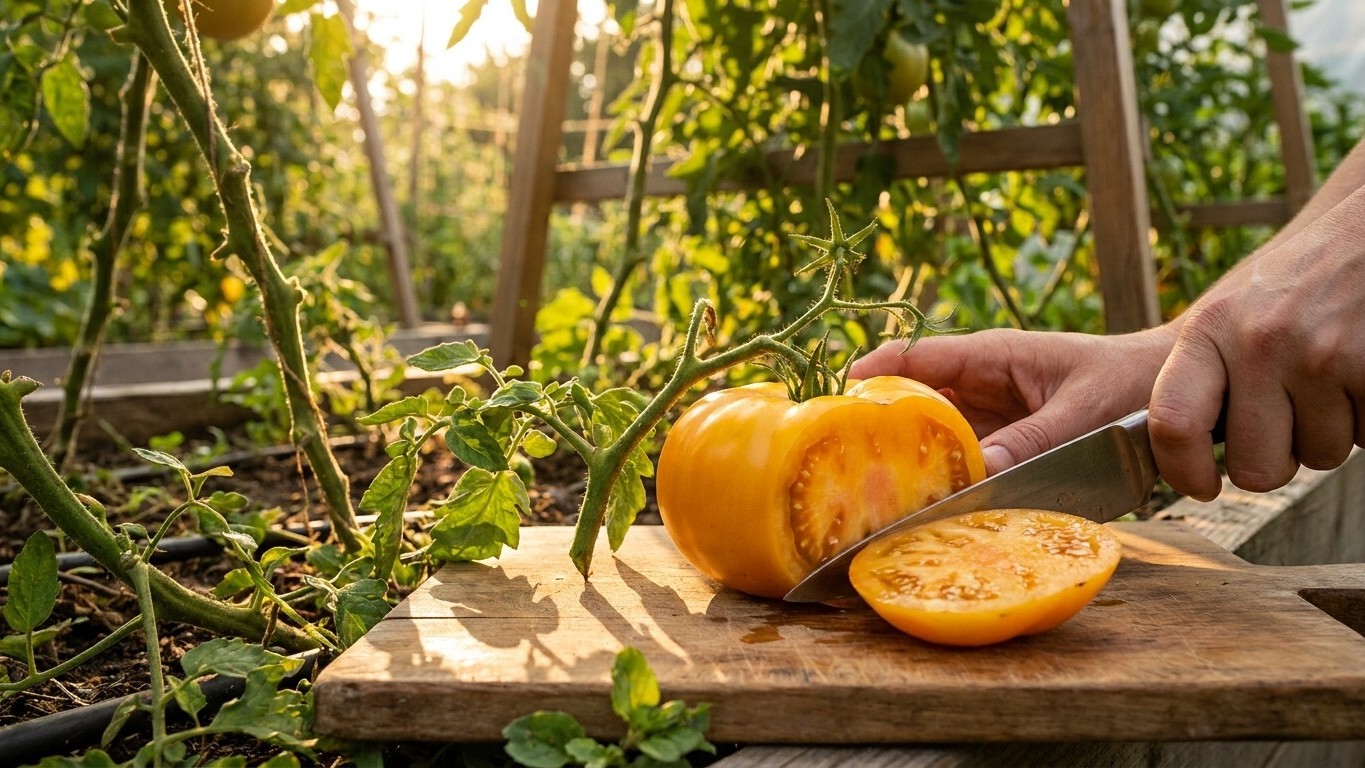

Yellow Brandywine is a slicing heirloom tomato that needs 78 days from transplant to first ripe fruit, grows as an indeterminate vine that keeps producing until frost, and rewards patient gardeners with rich, orange-yellow flesh. It fits comfortably in most of the continental U.S., but the margin for error shrinks fast once your frost-free season runs short or your summers spike past the mid-80s at night.
What Brandywine actually is
Three facts decide whether this tomato belongs in a given garden. First, the catalogue figure of 78 days to maturity is counted from transplant, not from the day you sow seed indoors. That distinction matters because seed-to-transplant time for tomatoes typically runs another five to seven weeks under lights, and conflating the two numbers is the single most common reason gardeners think a variety let them down when the math was wrong from the start.
Second, Yellow Brandywine is indeterminate. The vine does not stop growing and setting fruit at a predetermined height or after one flush. It keeps climbing, branching, and producing until frost cuts it down, which means it needs a tall cage, a stake driven deep, or a trellis system built to handle a plant that can top six feet by late summer. Skip the support and you get a sprawling mat of vines with fruit rotting on damp soil.
Third, the fruit itself is built for the cutting board, not the canner. It is described as an orange old-timer with rich flavor, and its intended use in the kitchen is slicing: sandwiches, salads, the kind of tomato you eat with a little salt and nothing else. That single detail should shape how many plants you grow. A household that wants sauce or paste needs a different variety entirely, no matter how well Yellow Brandywine performs in the ground.
Where it ripens in time, and where it is a gamble
The 78-day figure only tells half the story. What actually determines whether you get a full harvest or a handful of green tomatoes at first frost is the length of your frost-free window, minus the time your soil needs to warm before you can safely set plants outside, minus those 78 days themselves.
Start with the frost-free window, the stretch between your area’s average last spring frost and its average first fall frost. Subtract roughly two weeks at the start of that window, because tomato transplants sulk or stall in cold soil and most gardeners wait until nighttime lows are reliably above 50F before planting out, even if the calendar says the frost risk has passed. Subtract the 78 days needed to reach the first ripe fruit. Whatever remains is your actual picking season, the stretch during which the vine keeps producing before cold shuts it down again.
In a region with a long, generous frost-free season, that arithmetic leaves weeks or months of harvest, plenty of room for an indeterminate vine to hit its stride and keep bearing through late summer into fall. In a region where the frost-free window itself is short, the same math can leave almost nothing. If your last frost is late and your first fall frost arrives early, subtracting two weeks for soil warming and 78 days for maturity can eat the entire window before a single tomato colors up.
This is not a claim that Yellow Brandywine is impossible in short-season climates. It is a claim that the margin for error disappears. A gardener in a region with a tight window has almost no buffer for a cool, wet spring that delays planting, or a stretch of clouds that slows ripening. A gardener with a long, warm season can absorb those setbacks and still fill a basket. No frost-station figures are cited here beyond this general method, because the point is not one city’s date but the arithmetic itself: pull your own area’s average last and first frost dates, run the same subtraction, and you will know within a week or two how much slack you actually have.
The practical takeaway is to run this calculation before buying seed, not after the plants are already twelve inches tall in June. It costs nothing and it tells you more than any hardiness map.
The two ways a season goes wrong
A frost-free window that looks long on paper does not guarantee a good crop, because two limits sit outside what any frost table can show.
In cooler regions, the problem is not frost itself but accumulated warmth. Tomatoes need consistently warm days and nights to push fruit from flower to ripe color, and a region can post a technically long frost-free season while still running cool, overcast, or windy enough that the plant never gets the heat units it needs. Nights below 50F are the real threshold to watch: below that, tomato flowers frequently fail to set fruit at all, regardless of how many weeks remain before frost. A long season full of chilly nights can produce a vine covered in blossoms and almost no tomatoes.
In hot regions, the opposite failure shows up. Once daytime temperatures climb above roughly 86F, tomato pollen becomes sterile and fruit set stalls, even though the plant itself stays green and vigorous. This is why experienced growers in hot-summer regions plant a spring crop that finishes before the worst heat arrives, then a second crop in late summer timed to ripen once temperatures ease in fall, rather than expecting one unbroken season of production.
For Yellow Brandywine specifically, the heat-driven failure matters more than the cold-driven one, given its 78-day maturity. A vine started early enough to reach maturity before the hottest stretch of summer can slip its first harvest in ahead of the pollen-sterility window; started too late, it can spend the hottest weeks holding blossoms that never become fruit, then scramble to catch a second flush once temperatures drop. In cooler regions with a genuinely long frost-free window, the cold-night threshold is less of a threat simply because there is enough calendar to wait out a slow, chilly stretch.
What it resists, and what it does not
Here the catalogue record is short, and it deserves to be reported exactly as it stands rather than softened. Yellow Brandywine carries no published disease resistances. There is no listed protection against verticillium wilt, fusarium wilt, nematodes, or any of the other pressures that plague breeders build into modern hybrid tomatoes.
That is not a knock against the variety so much as a fact about heirlooms generally: most were selected over decades for flavor and form, not for laboratory-confirmed disease resistance, and their catalogue listings reflect that history honestly. Saying “no resistance claimed” is itself useful information, because it tells a gardener exactly what they are taking on. If your garden bed has a known history of verticillium or fusarium, this variety brings no built-in defense against either one, and rotating tomatoes out of that soil for three to four years, or growing in fresh raised-bed soil, becomes the main tool available.
It is worth being precise about a distinction that matters elsewhere in tomato breeding even though it does not apply here: some varieties are graded with intermediate resistance to a disease, meaning the plant slows the disease’s progress without stopping it outright, versus high resistance, which suppresses it much more completely. Confusing the two costs gardeners a crop when they assume “resistant” means “immune.” Yellow Brandywine sidesteps that confusion by simply carrying no resistance rating at all, so there is nothing to overestimate. Plan accordingly: healthy soil, adequate spacing for airflow, and mulch to cut soil splash onto lower leaves do more of the disease-prevention work here than they would for a resistant hybrid.
Growing it without the usual mistakes
Because Yellow Brandywine is indeterminate, it needs a different plan than a determinate tomato that sets one flush of fruit and finishes. A determinate variety can get by with a modest cage sized for a compact plant. This one cannot. Give it a stake at least six feet tall driven in at transplant time, or a cattle-panel trellis, and commit to tying or weaving the main stem as it climbs through the season. Waiting until the vine is already sprawling to add support means fighting brittle stems and snapped branches.
Spacing matters more than it looks like it should. An indeterminate vine left in a group planted too tightly shades its own lower leaves and traps humidity, and with no published disease resistance to fall back on, that humidity is exactly what invites fungal trouble. Space plants generously enough that air moves through the row, and strip the lowest leaves once the plant is established to keep foliage off the soil.
On feeding, back off nitrogen once flowering begins in earnest. A heavy nitrogen feed keeps an indeterminate vine throwing leafy growth at the expense of fruit set, which is the opposite of what you want from a variety that already needs 78 days just to start ripening. Switch to a lower-nitrogen, higher-potassium feed once the first flower clusters appear.
The mistake its particular timing invites is planting too late and expecting the long indeterminate habit to make up for lost time. It will not. An indeterminate vine rewards an early, well-timed start with weeks of extra harvest; started late, it simply runs out of season before it hits full stride.
Common questions
Is Yellow Brandywine the same as the classic pink Brandywine?
No. It shares the Brandywine name and the indeterminate potato-leaf-style heirloom lineage in a general sense, but this is a distinct yellow-orange strain with its own flavor profile, described as rich-tasting, and its own 78-day maturity figure from transplant.
How many plants do I actually need for slicing tomatoes all summer?
Because it’s indeterminate and used mainly for slicing rather than canning, most households do fine with two to four well-supported vines rather than a large block, since each plant keeps producing steadily rather than dumping one big harvest.
Can I start seed indoors to beat a short season?
Yes, and this is the main lever available to short-season gardeners. Starting seed indoors five to seven weeks before your area’s safe transplant date, then hardening off carefully, effectively lengthens your usable season without changing the frost dates themselves.
Why is my Brandywine plant huge and healthy but not setting fruit?
Check nighttime temperatures first. Below 50F or above the mid-80s in the day, tomato pollen often fails to set fruit, regardless of how vigorous the vine looks. This is a temperature problem, not a feeding or disease problem, and it usually resolves once conditions moderate.