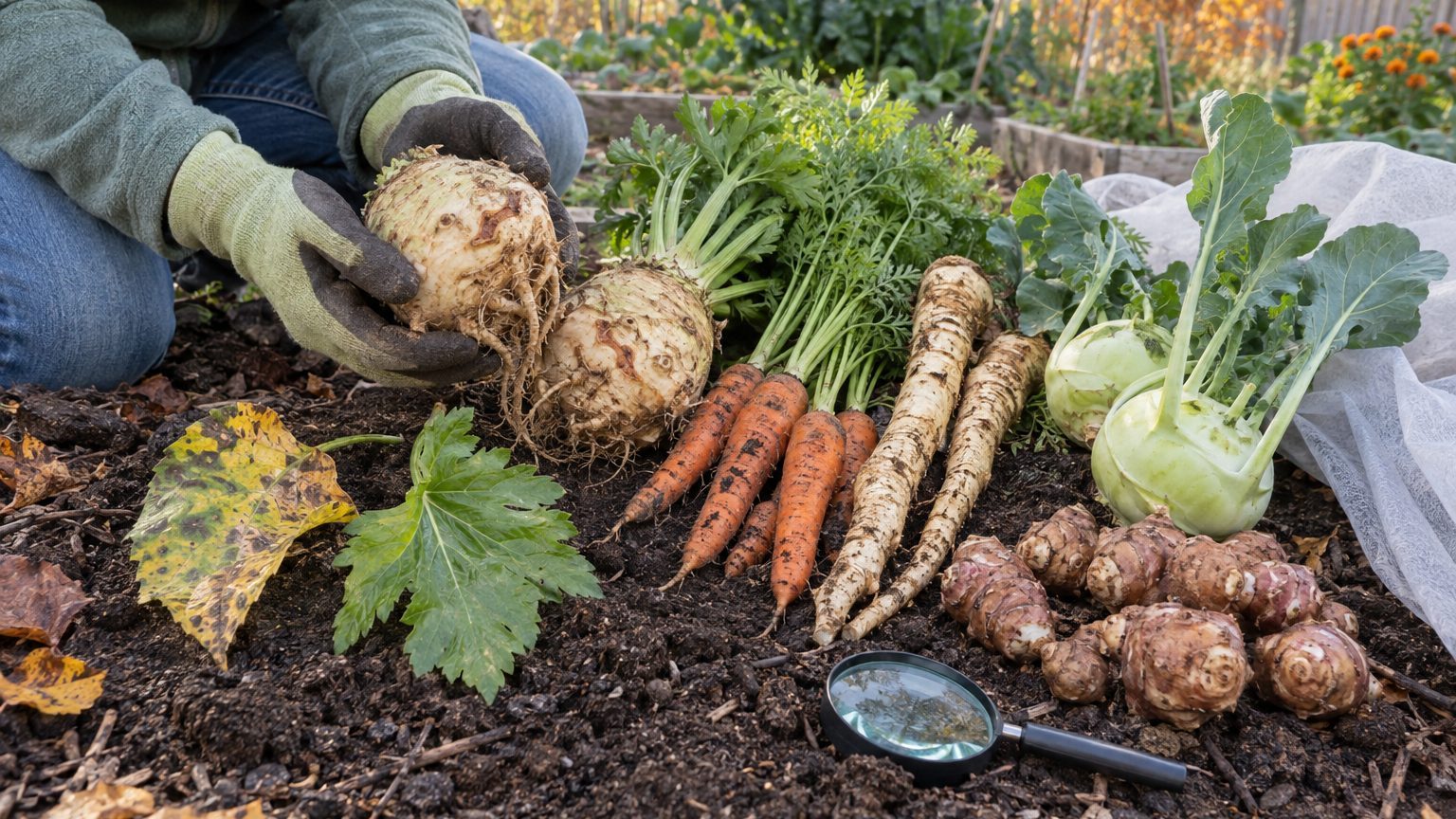

Each of these four crops has its own short list of troublemakers, and the lists overlap less than you’d expect. Celeriac gets hit by the same fly that ruins carrots. Kohlrabi and horseradish share every pest of the cabbage family, plus a few diseases. Jerusalem artichokes barely attract insects at all, but voles and fungus can still take a bite out of the harvest. Knowing which group your crop belongs to tells you what to watch for and when.
This page covers the common culprits for each of the four crops, how to recognize the damage, and what works without turning your garden into a spray zone. For the growing basics, start with the overview of Celeriac, Kohlrabi, Horseradish and Jerusalem Artichokes.
Celeriac: one serious fly, a few leaf diseases
Celeriac sits in the ground for roughly four months after transplanting, which gives pests plenty of time to find it. The one that does real damage to the root is the carrot rust fly. Its larvae tunnel through the outer layer of the root, leaving rusty brown channels that invite rot. The fly also attacks carrots, parsnips and parsley, so a bed that held any of them last year is a poor place for celeriac. It’s mostly a northern and cool-climate problem, and wet springs make it worse.
Floating row cover is the most reliable defense. Lay it right after transplanting, bury or pin the edges so nothing crawls underneath, and leave it on through the weeks when adults are laying eggs. Local extension offices usually publish emergence timing for your region, which beats guessing. Crop rotation helps only if the next bed is well away from last year’s, since the adult flies move around.
Above ground, the usual suspects are leaf diseases. Septoria leaf spot and Cercospora early blight both show up as small tan or brown spots that spread and merge, and both travel on splashing water. A drip line or soaker hose keeps foliage dry. Give plants enough room for air to move, and wait at least two or three years before putting celery family crops back in the same spot. Celeriac tolerates some leaf loss without hurting the root, so a few spotted leaves are no emergency. A whole canopy turning brown by midsummer is another matter.
Then there are the caterpillars. Black swallowtail larvae, green with black bands and yellow dots, munch on celeriac leaves the way they munch on parsley and dill. Handpicking works if you can stand to do it. Plenty of gardeners tolerate a few, since the butterflies are worth the nibbled leaves. Aphids occasionally cluster on new growth and usually yield to a hard spray of water. Slugs chew young transplants in damp weather, and a ring of iron phosphate bait or a evening flashlight patrol keeps losses down.
One problem that looks like a pest but isn’t: hollow centers and brown, corky spots inside the root. Uneven watering and low boron in the soil are the usual explanations, so check with a soil test before you go hunting for bugs.
Kohlrabi and horseradish: the cabbage family’s long list
Both crops are brassicas, which means they attract every insect that has ever eaten a cabbage. The difference is in what the damage costs you. Kohlrabi’s swollen stem forms above ground, so root-feeding pests matter less than they do for turnips or radishes. Horseradish is grown for its root, but its leaves take most of the abuse, and they are mostly forgiving.
Insects that show up every year
Flea beetles come first. These tiny, jumpy beetles chew dozens of small round holes in leaves, and on seedlings they can kill a plant in days. On established kohlrabi they’re cosmetic. On horseradish, whose leaves can look like lace by August, the root usually keeps growing anyway. Row cover over young kohlrabi seedlings stops most of it.
The cabbage root maggot is the other early-season threat. Adult flies lay eggs at the base of plants in spring, and the white larvae tunnel into the stem and roots. Wilting seedlings and a stunted plant that pulls out too easily are the giveaways. Because the flies are most active in spring, a fall crop of kohlrabi often escapes the worst of it. Row cover again does the heavy lifting for spring plantings.
Caterpillars arrive as the weather warms. The imported cabbageworm (velvety green, from those white butterflies fluttering over the bed), cabbage loopers and diamondback moth larvae all chew leaves and leave droppings behind. Bacillus thuringiensis (Bt), a bacterial product sold for caterpillars, is approved for organic use and targets only caterpillars, though it needs to be applied while larvae are small. Check leaf undersides weekly in summer.
Gray-green cabbage aphids pack into dense, waxy colonies on leaf undersides, and harlequin bugs (red and black shield-shaped insects) suck sap in warmer states, especially in the South. Handpicking harlequin bugs works better than most sprays. Aphid colonies on kohlrabi can be hosed off, and they matter more on horseradish for a different reason, covered next.
Clubroot and other diseases worth fearing
Clubroot is the one that can retire a garden bed. The organism behind it, Plasmodiophora brassicae, causes swollen, distorted roots, and plants above ground wilt on hot afternoons and recover at night until they finally don’t. Resting spores can persist in soil for many years (figures of 15 to 20 years are widely cited), and they hitch rides on boots, tools and transplants. Acidic soil encourages it, so raising pH toward 7.2 with lime helps in beds that test low. If you buy transplants, check roots before planting. Digging up one clubbed root is a reason to stop growing brassicas in that bed for a long time.
Black rot, which starts as yellow V-shaped patches on leaf edges, is carried on seed and spreads in warm, wet weather. Buy clean seed and rotate beds so brassicas return only every three or four years.
Horseradish has its own concerns. White rust produces chalky white pustules on the leaves. Turnip mosaic virus, spread by aphids, mottles and distorts foliage and can ride along in the root cuttings used for planting, so start with healthy sets from a reputable source. Verticillium wilt is a bigger issue for commercial growers but can build up in garden soil too.
Rotation is awkward with horseradish. Any piece of root left behind regrows, so a patch never truly clears out when you dig it, and problems in the soil carry over. When you lift roots in fall, take out as much as you can; the guide to Lifting Four Different Kinds of Root covers how to do that without leaving a crop of volunteers.
Jerusalem artichokes: more mammals than insects
Jerusalem artichokes are a kind of sunflower, and they’re tough. Insect damage is usually minor, and the plants shrug off most of it. Slugs and snails may graze spring shoots as they emerge. Aphids and various chewing insects show up on leaves and rarely amount to anything.
Diseases follow the sunflower family. Powdery mildew coats leaves in late summer and looks worse than it is. Rust shows up as orange-brown pustules on the undersides of leaves. White mold (Sclerotinia) is the more serious one: cottony growth on stems near the soil line, then stems that wilt and shred. Remove infected stalks, don’t compost them, and avoid crowding the stand so air can move through.
The bigger loss often comes from mammals. Voles and pocket gophers tunnel to the tubers, and groundhogs, rabbits and deer will browse the tops. In parts of the South, feral hogs can dig up an entire patch. Planting in a raised bed lined with hardware cloth beats trying to out-trap a vole population. Since tubers keep poorly once dug (they shrivel within weeks in a fridge), many gardeners leave them in the soil and dig through winter, which exposes them to rodents for months. Dig what you need, and mulch heavily rather than leaving a big patch unattended.
Containing the plant matters more than any pest. A tuber missed during harvest sprouts the next year, so the patch you plant is the patch you keep, and that includes whatever disease it harbors. The article on Jerusalem Artichokes: Plant Them Where You Mean It explains where to site them so they can’t spread into places they shouldn’t.
A defense plan that covers all four
Most of this comes down to a few habits that carry across crops. Row cover handles the root fly on celeriac, the maggot and flea beetles on kohlrabi, and early-season horseradish pests, as long as the edges are sealed and the cover goes on before adults arrive. It does nothing if the soil already holds pupae from last year, which is where rotation comes in.
Group your crops by pest family when planning beds:
- Celeriac: keep away from carrots, parsnips, parsley and celery grown in the previous two to three years.
- Kohlrabi: keep away from cabbage, broccoli, kale, turnips and radishes for three to four years.
- Horseradish: treat it as a brassica and keep it contained, since it’s a perennial.
- Jerusalem artichokes: give them a dedicated bed, away from sunflowers if you can.
Water at the base rather than overhead, which cuts down on leaf spots, white rust and mildew in one move. Scout weekly during the first month after planting, because that’s when most damage can still be reversed. A handful of weekly checks, turning leaves over and looking at the soil line, catches nearly everything on this page while it’s still small.
Before you buy any product, check the label for the specific crop and pest. Pesticide registrations vary by crop, and kohlrabi and horseradish are sometimes listed differently than cabbage. Your state’s cooperative extension service posts local emergence dates and current recommendations, and a call to the county office is free.
One last nuance on kohlrabi: damage from root maggots often stays in the outer layer of the stem, so a bulb with some tunneling can be peeled and eaten, while one that has gone soft or smelly at the base should go to the trash rather than the compost pile.