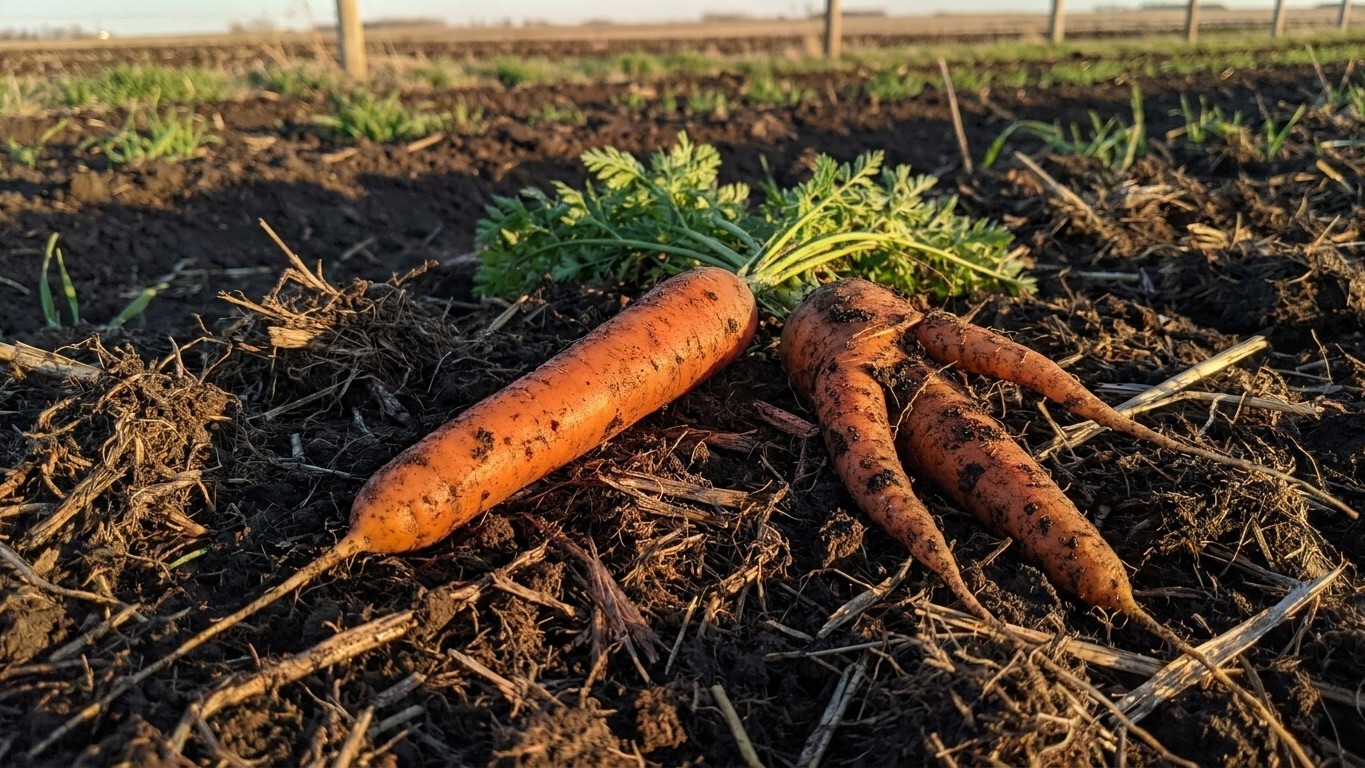

The shoulder of the root is the tell: once it pushes up through the soil line at roughly three-quarters of an inch across and the tops have gone full and dark, the carrot underneath is ready, whatever the date says. In Georgia, that moment tends to land 65 to 75 days after seeding, according to Clemson Cooperative Extension. That’s the window to plan around, not a promise for any single row.
When carrots are ready in Georgia
A carrot doesn’t ripen the way a tomato does. There’s no color change to wait for, no fruit swelling on the vine. The only honest signal is the root itself, and the easiest way to check it without sacrificing the plant is to brush back an inch of soil at the base of the healthiest-looking top and look at the shoulder. If it’s still thin as a pencil, leave it. If it’s rounded and close to that 65 to 75 days mark Clemson gives for Georgia gardens, it’s worth pulling a test root to taste and check the core.
That window runs from the day seed went into the ground, not from any transplant date, because carrots don’t get transplanted. Every root grows exactly where its seed landed, which is also why thinning seedlings early matters more for this crop than for almost anything else in the garden: crowded roots stay skinny no matter how long they sit.
Utah State University Extension gives a wider national range of 70 to 100 days from seeding to harvest, which overlaps with Clemson’s Georgia-specific figure but runs longer on the far end. The gap between the two isn’t a contradiction, it’s a reminder that soil, spacing, and how much water the roots got in the middle weeks all push the timeline around. A carrot grown in loose, sandy ground with steady moisture tends to finish nearer the short end of either range. One grown in compacted or uneven soil, or one that dried out and then got soaked again, often takes longer and forks or cracks along the way.
Georgia’s representative cropland soil, the Tifton series mapped by USDA NRCS, happens to run sandy at the surface, about 84 percent sand with only 6 percent clay. That’s good news for carrots specifically, since Utah State Extension notes that heavy or rocky soil is what makes roots fork, and sandy ground rarely does. It’s not a guarantee for every yard in the state, since garden soil gets built, amended, or scraped down to something the survey never mapped, but it’s a reasonable starting assumption if a soil test hasn’t been run. No frost date threshold is published on this page, so timing here rests on the seeding-to-harvest count above rather than a calendar date tied to first freeze.
Keeping them, and for how long
Clemson Cooperative Extension’s Home & Garden Information Center is specific about what happens after the roots come out of the ground: store carrots at 33°F and high humidity to prevent wilting. That’s the figure to write down, and it’s colder than most people expect for a root vegetable. Thirty-three degrees sits just above freezing, not in the range of a cool pantry or an average refrigerator drawer set on “normal.”
The same source draws a clear line between two kinds of storage life. Bunched carrots, meaning roots that still have their leafy tops attached, keep for about 10 to 14 days. That’s a short runway, and the tops are the reason: leaves keep pulling moisture out of the root even after harvest, which is exactly the wilting Clemson’s temperature and humidity guidance is trying to slow down. Cut the tops off close to the crown before storage, and the root stops losing water to its own foliage, which is why trimmed carrots hold up far longer than bunched ones under the same cold, humid conditions.
None of this is a promise. Clemson’s figures describe a maximum under conditions that are genuinely hard to hit outside a commercial cooler: a steady 33°F and humidity high enough to keep the air around the roots from pulling moisture out of them. A garage that swings ten degrees overnight, or a refrigerator drawer that dries out because it’s opened twenty times a day, will shorten that window without any warning. Treat 10 to 14 days for bunched roots and the longer stretch for trimmed ones as the ceiling, not the floor, and check roots every few days rather than assuming they’re fine because the calendar says they should be.
Georgia’s climate adds one more wrinkle. Late-season humidity here tends to run high even as temperatures drop, which is good for the humidity half of Clemson’s guidance and bad for anyone tempted to store carrots somewhere warm and damp, like an unheated sunporch. Warmth is what shortens storage life fastest, faster even than modest humidity swings, so the temperature side of the equation deserves more attention than the humidity side in a Georgia household.
Where in the house that actually is
Thirty-three degrees isn’t a room temperature, it’s a refrigerator temperature, and even then it’s colder than a lot of home units run by default. Most kitchen refrigerators cycle between 35°F and 40°F, which is close enough to work but still on the warm side of Clemson’s figure. The crisper drawer, especially one with a humidity control set to “high” or “vegetables,” is the closest match to what the roots actually want: cold, and humid enough that the air isn’t constantly pulling moisture out of them.
Checking that drawer with an actual thermometer is worth the five minutes it takes, because the dial on most refrigerators reflects the average temperature of the whole box, not the drawer. A cheap appliance thermometer left in the crisper overnight will tell you whether it’s running close to 33°F or closer to 40°F, and that gap is the difference between carrots that hold for weeks and carrots that go soft in days.
A garage or an unheated back porch, common storage spots in Georgia homes that don’t have a basement, swings too widely to trust for anything but the shortest stretch. Fall nights here can dip near freezing while afternoons climb into the 70s, and that kind of daily swing does the same damage to stored roots that a warm room does, just more slowly and less predictably. A heated laundry room or mudroom is worse in the other direction: comfortable for people, far too warm for roots that want to sit just above freezing.
For most Georgia households without a root cellar, the refrigerator crisper is the practical answer, not because it’s ideal but because it’s the only common household space that gets close to 33°F with any consistency. If storage space is limited, prioritize the roots meant to last longest, trimmed and unwashed, and keep any bunched carrots with tops still on toward the front, since those are the ones on the shorter 10 to 14 day clock and need to be used first.
What goes wrong here
Georgia’s sandy, well-drained topsoil, the same trait that helps carrots grow straight instead of forked, cuts the other way once the roots are out of the ground and sitting in storage. Sand drains fast in the garden but holds almost no moisture on its own, which means a container of just-pulled carrots left in a garage or shed dries out and wilts faster than the same roots would in heavier ground. The fix is the same high-humidity storage Clemson recommends, not a different variety or a different soil amendment.
A damp, mild Georgia fall is the second failure point, and it runs in the opposite direction from drying out. Roots left in the ground too long past that 65 to 75 day mark, especially after a wet stretch, are more prone to splitting and to rot setting in at the shoulder before harvest even happens. Pulling a test root at the low end of the window rather than waiting for every plant to look perfect avoids losing a whole row to a single soggy week.
The third is simpler and has nothing to do with weather: a glut. Carrots seeded thickly in a short row often mature within days of each other, which means a home garden can produce more roots in one week than a household can eat, can, or give away before storage limits run out. Staggering seeding by two or three weeks, or seeding half a row now and half a row later, spreads harvest over a longer stretch and keeps the 10 to 14 day clock on bunched roots from working against you.
On pests specifically, UGA Cooperative Extension documents aphids, Colorado potato beetle, corn earworm, cowpea curculio, cutworms, melonworm, Mexican bean beetle, pickleworm, spider mites, and squash vine borer as pests tracked for Georgia growers. Not every one of those targets carrots directly, but aphids and spider mites are the two most likely to show up on carrot foliage in a home bed, and both are easier to catch early on the leaves than after they’ve weakened the root below.
Common questions
Can carrots stay in the ground past 75 days if the weather is cool?
Clemson’s 65 to 75 day figure is a harvest window, not a hard deadline, and cool weather slows growth rather than spoiling roots outright. The bigger risk in Georgia is a wet stretch late in the season, which can split or rot roots left in the ground, so checking a test root once the window opens matters more than the calendar date itself.
Do carrots need to be washed before storage?
Clemson’s guidance centers on temperature and humidity, not on washing, and roots stored unwashed with soil still clinging to them generally hold moisture better than scrubbed ones. If washing happens before storage, drying the roots fully first helps avoid the extra moisture that speeds rot in a crisper drawer.
Why does Georgia’s sandy soil matter for carrot shape?
Utah State Extension notes that heavy or rocky soil is what causes carrot roots to fork, and Georgia’s representative Tifton series soil runs about 84 percent sand with only 6 percent clay, which tends to favor straight roots over forked ones. That’s a starting assumption based on state-level survey data, though, not a measurement of any individual garden bed, and a soil test is the only way to know what a specific yard is actually working with.
How long do trimmed carrots keep compared to bunched ones?
Clemson specifies 10 to 14 days for bunched carrots, meaning roots still attached to their leafy tops, because the tops keep drawing moisture from the root after harvest. Cutting the tops off before storage removes that drain and extends storage life well beyond that figure, though Clemson’s published guidance doesn’t give an exact number of days for trimmed roots.