
Georgia gardeners often frame carrot timing around frost dates, but no specific frost-date table is published on this page. What actually decides whether that seed turns into a straight, sweet root is the ground it lands in. Carrots take 70 to 100 days from seeding to harvest, and Georgia’s representative soil is sandy, acidic, and low in organic matter, three things that change how you prep a bed before you ever think about a calendar.
The short answer
The soil that represents Georgia in USDA records is the Tifton series, an Ultisol, which is the label soil scientists give to old, heavily weathered, leached ground that runs naturally acid and short on nutrients. The surface horizon comes in at 84 percent sand, 6 percent clay, and 9 percent silt, with a surface pH around 5.5, slightly acid, and organic matter around 0.8 percent. Drainage class: well drained.
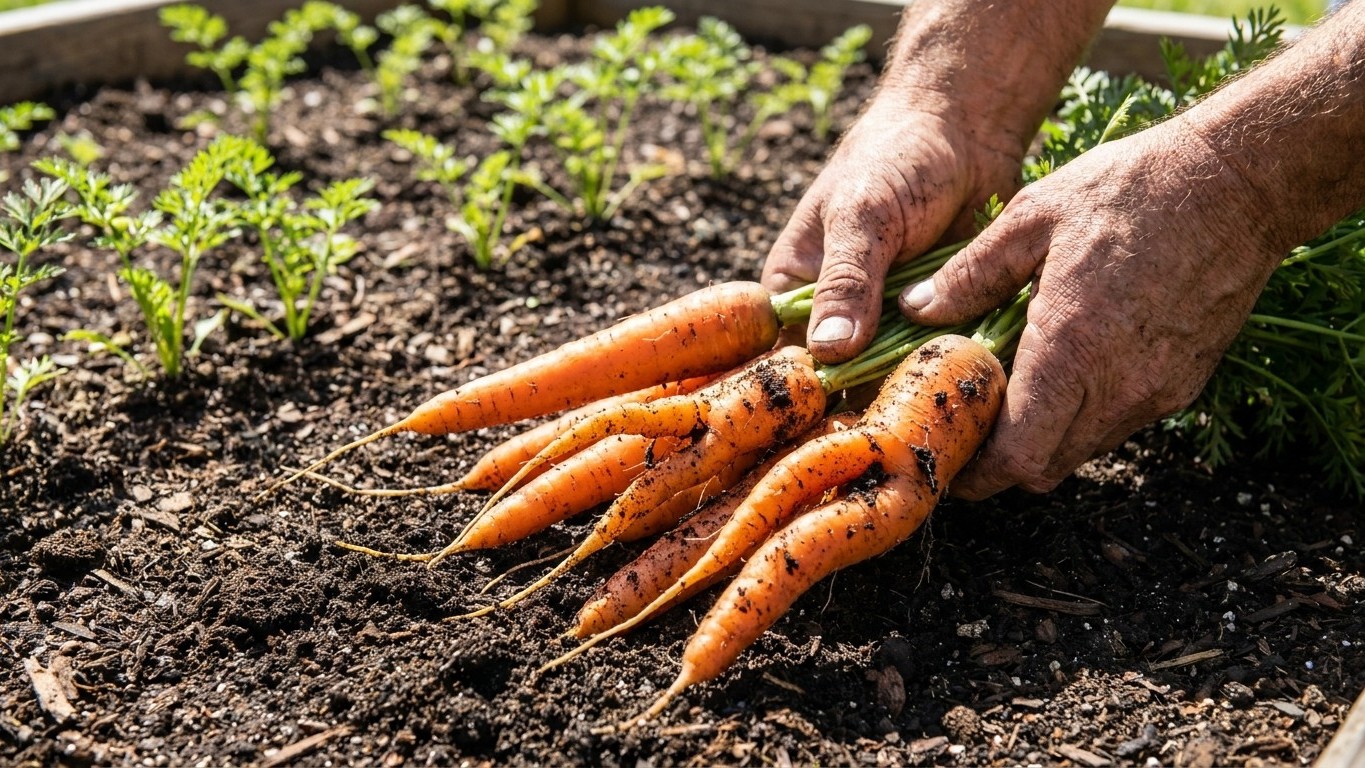
For a carrot, that texture is mostly good news. Carrots want deep, sandy, well-drained soil rich in organic matter, and a soil that’s 84 percent sand and well drained checks two of those three boxes without any digging on your part. Forking, the split, twisted root that shows up when a carrot hits something it can’t push through, is caused by heavy or rocky soil. Sand at that percentage doesn’t compact into the dense, root-splitting mass that clay does, so forking from soil density alone is less likely on ground that matches this profile.
The catch is organic matter. At 0.8 percent, the representative surface horizon is thin on the stuff that holds moisture and feeds soil life, and sandy soil this lean drains fast enough to leave roots gasping for water in a dry stretch. The fix for heavy soil is compost and double digging; the fix for sandy, hungry soil runs the same direction, work in compost, though for a different reason, you’re building water-holding capacity and nutrients rather than breaking up density. Either way, the tool is the same shovel and the same bag of compost.
None of this is a diagnosis of your yard. Georgia spans hundreds of soil series, and the Tifton profile is a statewide average, not a survey of your raised bed or the strip of dirt behind your driveway. A subdivision built on fill, a lot near a creek, or ground a previous owner amended for a decade can carry none of these numbers. Treat the Tifton figures as a starting point that tells you what the region’s ground tends to do, then confirm what your own bed actually does before you commit a row of seed to it.
The test that settles it in your own garden
A state soil survey can’t tell you what’s under your own tomato cage. The only way to know is to go dig, and it takes fifteen minutes with tools most people already own.
- Pick a spot in the bed you plan to seed and dig straight down with a spade, going as deep as the blade will reach without forcing it.
- Look at what comes up. Loose, crumbly soil the whole way down is what you want. A hard, compacted layer partway down, or a wall of rock and gravel, tells you roots will hit resistance right where a carrot needs to keep growing straight.
- Pull out any stones or chunks of hard clay you notice in the spoil pile. A soil full of pebbles and rock fragments is exactly the kind of heavy, rocky ground that makes carrots fork.
- Grab a handful of the soil from the hole, dampen it slightly, and squeeze it. Sand won’t hold a shape and falls apart the moment you open your hand. Clay balls up tight and holds a ribbon shape when you press it between your fingers. Most garden soil lands somewhere between the two, and where it lands tells you how much compost you need to work in.
- Fill the hole partway with water and watch what happens. Water that disappears quickly means good drainage. Water that sits and lingers means the ground drains poorly, and that combination of standing water and dense soil is where carrots struggle most.
Run through these steps in more than one spot if your yard has an obvious slope or a low corner that stays soggy after rain. Soil can change character across twenty feet of ground, and a single hole in the sunniest part of the yard won’t tell you what’s happening near the fence line.
What goes wrong here
- Forking in heavy ground. Wherever a garden’s soil runs closer to clay than to Georgia’s sandy statewide profile, roots hit dense earth and split or twist instead of growing straight down. The remedy is compost worked in generously and double digging to loosen the bed well below where the root will grow, or building a raised bed filled with a looser mix if the native ground underneath is too compacted to fix in place.
- Poor germination in a hot spell. Carrot seed is slow to sprout under the best conditions, and a stretch of hot, dry weather right after seeding can dry out the top inch of soil before the seed ever gets going. Keeping that top layer consistently damp, with a light mulch or frequent shallow watering until seedlings appear, is the difference between a full row and a patchy one.
- Splitting from uneven water. A root that grows steadily and then gets hit with a sudden heavy soak after a dry spell can split lengthwise as it swells too fast. Regular, even watering on a schedule, rather than letting the bed dry out and then flooding it, keeps growth steady and the roots intact.
- Low fertility from thin organic matter. Sandy soil that starts around 0.8 percent organic matter doesn’t hold nutrients long, and carrots grown in ground that hasn’t been amended can come out thin and stunted even without forking. Working compost into the bed before seeding, not just once but as a standing habit each season, keeps that number climbing instead of staying flat.
Common questions
Is Georgia’s soil good for growing carrots?
The state’s representative soil, the Tifton series, is sandy and well drained, which suits carrots well since heavy, rocky ground is what causes forking. The main weakness is low organic matter, around 0.8 percent at the surface, which compost addresses directly.
How deep does soil need to be loosened before seeding carrots?
No specific depth figure is published here, but the practical guide is to loosen soil to at least the depth of a full spade blade, and check that layer for rocks, compacted clay, or any hard band that would stop a root from growing straight.
Can carrots be grown in clay soil?
Heavy or rocky soil makes carrot roots fork, so clay-heavy ground needs plenty of compost worked in and thorough double digging, or a raised bed filled with looser soil, before it’s a good match for carrots.
How many days do carrots take to mature after seeding?
Carrots are sown directly in place, with no transplanting involved, and take 70 to 100 days from seeding to reach harvest size, depending on the growing conditions in that particular bed.