
USDA’s 2023 hardiness map puts Georgia at zone 6a in the mountains up to 9b on the coast, and that spread is the whole story. A flower that shrugs off winter in Savannah can die outright in Blairsville, and one bred for Northeast humidity can rot in an Atlanta August. Start by matching a plant’s tag to your own county rather than the state average.
What thrives in Georgia

A flower that does well here has to clear three hurdles at once: survive the coldest nights, tolerate a long stretch of heat, and shrug off the humidity that comes with it. NOAA’s 1991-2020 climate normals put the coldest month’s average low at Atlanta at 35.6°F, which is mild enough that a lot of borderline-hardy perennials make it through without protection, especially in the milder southern half of the state. Cold is rarely what kills a flower bed in Georgia. Heat and wet air are.
Summer is the real filter. Atlanta averages 35.8 days a year at 90°F or hotter, according to NOAA’s NCEI normals, and that heat load, combined with the state’s humidity, is what pushes cool-climate favorites like delphinium and lupine into failure by July. The plants that hold up share a few traits: tough, often fuzzy or narrow foliage that sheds moisture instead of holding it, deep or fibrous root systems that ride out dry spells between storms, and enough airflow around the leaves to resist the powdery mildew and leaf spot that thrive in wet, still air.
Families that do the heavy lifting
Look to the daisy family (Asteraceae) for reliable performers: coneflower, black-eyed Susan, and coreopsis all handle heat and drought once rooted in. The mint family (Lamiaceae) covers salvia and Russian sage, both of which take full sun and poor soil without complaint. Milkweeds (Asclepias) and many native asters round out a heat-tolerant palette that does not need daily attention once established.
Drainage matters as much as heat tolerance. Georgia’s clay soils hold water long after a storm passes, and a plant that would otherwise handle the humidity fine can still rot at the crown if it sits in standing water. Raised beds or a generous handful of compost worked into clay before planting solves more problems than any variety choice will.
Native plants worth the space
Native and regionally native plants carry a real advantage once they are established: they need less water, less fertilizer, and less babying than imports bred for a different climate, because they evolved alongside Georgia’s summer heat and clay soils rather than in spite of them. That does not mean no care the first year. A newly planted native still needs regular watering through its first summer while roots establish. After that, the difference is noticeable.
Purple coneflower (Echinacea purpurea) and black-eyed Susan (Rudbeckia hirta) are two of the easiest starting points, both blooming through the worst of the summer heat while feeding bees and butterflies. Butterfly weed (Asclepias tuberosa) is the milkweed most gardeners plant on purpose, and it is the only host plant monarch caterpillars will eat, so a few clumps do more for pollinators than a whole bed of imported annuals. Joe Pye weed (Eutrochium purpureum) draws swallowtails and bumblebees in numbers once it hits its stride in a damp corner of the yard, and Georgia aster (Symphyotrichum georgianum) closes out the season in October and November when almost nothing else is blooming.
Many of these same species range across the wider Southeast and into the Ohio Valley, so a gardener researching flowers that actually thrive in Kentucky will recognize a lot of overlap in the native palette, even though the two states’ frost windows and hardiness zones differ. What changes state to state is less the plant list and more the timing: a Georgia gardener works with a longer growing season and a milder winter than most of Kentucky sees.
Skip claims about a plant being native to one specific county unless a local extension source says so directly. It is safer, and more accurate, to describe a species as native to the broader Southeast or eastern United States than to draw a precise boundary you cannot back up.
Perennials that come back

Whether a perennial survives a Georgia winter depends less on the plant and more on where in the state you garden. USDA’s zone range of 6a to 9b means a plant tag reading “hardy to zone 7” is a safe bet in Atlanta or south of it, but a gamble in the mountains around Blairsville, which sit closer to zone 6a. Read the low end of the zone number on the tag against your own zone, not the state’s average, before assuming a perennial will overwinter without mulch or a cold frame.
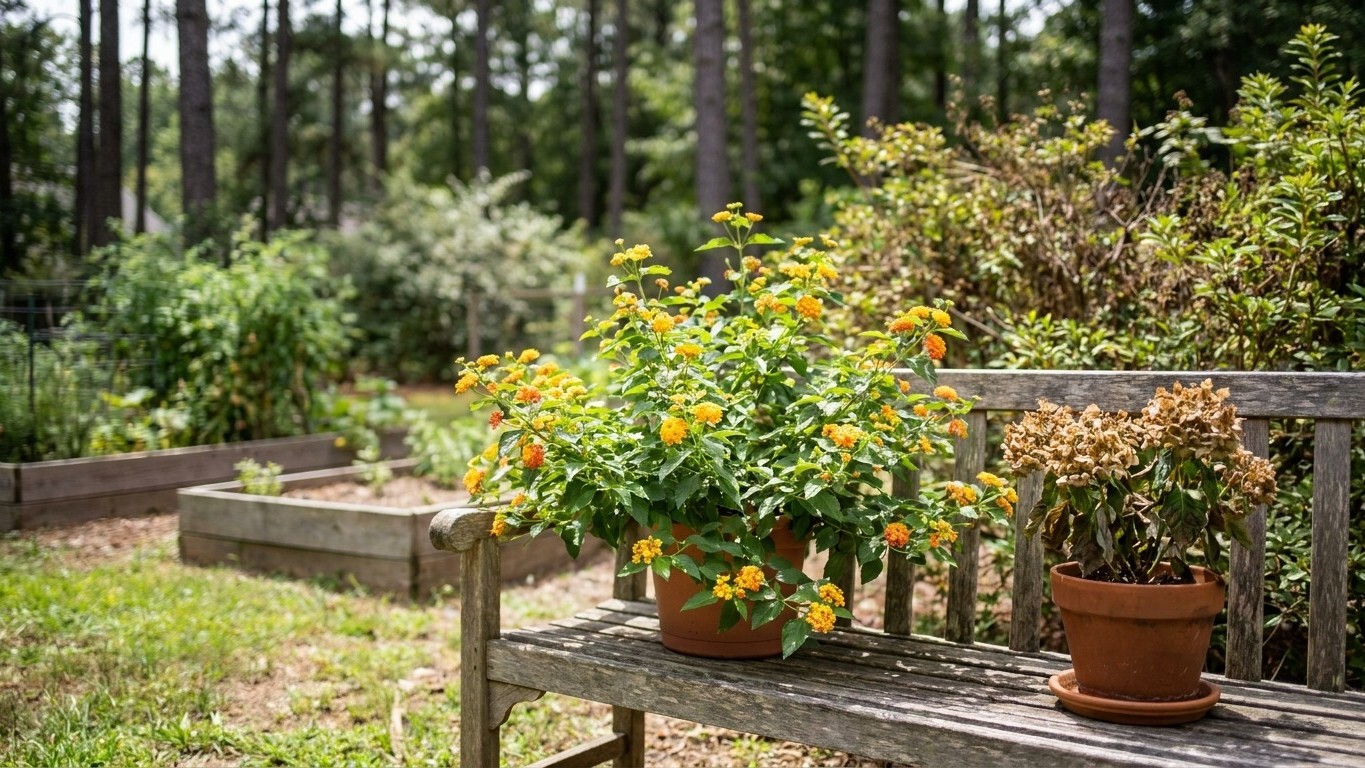
Some plants marketed and sold as annuals in Georgia garden centers are actually perennials that just cannot survive winter this far north. Lantana is the clearest example: it is a woody perennial in south Florida and the Gulf Coast, but in north Georgia’s colder pockets it usually dies back to the ground in winter and needs replanting, or heavy mulch and some luck, to return. Salvia greggii behaves the same way, reliably perennial in the milder southern half of the state and less predictable near the mountains.
What actually comes back reliably
| Perennial | Typical hardiness | Bloom season | Height |
|---|---|---|---|
| Daylily (Hemerocallis) | Zones 3-9, reliable statewide | Late spring to midsummer | 1-3 ft |
| Garden phlox (Phlox paniculata) | Zones 4-8, reliable statewide | Mid to late summer | 2-4 ft |
| Salvia greggii | Zones 7-9, best in southern half | Late spring through fall | 1.5-3 ft |
| Lantana | Zones 8-10, grown as annual north of Macon | Summer through frost | 1-3 ft |
For contrast, a gardener moving from a much colder climate, say checking a page on flowers that actually thrive in North Dakota, will notice how much of that state’s perennial list depends on plants surviving deep, sustained freezes that Georgia rarely sees. Here the challenge runs the other direction: heat and humid summers eliminate more plants than winter cold does.
Putting a border together
Layering by height
Put the tallest plants at the back of a bed viewed from one side, or in the center of an island bed viewed from all sides. Joe Pye weed and garden phlox make good backbone plants at four to five feet, daylilies and coneflower fill the middle at two to three feet, and low growers like coreopsis or creeping phlox edge the front. Leave the height chart loose rather than exact, since a plant that reaches three feet in rich soil might stall at two in poor clay.
Succession of bloom
A border that peaks once and goes bare for the rest of the season is a common first-year mistake. Stagger bloom times so something is always flowering: spring bulbs and phlox subulata early, coneflower and daylily through early summer, black-eyed Susan and salvia carrying midsummer, and asters or lantana closing out into fall. Checking each plant’s listed bloom window before buying, rather than at the garden center in April when everything looks the same, avoids a bed that goes quiet by July.
Repeat color and leave room
Buying one of everything makes a border look busy rather than designed. Repeating the same two or three colors in drifts of three to five plants reads as intentional even in a small yard. And when spacing a new bed, plant at the mature spread listed on the tag, not the size the plant is in the pot. A perennial bed planted too tight looks great for one season and then fights itself for light and airflow the next, which is exactly the crowded, humid condition that invites fungal disease in Georgia’s climate.
Local help
The University of Georgia Extension runs the state’s Master Gardener program, training volunteers who staff plant clinics and answer soil and pest questions county by county, and its extension service publishes plant lists suited to specific counties rather than the state as a whole. That local detail matters more than any general guide, since a recommendation calibrated to the coastal plain will not always hold up in the mountains. Georgia gardeners working across regions can also compare notes with other Georgia guides covering vegetables, shrubs, and seasonal timing for the same climate.
Common questions
What flowers can I plant right now in Georgia?
It depends entirely on your last frost date, which NOAA’s climate normals put at March 11 to March 29 for the Atlanta area, with the mountains running later and the coast earlier. Tender annuals and warm-season perennials go in after that window closes in your specific area, not on a fixed calendar date.
Why do my flowers look great in spring and then die in July?
Most often it is a plant chosen for its bloom rather than its heat tolerance. Cool-season favorites like pansies and delphinium are built for a shorter, milder summer than Atlanta’s average of 35.8 days above 90°F, and they simply give out once that heat sets in.
Do I need to worry about frost damage in fall?
Yes, once you get past NOAA’s first fall frost window of November 13 to December 1 for the Atlanta area. Tender perennials and tropical-looking annuals like lantana should be mulched heavily or brought in before that window, especially north of Atlanta where frost tends to arrive earlier.
Can I just copy a plant list made for a neighboring state?
Only partly. Species overlap a lot across the Southeast, but bloom timing, frost windows, and hardiness zones shift enough between states that a list built for a colder or milder climate needs adjusting against Georgia’s own zone range and frost dates before you plant it here.
Related guides
- Flowers That Actually Thrive in Florida, and the Ones That Struggle
- Flowers That Actually Thrive in Alabama, and the Ones That Struggle
- Flowers That Actually Thrive in Kentucky, and the Ones That Struggle