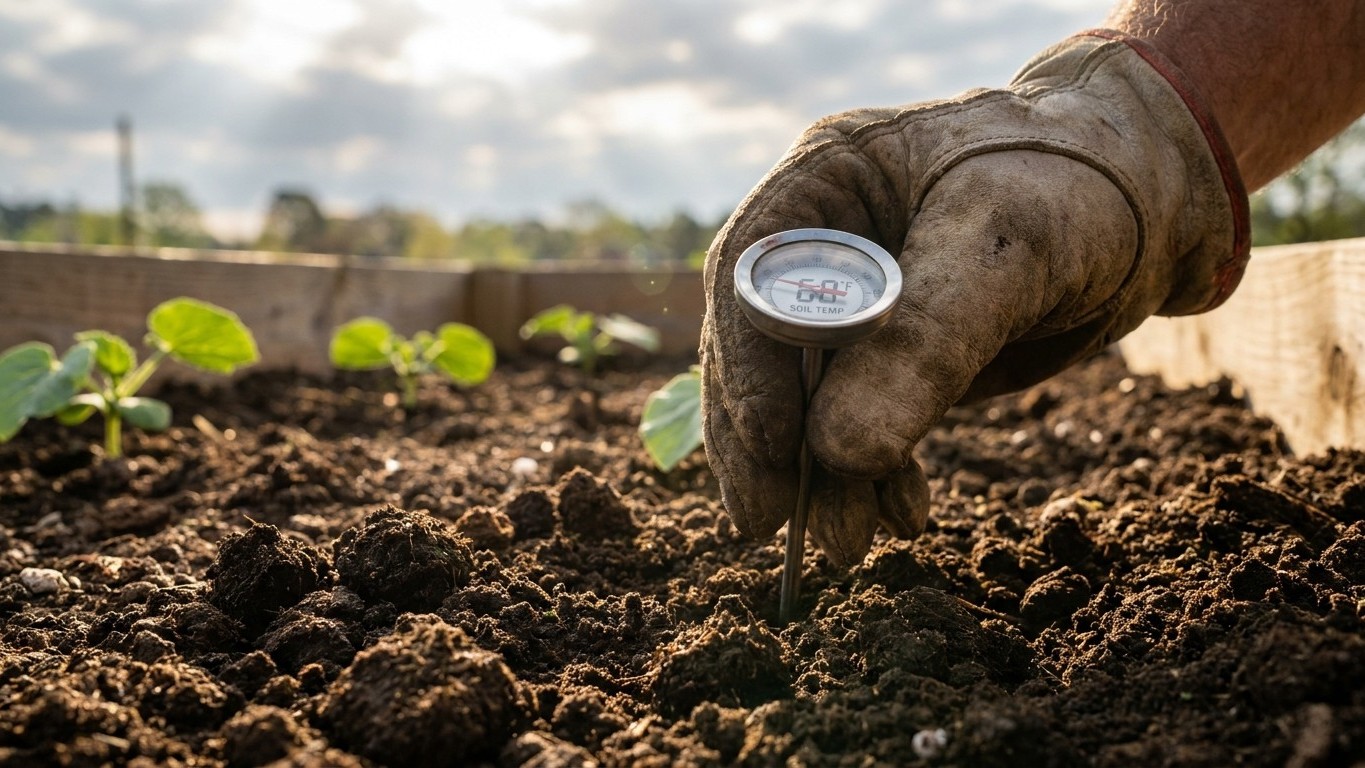

Georgia gardeners can set melon transplants or direct-seed once soil temperatures hold above 65°F, generally from mid-to-late April in most of the state, later in the mountains. The growing window itself runs long, often past 220 days, and summer heat is reliably strong enough to ripen fruit. Water management, not warmth, ends up being the deciding factor most seasons.
When the soil is warm enough in Georgia

The real question isn’t “when’s the last frost,” it’s “when is the soil actually warm.” Those two things are related but not identical, and mixing them up is how melon seedlings end up stalled in cold, wet ground for three weeks doing nothing.
For the Atlanta reference station (USW00013874), NOAA’s 1991-2020 Climate Normals put the last spring frost, defined as the 32°F freeze probability band, between March 11 and March 29. That’s a range, not a date, because it reflects a 30-70% probability window. Half of the years in that dataset saw a freeze after the early end of that range. A frost date is a probability, not a promise, and melons don’t care about the calendar entry anyway. They care about soil temperature, and soil takes time to catch up once air temperatures stop dipping below freezing. In practice, that means waiting two to four weeks past the last frost date before soil at seed depth or transplant depth is reliably warm enough for a melon to grow instead of just survive.
There’s an important caveat baked into that Atlanta number: it comes from an urban airport station, which runs warmer than the surrounding countryside because of the heat-island effect. North Georgia and the mountain counties freeze several weeks earlier in fall and stay cooler longer in spring. The coastal plain, by contrast, runs milder than Atlanta on both ends of the season. So a gardener in Blairsville is working with a very different clock than one in Valdosta, even though both are technically “Georgia.”
What actually raises soil temperature faster, regardless of region, is technique: black plastic mulch, raised beds that drain and warm faster than flat ground, and simply waiting for a stretch of consistently warm nights rather than one warm afternoon. None of that requires knowing a specific cultivar name. It requires knowing your own dirt. For variety-specific guidance, the University of Georgia Extension Service runs regional trials that account for exactly these north-south differences, and that’s the resource worth checking before buying seed, not a generic seed rack description.
How long the season lasts here
Put the two frost windows together and Georgia’s frost-free season stretches from roughly 229 days, using the latest possible spring frost (March 29) paired with the earliest possible fall frost (November 13), up to about 265 days, using the earliest spring frost (March 11) paired with the latest fall frost (December 1). Either way, that’s a long growing window by national standards, and it changes what’s worth attempting.
A season that long isn’t just “enough time for melons.” It’s enough time for two rounds of them. A first sowing planted once soil warms in late April or early May can finish well before the heart of fall, leaving room for a second sowing timed to mature before the first fall frost risk climbs in November. That second window is tight in northern Georgia, where mountain frost arrives earlier than the Atlanta normal suggests, but it’s genuinely workable across the central and southern parts of the state.
This is also where the transplant-versus-direct-seed decision gets more interesting than it looks. With a shorter window, transplants make sense because they buy time. With Georgia’s window, direct-seeding the first round is often fine, and it’s the second, later sowing where a root check on transplants (making sure they haven’t gotten pot-bound waiting for warm enough weather) actually matters, since a stunted transplant going into a second round has less season left to recover from transplant shock than a first-round plant would.
The mechanics of staggering plantings, spacing them so the second batch isn’t competing with the first for water and light, are worth reading up on rather than improvising. Our succession sowing guide walks through timing a second planting so it actually finishes before frost risk climbs back up in fall, rather than getting caught by a November freeze the Atlanta normals would have flagged in advance.
Heat and water in Georgia

Melons ripen on accumulated warmth, not on the calendar, and Georgia supplies plenty of it. The Atlanta reference station logs an average of 35.8 days a year at or above 90°F. That’s a real heat load, not a marginal one, and it puts Georgia squarely in the category where the growing question isn’t “will it get hot enough,” it’s “how do I manage what the heat does to water demand.”
Rainfall complicates the picture rather than solving it. Summer rain across June, July, and August averages about 13.6 inches, broken down as 4.54 inches in June, 4.75 in July, and 4.3 in August, the driest of the three. On paper that sounds like enough moisture. In practice, it rarely lines up with when the plant needs it most. Summer rain in the Southeast tends to arrive as isolated thunderstorms rather than steady soaking rain, which means a lot of it runs off rather than reaching root depth, especially on compacted or sloped ground. And with nearly 36 days a year pushing past 90°F, evaporation from soil and transpiration from the plant itself pull moisture out faster than a single storm replaces it.
That combination, real heat plus unreliable rain timing, means irrigation decides fruit size in Georgia more often than rainfall does, and the final two weeks before harvest decide sugar content. A melon that runs short on water during fruit sizing stays small; one that gets inconsistent water in the final stretch, a dry spell followed by a heavy storm, tends to crack or dilute its sugars right before harvest. Consistent, moderate watering through that last fortnight matters more than total seasonal rainfall does.
One more wrinkle worth naming honestly: how that rain and heat interact depends on soil type, and the same 13.6 inches behaves completely differently on sandy coastal-plain soil, which drains within a day, than on the heavier clay common further north, which can hold water for a week and invite root rot instead of drought stress. A rain gauge on your own plot, not the regional average, is what actually tells you when to irrigate.
Which melons suit Georgia
Rather than naming a specific variety, which changes from one UGA trial year to the next and varies by region within the state anyway, it’s more useful to think in types and match them to what this territory’s numbers actually demand.
Georgia’s long frost-free window, up to 265 days at the favorable end, means gardeners aren’t limited to only the earliest-maturing types the way a short-season northern territory would be. There’s room for both quick-finishing types suited to a first spring sowing and longer-season types for gardeners further south who want to push a second planting through fall. But the state’s humidity and summer rainfall pattern, even at a modest 13.6 inches, mean disease pressure (powdery mildew, downy mildew, and fungal leaf spots) shows up reliably in a Georgia garden by midsummer. That makes disease resistance the first filter to apply when choosing what to plant, ahead of flavor or size claims on a seed packet.
The heat load, those 35.8 days above 90°F at the Atlanta reference point, also argues for types and growing setups that give the root zone some relief: mulch to keep soil temperature down, spacing generous enough for airflow between vines, which also helps dry leaves faster after those thunderstorm-pattern summer rains and cuts down on the fungal problems mentioned above.
Georgia sits across USDA Hardiness Zones 6a through 9b, a range built on winter’s extreme minimum temperature rather than summer performance, and it’s wide enough that a variety trialled and recommended in Savannah won’t necessarily be the right call in the north Georgia mountains, or vice versa. That’s precisely why this page stops short of naming one: the UGA Extension Service runs county-level trials that account for exactly this range, and checking their current recommendations for your county is a more reliable step than trusting any single cultivar name printed on a page that can’t see your soil, your rainfall, or your zone.