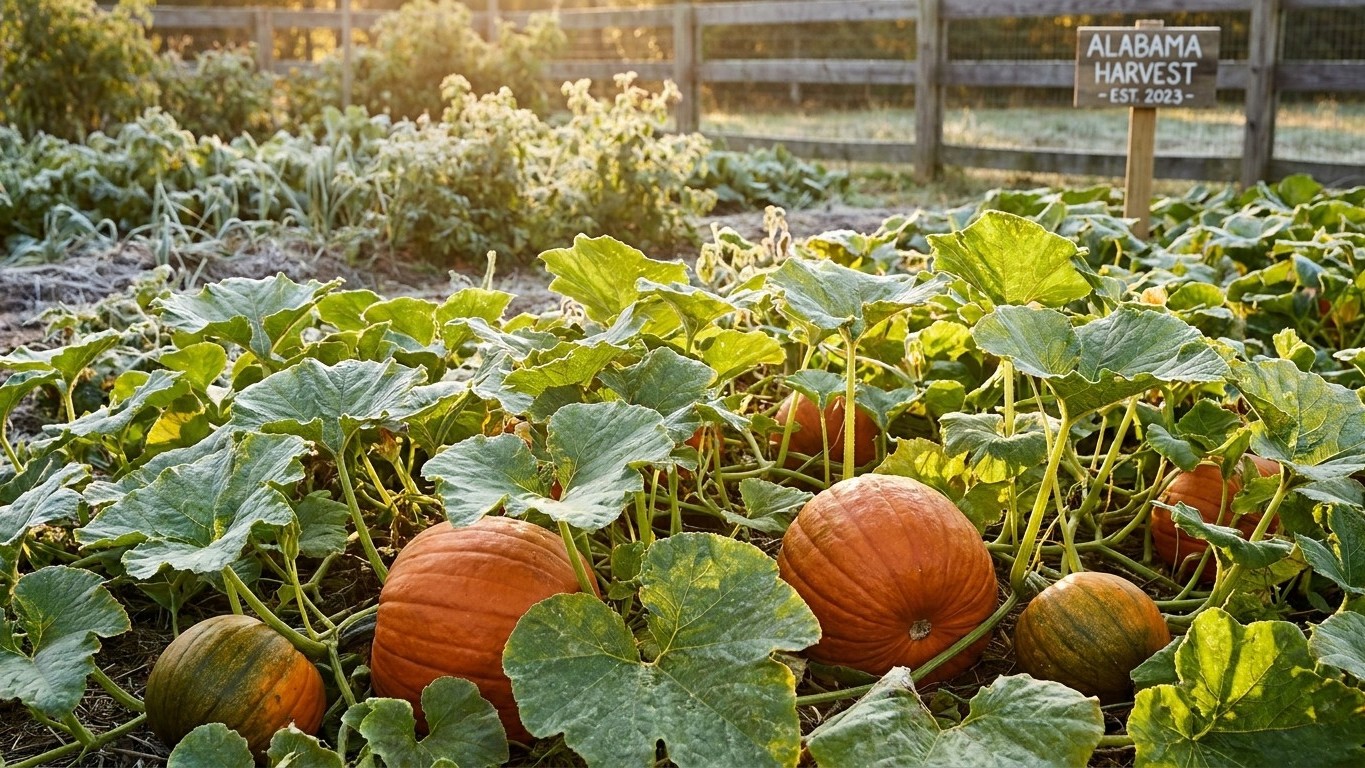

Yes, but only if the last flower opens early enough. Georgia’s first fall frost lands somewhere between November 13 and December 1, and a pumpkin needs 45 to 55 days after its flower opens, not after the seed goes in the ground, to finish ripening. That means the real question isn’t “when do I plant,” it’s “when does the plant flower,” and the answer depends on exactly where in the state you’re gardening.
The short answer
Start with the frost window: November 13 to December 1, based on NOAA NCEI’s 1991-2020 Climate Normals for the Atlanta-area station (USW00013874). Utah State University Extension’s pumpkin guidance sets the maturation clock at 45 to 55 days from flowering to harvest. Run that clock backward from the frost window and you get the last date a flower can open and still deliver a pumpkin with a hardened, colored shell instead of a green, half-formed fruit.
Work the early edge of frost first. If your yard tends to freeze on the early side of Georgia’s window, around November 13, and your pumpkin needs the full 55 days, the last flower that can still ripen needs to open by September 19. Give that same spot the shorter 45-day end of the range and the deadline slides to September 29. Now work the late edge. In spots where frost doesn’t show up until closer to December 1, a 55-day pumpkin can still flower as late as October 7, and a 45-day pumpkin can wait until October 17.
| Frost date used | Latest flower (45 days to mature) | Latest flower (55 days to mature) |
|---|---|---|
| November 13 | September 29 | September 19 |
| December 1 | October 17 | October 7 |
That’s the real window: somewhere between September 19 and October 17, a pumpkin flower has to open if it’s going to become a ripe, harvestable fruit before frost. The wide spread comes from two things stacking on top of each other. First, Georgia itself spans a frost range, not a single date. North Georgia and the mountains typically freeze several weeks earlier than the Atlanta station’s normals suggest, since Atlanta’s airport sits in an urban heat island. The coastal plain runs milder in the other direction. Second, the 45-to-55-day maturation range means two pumpkins that flower on the same day can still finish a week and a half apart. Neither number is a guess. Both come straight from the sourced ranges above. The job for a Georgia gardener is to cross them against each other for their own yard, not to lean on a single date pulled from either one alone.
When to sow here
Georgia’s last spring frost falls between March 11 and March 29, but that date tells you almost nothing about when to put pumpkin seed in the ground. Utah State’s guidance is specific on this: soil needs to reach 65 F before sowing, and soil temperature lags well behind air temperature. The ground holds onto winter cold for weeks after the air has already warmed past the frost mark, so treating the last frost date as a planting signal skips the step that actually matters, which is what the dirt itself is doing.
- Mark Georgia’s last spring frost window, March 11 to March 29, on the calendar, but treat it only as the point where air stops threatening seedlings, not as a soil signal.
- Get a simple soil thermometer and check the top few inches of the pumpkin bed at midday, since morning readings run artificially low and won’t reflect the day’s real warmth.
- Keep checking through the weeks after the last frost date passes. The soil typically needs meaningfully longer than the air does to hold a steady 65 F, which is why sowing right after the frost date usually means sowing into cold soil.
- If the calendar is tight and there’s pressure to start earlier, lay row covers over the bed ahead of sowing. That step can buy about two weeks, moving the point at which the soil underneath reads 65 F earlier than bare, uncovered ground would allow.
- Sow only once the thermometer confirms 65 F on its own, not on a covered reading taken through plastic, and treat that reading as the actual start of the season, not the frost date on the calendar.
None of this changes the finish line from the section above. Whatever sowing date the soil thermometer allows, the goal stays the same: get the plant flowering inside that September 19 to October 17 window so the fruit has its full 45 to 55 days before frost closes it out.
What goes wrong here
- A late flower that never colors. When flowering slips past the safe window for a given spot, whether that’s September 19 in an early-frost yard or October 17 in a milder one, the fruit runs out of the 45 to 55 days it needs before frost stops growth cold. The pumpkin stays green and hard-skinned instead of finishing its color. The fix is working backward from the local frost date before sowing, not after, so the plant has time to flower early enough to matter.
- A fruit caught by frost before it fully hardens. Even a flower that opened on schedule can get cut short if frost arrives on the early edge of Georgia’s window while the fruit is still a few days short of its 45-to-55-day mark. Utah State’s guidance is to harvest with the stem attached before frost hits, rather than waiting for a fully finished shell that frost may not allow. Move the fruit somewhere it won’t freeze once it’s off the vine, since that’s the extent of the storage advice the source gives, no specific temperature or humidity number attached.
- A vine that dies back before the skin hardens. The fruit needs a living vine for the entire maturation window, and Georgia’s humid growing season gives pests plenty of time to take that vine down early. Watch for the same pressures covered on this site’s Georgia squash bug page and Georgia cucumber beetle page, since either one can shorten the vine’s working life well before the fruit has finished hardening its shell.
Common questions
What’s the very last date I can flower pumpkins in Georgia for Halloween?
It depends on your local frost timing and the variety’s maturation length, but crossing Georgia’s November 13 to December 1 frost window against the 45-to-55-day clock puts the outer limit somewhere between September 19 and October 17.
Does the Atlanta frost date apply to my whole county?
Not evenly. The NOAA NCEI figures come from an Atlanta-area airport station, which runs as an urban heat island. North Georgia and the mountains typically freeze weeks earlier in fall, and the coastal plain tends to stay milder longer.
Can I speed up ripening if frost is coming early?
There’s no published fix for compressing the 45-to-55-day flowering-to-harvest window itself. The available response is to harvest with the stem attached before frost hits, even if the fruit hasn’t fully colored, and store it somewhere it won’t freeze.
Is 65 F soil the same as Georgia’s last frost date?
No. Georgia’s last spring frost falls between March 11 and March 29, but soil temperature lags behind air temperature by weeks. Sowing should wait for a soil thermometer to confirm 65 F, not for the calendar frost date alone.