
Georgia is a good shallot state, mostly because its winters are mild enough for autumn planting across much of the state. The harder part is timing. Frost dates run from mid-March to early December at the Atlanta reference station, summers are hot and humid, and the mountains and coastal plain behave differently from the metro. Here is how to read those numbers and plan around them.
When the soil is warm enough in Georgia
The last spring frost at the Atlanta reference station falls between March 11 and March 29. That range comes from the NOAA NCEI 1991-2020 Climate Normals, station USW00013874, and marks the 30 to 70 percent probability band for a 32°F freeze. It is a probability, not a promise, so a late cold snap after March 29 can still happen in some years.
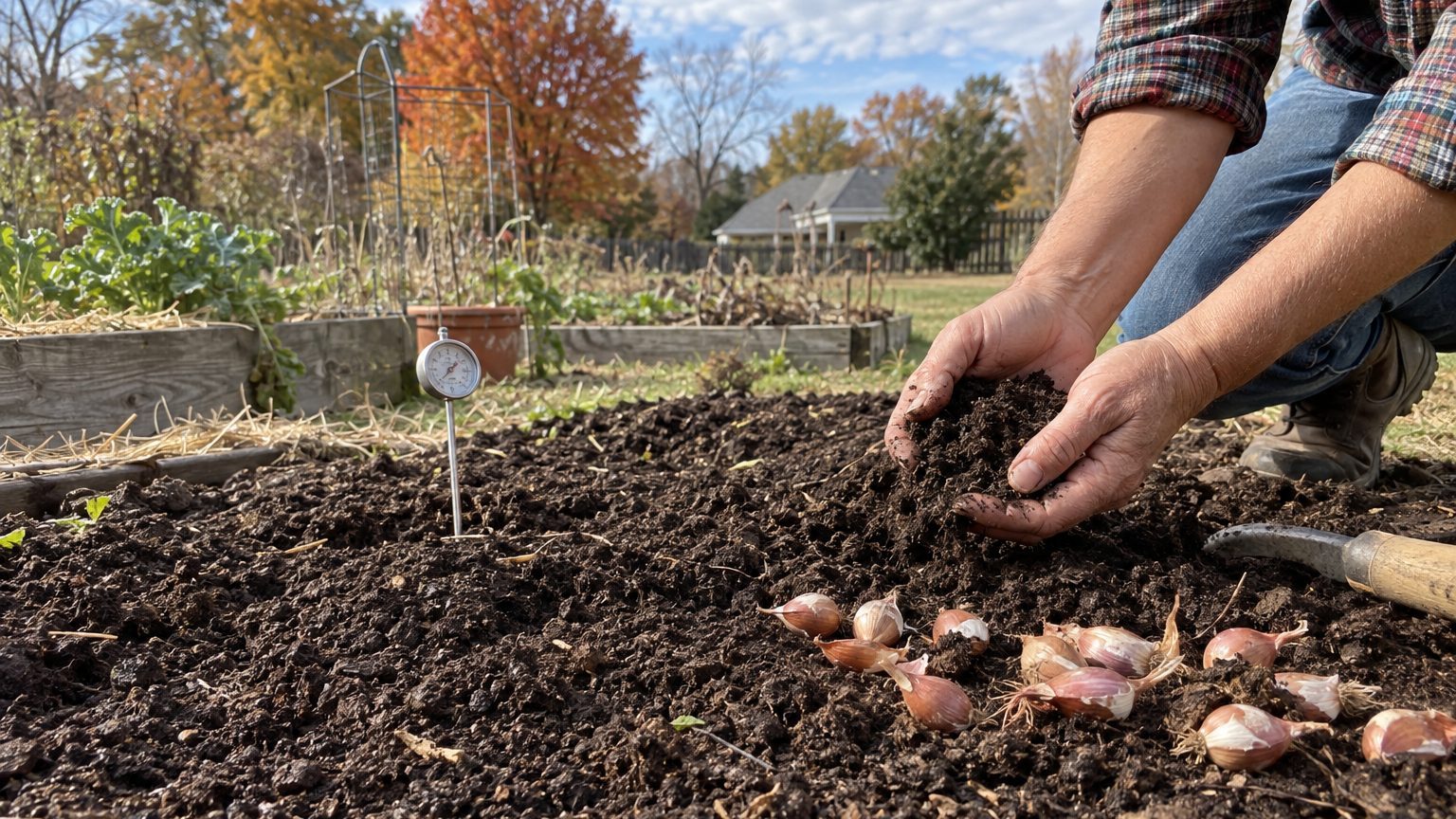
Treat the frost date as a proxy. Shallots don’t care what the calendar says. They care what the soil is doing, and the soil warms after the frost risk ends, not with it. A bed can be frost-free in late March and still sit cold and sodden from a wet week. A cheap soil thermometer pushed a few inches down in the morning tells you more than any almanac. What you want in spring is ground you can work without it clumping into wet balls in your hand, and roots that will actually start growing once the sets are tucked in.
The same logic applies in fall, in reverse. The first fall frost at the same station lands between November 13 and December 1, and soil holds its summer warmth long after the air cools. Plant too early, while the ground is still hot, and sets throw up leafy top growth that winter then has to deal with. Plant after the heat breaks and the soil has cooled, and the bulb spends the cold months building roots instead. That is the whole case for autumn planting: a head start that spring planting can’t match.
One caution about the numbers. Atlanta is an urban airport heat island. North Georgia and the mountains freeze several weeks earlier in fall, and the coastal plain runs milder. If you garden near Blue Ridge or Dahlonega, your dates will not match the Atlanta ones. Use them as a starting point and then watch your own ground and your own first frost.
The timing of shallots overlaps heavily with garlic, which has its own section on this site. Autumn planting, curing, storing and allium rotation all work much the same way for both, so the garlic pages are the better place for the general method. What differs for shallots is the shape of the crop. One planted set multiplies into a cluster of bulbs, so give each set a little more room than you might expect, and expect the cluster to pull itself slightly out of the soil as it bulks up. For the full overview of the crop, see Growing Shallots: One Bulb In, a Handful Out.
What to check at harvest
Curing and storage touch food safety, so be strict here. Once the tops have fallen over and dried, lift the clusters and cure them somewhere dry with good airflow, out of direct sun. Before anything goes into storage, inspect each bulb. The neck should be dry and tight, and the base should be firm with no fuzz. A soft neck or a moldy base ends the question: that bulb does not go into storage, and you shouldn’t trust it because the rest of it looks fine. Also, don’t count on a bulb keeping for any set length of time. Check stored bulbs regularly and discard anything that softens.
How long the season lasts here
Both frost dates come from the same Atlanta station, so the subtraction is fair. From the latest spring date (March 29) to the earliest fall date (November 13), the gap is 229 days. From the earliest spring date (March 11) to the latest fall date (December 1), it is 265 days. So the frost-free window at this station runs about 229 to 265 days, depending on the year.
That is a long window. Many northern states count their frost-free season in the low 100s. A long window changes the decisions you face as a gardener.
First, it allows a second sowing. A grower in a short-season state has one chance, and if the first planting fails, the year is gone. In Georgia, you can plant sets in autumn, then follow with a spring planting of fresh sets or a seed-grown crop to stagger harvests. An autumn planting gets you larger, earlier bulbs, and a spring planting fills in behind it. If a wet winter takes out part of the fall bed, you haven’t lost the year.
Second, it takes pressure off transplanting. With 229 or more days to work with, a seedling can take a few weeks to settle in without cutting into the harvest. You still want to look at the roots (white, firm and fibrous is good, brown and slimy is not), but the stakes are lower. For how to space out repeat plantings, the succession sowing guide on this site walks through the logic.
Third, the long window means your real constraint is heat, not cold. Shallots are cool-season bulbs. They size up in the mild stretches and then need to mature and dry down before summer pushes soil temperatures up and humidity climbs. The frost-free period includes July and August, which the crop does not want to spend in the ground. Count back from the point where summer heat sets in, not forward from the last frost.
Heat and water in Georgia
This page does not have a sourced count of days above 90°F or a sourced figure for summer rainfall, so it won’t quote one. What can be said safely is that Georgia summers are hot and humid, and that humidity is the part that matters most for an onion-family crop. Heat speeds the end of bulbing. Humidity and wet foliage invite fungal disease. For specific station data, your county Extension office or NOAA’s climate normals pages are the places to look.
The question that matters most for shallots here is autumn against spring, and winter cold decides it. The figure to use is the mean daily minimum of the coldest month, which at the Atlanta reference station is 35.6°F (NOAA NCEI Climate Normals 1991-2020). That is a mean, not a record low, so individual nights drop below it. But a coldest-month average still above freezing tells you the ground is not locked solid for weeks, which is the situation autumn-planted sets handle best.
The USDA Plant Hardiness Zone Map (2023, built on 1991-2020 normals) places Georgia in zones 6a through 9b. That range is built on one variable, the average annual extreme minimum. Atlanta sits in the middle of the range. The mountains are at the cold end and the coast is at the warm end.
| Part of Georgia | Winter pattern | Safer call |
|---|---|---|
| Mountains and far north | Colder, earlier fall freezes, more freeze-thaw cycles | Autumn planting with mulch, or spring if the ground heaves or stays wet |
| Atlanta metro and Piedmont | Mild winters, coldest-month mean minimum of 35.6°F at the reference station | Autumn planting, with drainage attention in clay |
| Coastal plain | Milder, longer season | Autumn planting, with an eye on wet winters and early heat |
Where the ground freezes hard and stays wet, autumn-planted sets rot or heave, and spring is the safer choice. That describes the colder end of the state more than the middle. Where winters are milder, autumn planting rewards you with the larger, earlier bulbs it is grown for. Much of Georgia’s soil is heavy clay, and clay that sits wet through a mild winter can rot sets just as surely as a hard freeze can. Raised beds or ridged rows help, and so does keeping mulch light rather than thick and soggy.
For contrast, Growing Shallots in Ohio deals with a colder winter where this spring-versus-fall question tips the other way more often, and Growing Shallots in Arizona deals with desert heat and very different water problems. Georgia sits between them: a winter mild enough for fall planting and a summer humid enough to punish it if the crop is still in the ground.
Which shallots suit Georgia
This page names no varieties, and that is deliberate. A cultivar name is only worth repeating if it has been trialled where you garden. Georgia stretches from mountain valleys to the coast, and a type that does well near Savannah may struggle near Blairsville. The varieties grown and tested locally are the only recommendation that means anything. The University of Georgia’s University of Georgia Extension and your county office are the places to get them.
What this page can do is reason from the territory’s facts, by type.
- Earlier-maturing types. Georgia’s window is long, but summer heat sets the real deadline. A type that bulbs up and dries down sooner finishes before the worst heat and humidity. This matters more in the south of the state.
- Types that tolerate heat with airflow and shade at the root. Give plants room, avoid crowding sets, and consider a light mulch to keep the soil from baking. Good airflow dries foliage faster after rain.
- Disease resistance first. In a humid state, resistance to fungal problems such as downy mildew and bulb rots should be the first criterion, ahead of size or flavor. Ask your extension agent which diseases are most active in your county.
- Sets versus seed. Sets are the easier route for a first crop and suit autumn planting. Seed-grown types are worth trying for a spring planting once you know the ground.
As for sourcing, buy from suppliers that sell for your region, and avoid supermarket shallots for planting, since they may carry disease and are not selected for local conditions. When a neighbor or an extension bulletin recommends a specific variety, test it on a small row first and keep notes on when it matured and how it stored.
Don’t plant shallots where onions, garlic or leeks grew recently, since soil-borne problems carry between them. The extension service can tell you how many years to wait for your soil.
Common questions
When should I plant shallots in Georgia?
Autumn planting suits most of the state, once the summer heat has broken and the soil has cooled. Spring planting works as well, as soon as the ground is workable and not soggy. The Atlanta reference station’s last spring frost range of March 11 to March 29 is a guide, but the soil is the real signal.
Should I plant in fall or spring?
In the Atlanta area and farther south, fall is the usual choice because winters are mild enough, and it gives larger, earlier bulbs. In the mountains, where freezes come earlier and the ground can heave or stay wet, spring is the safer call.
Which variety should I buy?
Ask University of Georgia Extension or your county office for the types trialled in your part of the state. This page does not name varieties because it cannot source them.
How do I know a shallot is safe to store?
Inspect it. A sound bulb has a dry, tight neck and a firm base. A soft neck or a moldy base ends the question, and that bulb should be discarded. Appearance alone is never proof, and no storage length can be promised, so check stored bulbs regularly.
The frost figures on this page come from the NOAA NCEI 1991-2020 Climate Normals for the Atlanta station. If you garden elsewhere in Georgia, a few seasons of your own notes on first and last frost will tell you more than any station can.