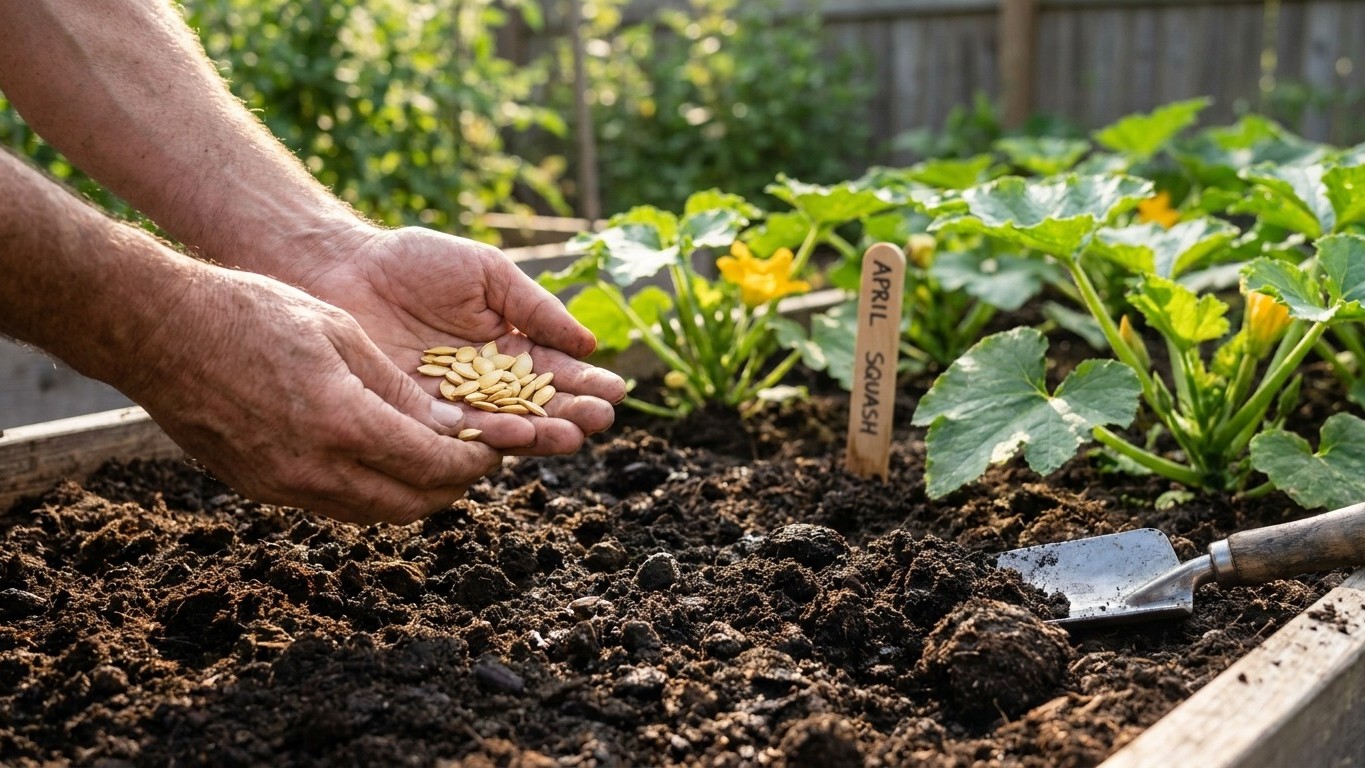

Summer squash goes into Georgia soil twice a year, not once. The first window opens as spring’s last frost risk fades, somewhere between March 11 and March 29 depending on where in the state you garden. A second window opens in mid-summer, counted backward from the first fall frost between November 13 and December 1. Between those two windows sits the state’s brutal heat load, which is exactly why one spring planting rarely carries a Georgia garden through the whole season.
The short answer for Georgia
Sow summer squash outdoors after the last spring frost window closes, which NOAA’s 1991-2020 climate normals place between March 11 and March 29 at the Atlanta reference station. That date range is not a guess. It marks the band where a 32F freeze carries between a 30% and 70% chance of still happening, meaning March 11 is the riskier edge of the window and March 29 is the safer one. Squash seed rots in cold, wet soil, so waiting for the later end of that band, or a few days past it, costs little and buys real insurance.
A second sowing belongs in the calendar too. Count back from the first fall frost window, November 13 to December 1, and a mid-to-late summer planting has time to mature before cold shuts the garden down. This second window matters more in Georgia than in cooler states, because the reference station also logs 35.8 days a year at or above 90F. That kind of heat load stalls fruit set on a spring-planted vine well before frost ever becomes the limiting factor, so a second sowing is less a bonus than a replacement for a plant that has already quit producing.
Both windows come from a single reference station near Atlanta, an urban airport site that runs warmer than much of the state. Anyone gardening in the mountains or the far north should expect the real frost dates to arrive earlier in fall and linger later in spring than these numbers suggest. Anyone on the coastal plain should expect the opposite. The frost dates here describe what the state’s most-studied station experiences, not what any single yard experiences, and that gap is the subject of the next two sections.
What will not work here
Planting at the earliest edge of the spring frost window, March 11, is a common misstep. That date sits at the 70% side of the probability band, meaning a freeze is still fairly likely to follow. Squash seed germinates poorly in soil that has not warmed, and a young seedling caught by even a light frost is finished. Treating March 11 as a green light rather than as the start of a risk window is the single easiest way to lose an early planting.
Leaving a spring-sown vine in the ground through the hottest stretch of summer is another version of the same mistake. With 35.8 days a year reaching 90F or higher, Georgia’s summer heat load is enough to shut down pollination: squash blossoms drop, bees work shorter hours in extreme heat, and fruit set slows or stops well before any frost is in sight. A gardener who plants once in spring and expects that same vine to carry through August is fighting the climate record, not gardening with it. The fix, as noted above, is a second sowing timed to fruit after the worst heat has broken.
Watering on a once-a-week schedule is a habit that fails here too. Summer rainfall averages about 13.6 inches across June, July and August, with August, the driest and often hottest month, delivering only 4.3 inches. That figure never reads alone: with over a month’s worth of 90-plus-degree days pulling moisture out of the topsoil, and rain often arriving as a single hard thunderstorm that runs off rather than soaking in, a weekly watering can leave the root zone dry for days at a stretch. Sandy soil common in the coastal plain drains that same rain within a day, which makes the gap even harder.
Finally, tight spacing between plants is a bigger risk in Georgia’s humid summers than in a drier state. The same rainfall and heat that stress the plant’s roots also create the damp, still air that powdery and downy mildew favor. Crowded rows trap that moisture around the leaves longer, and mildew pressure builds faster in a Georgia August than it would in a low-humidity climate running the same rainfall total.
What changes across Georgia
The USDA hardiness zone map places Georgia across a striking range, from 6a in the highest parts of the north Georgia mountains to 9b along the coast, a spread built entirely on one measurement: the average coldest temperature a location sees in a typical winter. That is a nine-subzone difference inside a single state’s borders, and it means the frost-date band given above, useful as a statewide reference, cannot describe both ends of that range accurately.
A gardener at higher elevation or farther north should expect the last spring frost to linger later than March 29 and the first fall frost to arrive earlier than November 13. Both windows in this article’s short answer come from a station near Atlanta, itself already noted as a warm-running urban site, so the mountain reader is working with a shorter season than these dates imply on both ends. A grower on the coastal plain sits at the opposite extreme: frost pulls back earlier in spring and holds off later in fall, stretching the usable window well past what the state-level dates suggest, and opening room for a later second sowing than a north Georgia garden could risk.
There is no single planting date that serves a 6a garden and a 9b garden equally well, and this page will not pretend otherwise. The right move is to use the USDA Plant Hardiness Zone Map to see where a specific county falls within that 6a-9b spread, then treat the frost windows above as a starting point to shift earlier or later depending on which end of the state that county sits on.
Where to check this for your own county
The University of Georgia Cooperative Extension, at extension.uga.edu, is the source built for exactly this gap between a statewide answer and a single county’s reality. A state-level planting calendar, the kind built from a single Atlanta-area weather station, is a reasonable starting point. A county-level recommendation from the extension office covering that specific county is a better one, because it accounts for local elevation, local frost patterns and local pest pressure in a way a single reference station never can.
Two things are worth pulling from that site specifically. First, the county’s own planting calendar, which will usually narrow the broad frost-date window given here into a tighter, more locally accurate range for both the spring and the late-summer sowing. Second, the variety trial results or recommendations tied to that county or to the broader region it sits in. Summer squash varieties differ in how they handle disease pressure, heat tolerance and days to maturity, and a variety that has actually been trialled under north Georgia mountain conditions, or under coastal humidity, carries more weight than a generic national recommendation.
This page describes Georgia at the state level, built from a single reference station and a statewide hardiness zone range. That is useful for understanding the mechanics behind the dates, why the frost windows are probability bands rather than fixed points, why the heat load pushes toward a second summer sowing, why the zone spread matters. But a county extension office recommendation, built on local data and local trial plots, will always be the more precise answer for an actual garden in an actual county.
Checking this against your own garden
Every date on this page is a normal, an average built from thirty years of weather records at one station. A reader’s own garden will confirm or override those dates faster than any calendar can, and three simple observations do most of that work.
Soil warmth by feel is the first. Summer squash seed wants soil that feels warm to bare skin at planting depth, not just air that feels warm at midday. A garden that still feels cool and damp a few inches down, even after the calendar’s frost window has closed, is signaling that its particular soil type, shade pattern or slope is running behind the regional average, and a few more days of waiting will do more good than any date on a chart.
The first flush of male flowers is the second sign. Squash typically produces male blooms before female ones, and their appearance means the plant has moved past the seedling stage most vulnerable to a late cold snap. A garden showing male flowers earlier than a neighbor’s, or earlier than a state average would suggest, is running warmer than the regional norm.
The first true leaves, the second set that appears after the rounded seed leaves, mark the point where a seedling has established a real root system. A slow arrival of true leaves after planting, compared to what the frost-date math predicted, is worth noting for next year’s timing on that same plot, since it says more about that garden’s specific microclimate than any station-wide normal ever could.