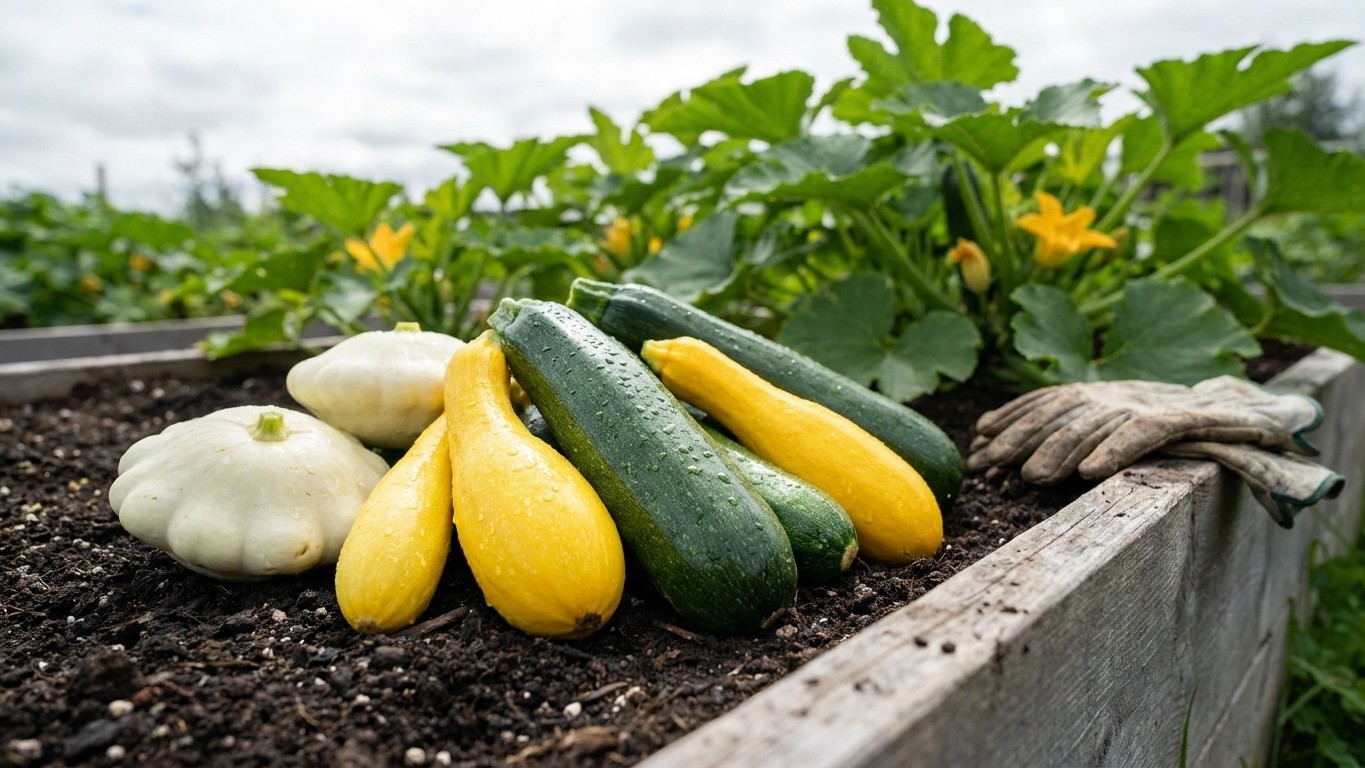

The Best Summer Squash varieties for Georgia gardens are heat-tolerant, disease-resistant hybrids of yellow straightneck, crookneck, and zucchini, chosen for vigor rather than novelty. Georgia’s frost-free window runs long and its summers run hot, which rewards squash that keep producing under stress and punishes anything bred for a shorter, milder season elsewhere in the country.
The short answer for Georgia
Start with the season length. The last spring frost at the reference station falls between March 11 and March 29, and the first fall frost doesn’t show up until November 13 to December 1. That’s a frost-free stretch of roughly seven and a half months at that station, though the CAUTION on that data matters here: north Georgia and the mountains lose several weeks of that window on both ends, while the coastal plain keeps it or stretches it further. A long window like this doesn’t just mean “plant early and relax.” It means squash plants sit in the ground long enough for pest and disease pressure to build, which changes which types are worth planting.
Pair that season length with 35.8 days a year at or above 90°F, and the picture sharpens. That’s more than a month of the calendar spent in heat that stresses shallow-rooted, heavy-feeding plants like summer squash. Varieties bred for cooler, shorter growing regions tend to slow fruit set once daytime highs stay in the 90s for stretches, and some drop blossoms outright. What holds up in Georgia is the type of squash bred for continued production through heat spikes, not the type that peaks in a narrow window and fades.
Which types fit
Yellow straightneck and crookneck squash, in modern hybrid form with some disease resistance bred in, tend to be the safest starting point for a Georgia garden. Zucchini works too, but only in varieties selected for vigor and resistance rather than heirloom lines chosen for flavor alone, because the heat and humidity here find the weak spots in older genetics fast. Scallop or pattypan types can work, but they’re a poorer match for a long, pest-heavy season unless the gardener commits to multiple plantings.
The practical move for most Georgia gardeners is succession planting: a first round of straightneck or crookneck in early spring, a second round of zucchini staggered a few weeks later, and a fall round timed to dodge the worst of the July and August heat. That spreads risk across a season that’s long enough to punish a single planting if it gets hit by disease or borers midway through.
What will not work here
Slow squash is the first thing to cross off the list. A variety that needs 65 days to first harvest doesn’t get much benefit from a seven-month frost-free window, because Georgia’s pest pressure, especially squash vine borer, builds steadily the longer a plant sits in the ground. A fast 42- to 48-day variety gets harvested and can be pulled or replaced before the worst of that pressure hits. A slow variety is still limping along when the borers arrive in force, usually by early to mid-summer.
Weekly watering fails here, and the rainfall numbers explain why. Summer rain averages about 13.6 inches across June, July, and August, but it doesn’t fall evenly, and August, the hottest stretch, is also the driest of the three at 4.3 inches. Combine that with 35.8 days a year above 90°F, and a squash plant watered once a week is running a moisture deficit for days at a time during the exact stretch when it needs steady soil moisture to keep setting fruit. Summer rain in Georgia often arrives as a single afternoon thunderstorm that runs off rather than soaking in, particularly on compacted or clay soil, so the raw rainfall total overstates how much water actually reaches the root zone.
Close spacing and humidity
Tight spacing is the other common mistake. Georgia’s combination of heat and summer rainfall creates the humid air that powdery mildew and downy mildew both need to spread. Squash planted close enough that leaves touch and airflow stalls will show mildew earlier and lose productive leaf area faster than the same variety spaced wider. This isn’t a minor cosmetic issue: mildew-damaged leaves photosynthesize less, and fruit size and count drop within a couple of weeks of a bad outbreak.
Specialty or exotic squash types marketed for their unusual shape or color are worth a hard second look before planting in Georgia. Many of them were bred and trialled in drier, shorter-season parts of the country, and they carry none of the disease resistance that’s become standard in modern straightneck, crookneck, and zucchini hybrids. Growing them here usually means more spraying, more losses, and a shorter productive window than a boring, resistant hybrid would give.
What changes across Georgia
Georgia’s hardiness zone range, 6a to 9b under the USDA Plant Hardiness Zone Map, is wide enough that there’s no single answer for the whole state. That’s a four-and-a-half zone spread, which is the kind of range that separates short mountain summers from a near-subtropical coastal plain. A gardener in the north Georgia mountains and a gardener near the coast are not gardening in the same climate, even though both are technically in “Georgia.”
The frost dates given for the reference station are a useful anchor, but the CAUTION attached to them is worth repeating: that station sits at an urban airport, which runs warmer than its surroundings through the heat-island effect. North Georgia and the mountains freeze several weeks earlier in the fall than that station shows, which shortens the safe planting window for a second or third succession round. The coastal plain runs milder in both directions, often allowing an earlier spring start and a later fall planting than the reference dates suggest.
What that means in practical terms: a gardener at higher elevation or further north should plan on tighter spacing between successive squash plantings and less room for a fall round, because the season simply closes sooner. A gardener on the coastal plain has more room to experiment with a later summer or early fall planting, since the frost-free window there runs longer than the reference station implies. Heat load likely shifts across the state too, though the 35.8-day figure cited here is specific to the Atlanta reference station and isn’t broken out by region in these facts.
None of this can be resolved from a state-level page. The right move is to check where a specific location falls on the USDA Plant Hardiness Zone Map rather than guess from a regional description.
Where to check this for your own county
Georgia’s land-grant extension service is the University of Georgia Cooperative Extension, at extension.uga.edu. That’s the right next stop for anyone who wants a recommendation sharper than a statewide page can offer, and it’s worth being direct about why: a county-level recommendation accounts for local soil, local frost timing, and local pest history in a way a state-wide article never can.
Two things are worth looking for specifically once there. First, the local planting calendar for the reader’s own county, which will typically give a spring planting window and, in the milder parts of the state, a second fall window, both built from data closer to that county than the single reference station used on this page. Second, look for whatever variety trial results the local extension office has published for summer squash. County extension offices and their agents frequently run or reference small-scale trials of straightneck, crookneck, and zucchini varieties under local conditions, and those results carry more weight for that specific county than any general guidance about “Georgia” as a whole.
This page has described what applies broadly across Georgia’s climate and season length. It hasn’t described, and can’t describe, the particular clay content of a Piedmont garden or the particular disease pressure a coastal county has seen in wet years. That’s the gap a county extension office fills, and it’s worth the ten minutes it takes to look one up before buying seed.
Checking this against your own garden
Every date and figure on this page is a regional average built from decades of station data. A gardener’s own observation of their own soil and plants outranks all of it, because no normal accounts for a particular yard’s drainage, sun exposure, or microclimate.
Soil warmth by feel is the first check. Summer squash seed germinates poorly in cold, wet soil, so pushing a bare hand a couple of inches into the planting bed and feeling for warmth, not just dryness, gives a better read than trusting a calendar date alone. Soil that still feels cool and damp in what should be a warm week means local conditions are running behind the regional average that year.
The first flush of male flowers is the second signal worth watching. Squash plants typically produce male flowers before female ones, and a steady run of males with no females showing up yet usually means the plant is still building size rather than ready to fruit. If that flush shows up noticeably earlier or later than expected for the local planting date, it’s a sign the season is running warmer or cooler than the regional pattern that year.
The appearance of the first true leaves, the leaves that show the characteristic squash shape rather than the rounder seed leaves, marks the point where a young plant has shifted from surviving on stored seed energy to actually growing on its own. A quick appearance of true leaves after a strong germination points to a warm, active bed; a slow, patchy emergence is worth investigating before assuming the seed or the variety was the problem.