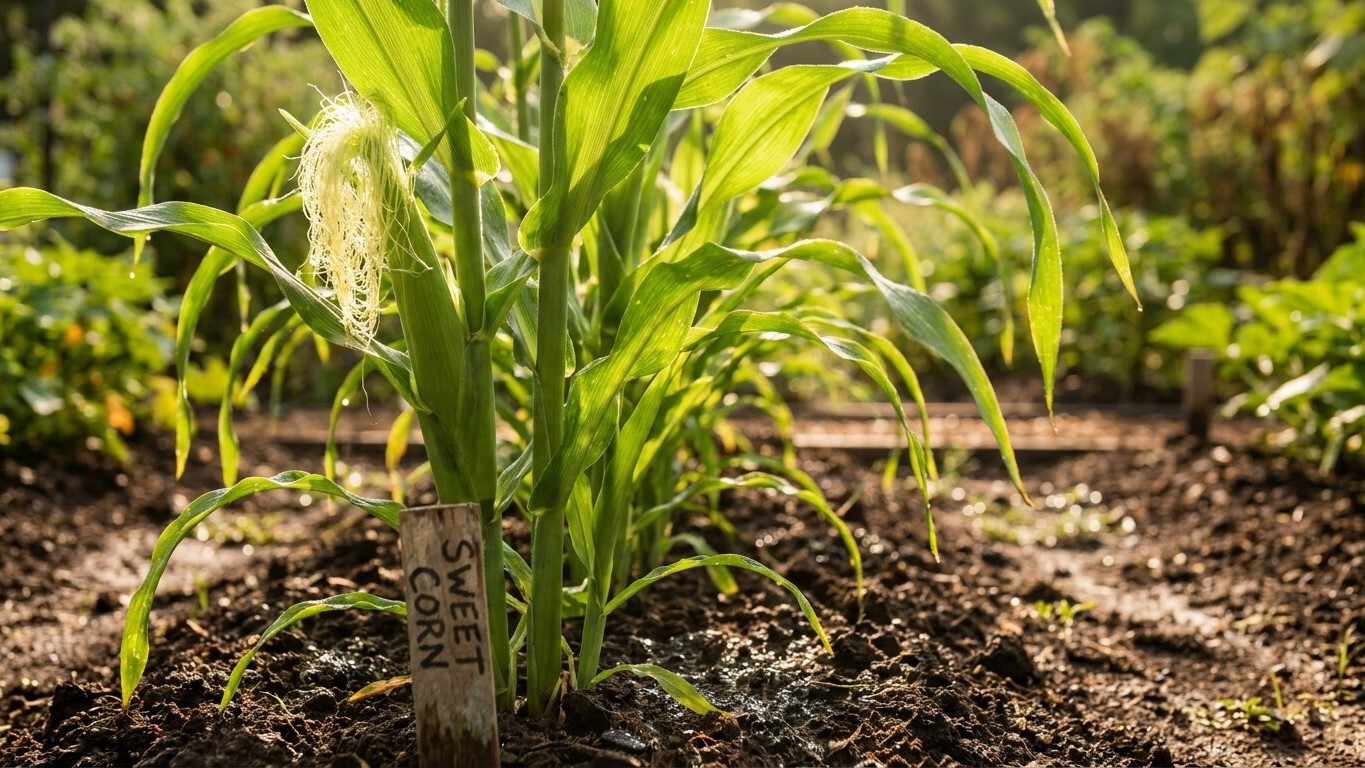

Yes, sweet corn ripens in Georgia, but the calendar most gardeners check isn’t the one that actually decides it. The date that matters is a soil temperature reading, sixty degrees Fahrenheit, not the last frost circled on a wall calendar. Once that threshold is met, the stretch to Georgia’s first fall frost, which typically doesn’t arrive until mid-November at the earliest, leaves the 60 to 90 days sweet corn needs with room to spare, no matter which part of the state a garden sits in.
The short answer
Sweet corn doesn’t care what the calendar says about frost. It cares about soil temperature, and that number tells a different story than the one Georgia gardeners usually rely on. At the reference station tracked in NOAA’s 1991-2020 Climate Normals, the last spring frost typically falls somewhere between March 11 and March 29. That date matters for tomatoes and peppers. For sweet corn, it’s almost beside the point, because the seed won’t germinate reliably until the soil itself reaches 60 F, and soil warms on its own schedule, well behind the air.
Bare ground holds onto winter’s chill longer than the atmosphere does. Even after the last freeze has passed and nighttime temperatures stop dropping below 32 F, the top few inches of a Georgia garden bed can stay too cool for corn seed for another stretch of weeks. Push seed into ground that hasn’t caught up yet and the result is uneven stands, seed rot instead of sprouts, and a planting that limps out of the gate rather than launching. Waiting for the soil, not the frost date, is what actually starts the clock that matters.
Once that clock starts, the real question is whether 60 to 90 days, the window Utah State University Extension gives for sweet corn from planting to harvest, fits before the season closes. In Georgia, it does, with room left over. The same NOAA station data that places the last spring frost in March places the first fall frost between November 13 and December 1. That’s a frost-free run of roughly seven and a half months at minimum. Even after subtracting the weeks it takes soil to climb past 60 F following that spring frost, there’s still comfortably more than 90 days of open season before autumn cold sets in.
The caveat is geography. That NOAA station sits at an urban airport, and pavement holds heat, which nudges both frost dates milder than what a mountain garden or a shaded rural yard actually experiences. North Georgia and the mountains can see frost arrive several weeks earlier in fall than the station average suggests, trimming the safe window. The coastal plain runs the other direction, staying frost-free longer and offering even more slack for a late-planted crop. Either way, running out of season isn’t the real risk here. With an average of 35.8 days a year reaching 90 F or hotter, corn that tassels during the peak of that heat can suffer poor pollination regardless of how many calendar weeks remain.
Does a late variety fit here?
“Fits” means two separate things: does the season hold enough days, and does the harvest land somewhere between the last punishing heat and the first real cold. Georgia’s long frost-free stretch answers the first question generously. The second one takes a bit more thought, depending on which end of the maturity range a gardener picks.
A 60-day variety
A fast-maturing type built around a 60-day timeline has almost no trouble here. Planted once soil reads 60 F, it can be harvested well before summer’s hottest stretch even peaks, or timed for a second planting later in the season with the same ease. That flexibility is useful in a state where the first fall frost doesn’t show up until November 13 at the earliest and sometimes not until December 1. A 60-day crop planted as late as midsummer still finishes with months of buffer left. The only real planning task is choosing a planting date that keeps tasseling out of the stretch of days that push past 90 F, since heat stress at pollination time can hurt the ear regardless of how quick the variety is.
A 90-day variety
A slower type needing the full 90 days also fits, and it’s worth saying that plainly rather than hedging. Once soil clears 60 F in spring and planting goes in, a 90-day count from there lands the harvest in mid to late summer, still comfortably ahead of the November-to-December fall frost window documented for this station. The tighter margin shows up only in the mountains or in north Georgia, where fall frost can arrive earlier than the state-level average suggests. A gardener there who delays planting deep into early summer, then adds a full 90-day count, could be cutting it closer to the first frost than the statewide numbers imply. The fix isn’t avoiding the variety. It’s not delaying the planting date past what the local frost pattern allows.
What goes wrong here
- Soil sown too cold. Planting by the frost date instead of the soil thermometer is the most common mistake in this climate. Seed sitting in ground below 60 F rots or sprouts unevenly, and the fix is simple: check the soil directly before planting rather than trusting that the last frost date alone means the ground is ready.
- A variety pushed past the season it has left. This shows up mainly in north Georgia and the mountains, where fall frost can land noticeably earlier than the statewide average. A 90-day variety planted late in a short-season pocket can run out of runway before the ear finishes. The remedy is matching the maturity length to the local frost pattern, not the state average, and planting earlier in those cooler pockets.
- Sweetness lost to a neighbor, not the weather. This one has nothing to do with soil or frost. Sweet corn types (su, se, and sh2) cross-pollinate when they tassel at the same time, and the result is starchy, disappointing ears even in a garden that did everything else right. Utah State University Extension’s guidance doesn’t publish a separation distance for this, so the fix isn’t measuring feet between rows. It’s timing: stagger planting dates so different types don’t tassel in the same window, and keep each type planted in its own block of three or more rows so pollen from one doesn’t dominate the silks of another.
Common questions
When should I actually plant sweet corn in Georgia?
Once the soil itself reads 60 F, not on the calendar date of the last frost. Soil warms slower than air, so waiting a bit longer than the frost date feels necessary is usually the right call, especially in cooler north Georgia gardens.
How do I know when to pick?
Look for three signs together, not just one: silks that have turned dry and brown, husks that are still moist and green, and juice that runs milky when a kernel is punctured. Any one sign alone can be misleading; all three together mean the ear is ready.
Can I grow sweet corn in a small home garden?
Yes, but plant it in a block of three or more rows rather than one long single row. That block shape is about pollination coverage, not a planting date, and it matters more in small gardens where a single skinny row often pollinates poorly.
What happens if two corn types tassel at the same time nearby?
The sweetness of both can suffer, since su, se, and sh2 types cross-pollinate freely when their tasseling overlaps. No specific separation distance is published for this, so the practical fix is staggering planting dates so the types tassel in different weeks instead of the same one.