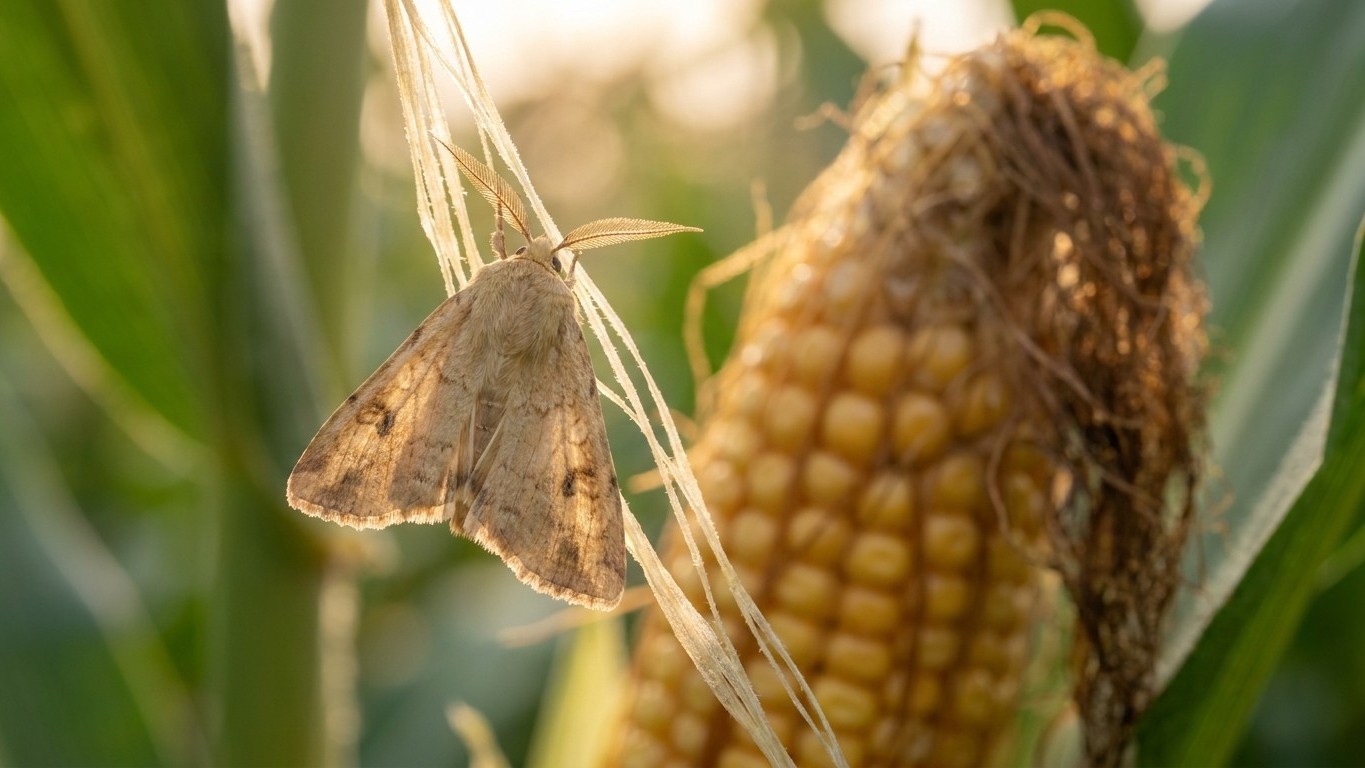

In lowland Hawaii, the calendar that decides when a pest shows up isn’t built on frost dates, because there aren’t any. It runs on soil warmth, rainfall and how long a corn plant has been in the ground. Of the garden pests that University of Hawaii CTAHR Extension tracks statewide, only a handful actually feed on corn. The rest are looking for different crops entirely, which matters if you’re trying to identify damage on your own stalks.
Which pests attack corn in Hawaii
University of Hawaii CTAHR Extension documents eight pests across home vegetable gardens in the state: Aphids, beet armyworm, cabbage webworm, Chinese rose beetle, Leafminers and bean fly, melon fly, Southern green stinkbug and mites, and Whiteflies. That’s the full documented list for this territory, and it isn’t a corn-specific list, so sorting it matters before you match any symptom to a name.
Cabbage webworm feeds on cabbage, broccoli and other cole crops; it has no reason to touch a grass-family plant like corn. Chinese rose beetle chews broad, tender leaves on ornamentals and soft-leaved vegetables at night, and corn’s narrow, ridged blades rarely draw it in. Leafminers tunnel inside the leaf tissue of broadleaf vegetables, while bean fly targets legume stems, so neither has a foothold on a corn stalk. Melon fly lays its eggs inside the fruit of cucurbits like melon, cucumber and squash; corn produces no fruit that fly can use. Whiteflies colonize the soft undersides of broad leaves and are seldom found working a corn plant’s upright blades.
That leaves three that actually belong on a corn-damage list. Aphids build up in the whorl and around developing tassels, feeding on plant sap and leaving sticky honeydew behind. Beet armyworm is a generalist caterpillar that will chew corn foliage along with dozens of other garden crops when it’s hungry enough. Southern green stinkbug and mites round out the group, with the stinkbug going after developing ears and mites building up on stressed leaves during hot, dry stretches.
The deciding question for any pest on that broader list isn’t whether it lives in Hawaii, it’s whether it actually feeds on a grass-family plant. Corn is a grass, and most garden pests here are built to attack broadleaf crops instead.
When each one shows up, and what it does first
Without a frost season to anchor a planting calendar, sweet corn’s timing runs on soil temperature and days from planting instead. The seed needs soil warmer than 60 F to germinate reliably, and the crop then needs 60 to 90 days from planting to reach maturity, according to Utah State University Extension. That window is what decides whether a corn planting has enough season ahead of it, not a date on a wall calendar.
Aphids tend to show up first, often within the initial few weeks after seedlings emerge. Look for small, soft-bodied insects clustered in the whorl of young leaves, along with a sticky film of honeydew that can eventually turn black with sooty mold as it accumulates.
Beet armyworm shows up next, usually as small caterpillars scraping ragged, papery patches into the leaf surface. Early damage looks like thin, see-through windows in the leaf tissue on the outer leaves before larvae grow large enough to chew all the way through.
Southern green stinkbug and mites arrive later, closer to silk emergence and through the period when ears are filling out. Stinkbugs puncture developing kernels, leaving discolored, sunken spots that show up once you peel back the husk. Mites appear as fine stippling and webbing on leaves, and they build up fastest during the hottest stretches of the year, the same stretches that make up Hawaii’s average of 18.7 days a year at or above 90 F at the Honolulu reference station. That heat load is what pushes mite populations from barely noticeable to a real problem in a short span.
Telling the damage apart from everything else
Corn shows plenty of symptoms that have nothing to do with insects, and mixing them up leads to spraying for a pest that isn’t there. Yellowing that spreads evenly and follows the leaf veins, rather than starting from the tip or margin, points more toward a nutrient shortage than aphid feeding. Curled or rolled leaves during a dry spell are often simple water stress, not mite damage, unless you can also see the fine stippling or webbing that mites leave behind.
| Symptom | Possible pest cause | Non-pest look-alike | What tells them apart |
|---|---|---|---|
| Sticky, blackened leaf surface | Aphids and their honeydew | Windborne dust or mineral residue | Aphid honeydew is sticky to the touch and often has visible insects nearby |
| Ragged, chewed leaf tissue | Beet armyworm | Wind-whipped leaf tearing | Chewing leaves a scraped, papery texture; wind damage tears cleanly along the leaf edge |
| Discolored, sunken kernels | Southern green stinkbug | Poor pollination | Stinkbug spots are localized punctures; poor pollination leaves whole patches of bald, undeveloped kernels |
| Fine stippling on leaves | Mites | Drought stress | Mite damage includes visible webbing on close inspection; drought stress alone does not |
None of this replaces a direct look. If a symptom doesn’t clearly match one of these patterns, that’s a signal to send a sample or photo to a local extension office rather than guess.
What actually works here, and what is a waste of time
Physical barriers timed to the plant’s stage do more good here than any treatment applied after the fact. Row covers placed over seedlings can keep aphids and young armyworm caterpillars off the plant during its most vulnerable early weeks. Those covers have to come off once tassels emerge, because sweet corn is wind-pollinated and needs open airflow between plants to set a full ear. Leaving them on past that point trades pest protection for a poorly filled ear, which is its own kind of loss.
Planting in the block shape that Utah State University Extension describes, three or more rows together rather than one long single row, gives the crop better pollination and less wind exposure, which means less stress overall. Stressed, poorly pollinated corn is exactly what draws in mites and gives stinkbugs an easier target, so the planting layout itself functions as pest prevention before any treatment is even considered.
What doesn’t help is spraying broadly once ears have already formed, hoping to catch a stinkbug problem after the damage is done. By that point the kernels are already marked, and a broad-spectrum treatment mostly kills off the insects that would otherwise be keeping aphids and mites in check. Picking a corn variety in hopes of dodging pest pressure by timing also doesn’t work the way it might elsewhere, since Hawaii has no frost to set an end date on the growing window. Any treatment decision, and what’s actually approved for use in the state, is a question for the local extension office rather than a guess based on what worked somewhere else.
Where to check this for your own county
University of Hawaii CTAHR Extension is the source for everything on this page, and it maintains offices across the islands, including Oahu, Hawaii Island, Maui and Kauai. What’s documented at the state level is a starting point, not a guarantee of what’s actually present in a particular garden. Pest pressure shifts with elevation, rainfall and whether a property sits on the windward or leeward side of an island, sometimes over a distance of just a few miles.
Confirm identification with the county office before treating anything, especially since the statewide list covers far more pests than the few that actually feed on corn. Bringing in a sample leaf, a photo of the damage, or even a description of when the symptom first appeared gives the office something concrete to work from, rather than a guess based on a list that was never built for one specific yard.
Common questions
Does frost ever kill off corn pests in Hawaii?
No. NOAA NCEI’s 1991-2020 Climate Normals show no measurable freeze occurring in inhabited areas of the state, so there’s no frost-driven die-off of insect populations the way there might be in colder climates. Pest activity here follows heat and rainfall instead.
Can sweet corn and other corn types be planted near each other?
The published concern is timing, not distance. Utah State University Extension notes that sweetness suffers if different sweet corn types tassel at the same time, so the fix is staggering plantings or separating varieties by when they flower, not by a specific number of feet.
Is there a safe month to plant sweet corn in Hawaii?
No month is specified in the available data. The relevant markers are soil warmer than 60 F and a stretch of 60 to 90 days ahead before conditions turn unfavorable, which depends more on local rainfall and elevation than on a fixed date on the calendar.
Why do my corn ears have discolored or shrunken kernels?
That pattern is consistent with Southern green stinkbug feeding, but it can also result from incomplete pollination. Checking whether the damage is localized to punctured spots versus spread across bald, undeveloped sections is the first step, and a local CTAHR office can confirm which one it is.