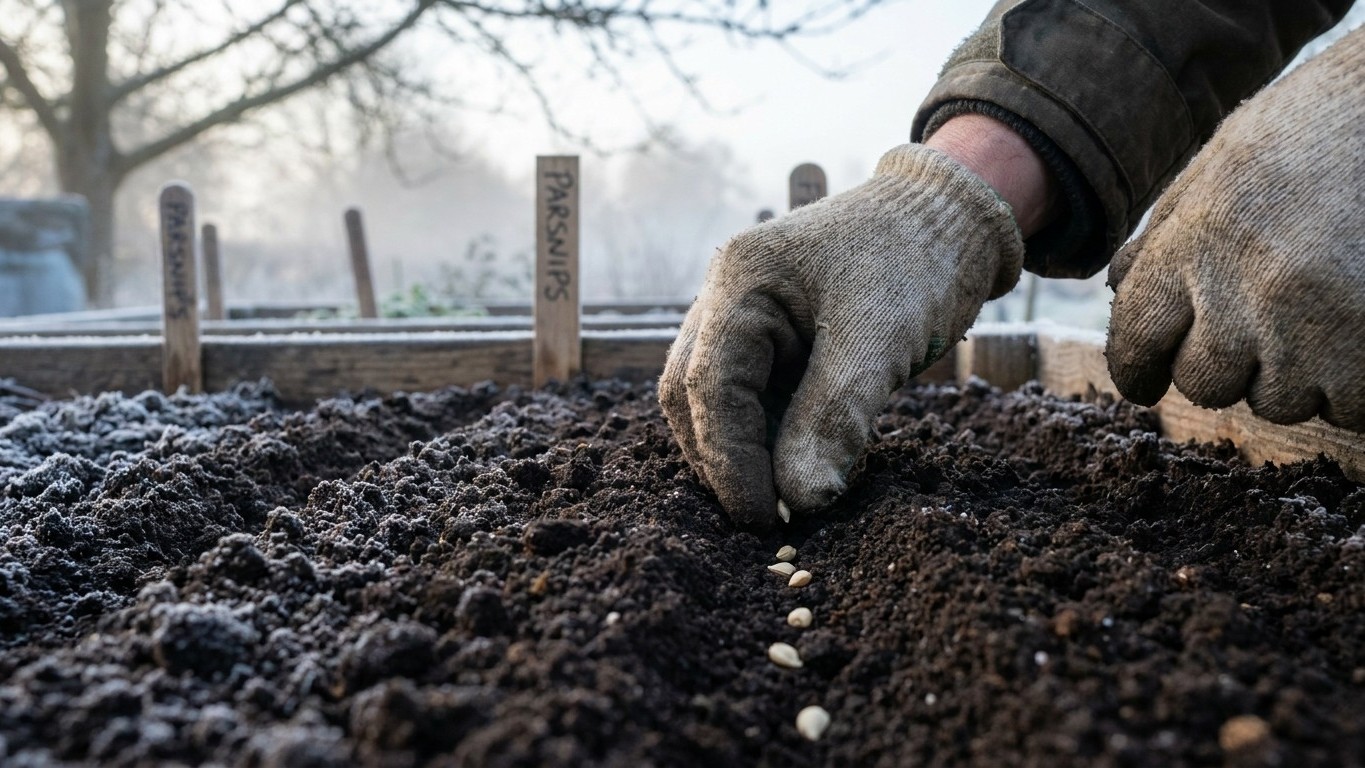

Boise’s coldest month averages a nightly low of 25.4°F, cold enough to hand parsnips the sustained chill they need to turn starch into sugar. Sow in early to mid-April, two to three weeks before the last frost, and this state’s frost calendar gives the crop room to mature and sweeten before you dig it. The catch is elevation: that math holds for the valley floor, not for the mountains above it.
The short answer
Start with the number that actually decides whether parsnips are worth planting: 25.4°F. That’s the mean daily minimum for the coldest month at the Boise reference station, drawn from NOAA’s 1991-2020 Climate Normals. It’s not a record low and it’s not a monthly average temperature. It’s the typical overnight low, night after night, through the coldest stretch of winter. A figure like that tells you something a hardiness zone never can: it confirms that freezing nights aren’t a rare event here, they’re the baseline for weeks at a stretch.
That distinction matters more for parsnips than for almost any other root vegetable. Parsnips don’t just tolerate cold, they depend on it. Utah State University Extension is blunt about the mechanism: the roots convert stored starch into sugar only after several weeks of cool, frosty weather. A parsnip pulled from warm ground in September is edible but bland. The same root left in place through a run of freezing nights turns noticeably sweeter. So the question for any Idaho garden isn’t just “can I grow parsnips here,” it’s “will this location actually deliver the frost exposure the crop needs to taste like anything.”
In and around Boise, the answer is yes. A mean minimum of 25.4°F in the coldest month means temperatures are dropping well below freezing on a regular basis, not just brushing 32°F once or twice. That’s the kind of sustained cold snap the sweetening process asks for. Leave parsnips in the ground into fall and early winter here, and they’ll get the exposure they need.
Where this gets more complicated is everywhere that isn’t the Boise valley. Idaho’s terrain climbs fast outside the Treasure Valley, and elevation changes the frost calendar dramatically. Higher ground across the state runs colder and the growing season shrinks accordingly, which is good news for sweetening (more frost, sooner) but bad news for the days-to-maturity math, since a shorter frost-free window leaves less time for the root to size up before winter shuts things down. A gardener in a mountain valley isn’t fighting a mild-winter problem, they’re fighting a short-season problem, and the two require different planning.
So the short answer sorts into two cases. In lower, warmer valleys with a normal-length frost-free season, sow in early spring and expect a sweet, well-sized root by late fall or early winter. In higher, shorter-season parts of the state, the cold isn’t in question, but the calendar is tighter, and timing the sowing date correctly matters more than usual.
Does the season fit?
Parsnips need 100 to 120 days from the day you seed them, not from transplanting, since this is a root crop that’s always sown directly in place. Add to that a germination period of 14 to 21 days before you even see a seedling, and the full timeline from seed packet to harvestable root stretches close to four months. Here’s how that lines up against Boise’s frost dates, worked out step by step.
- Start with the last spring frost window. At the Boise reference station, the last spring freeze typically falls somewhere between April 23 and May 7, based on NOAA’s 1991-2020 normals for 32°F freeze probability.
- Back up two to three weeks for sowing. Parsnip seed goes in the ground two to three weeks ahead of that last frost date, which puts a realistic sowing window somewhere around early to mid-April for this location.
- Account for slow germination. Parsnip seed is notoriously slow to sprout, taking 14 to 21 days to emerge. Nothing visible happens above ground for two to three weeks after sowing, which is worth remembering before you assume a bare patch of soil means failed seed.
- Count forward 100 to 120 days from the sowing date. From an early-to-mid-April sowing, 100 to 120 days lands the roots at full maturity somewhere in the second half of July through late August.
- Compare that to the first fall frost. The first fall freeze at the Boise station falls between October 7 and October 21. That leaves roughly six to ten weeks between when the roots reach full size and when the first hard frost arrives.
- Read the gap as sweetening time, not wasted time. That six-to-ten-week window is exactly where the payoff happens. The root is already grown; leaving it in the ground through that stretch, and on into the cold that follows, is what lets the frost do its work converting starch to sugar.
Worked through in full, the season fits comfortably in the Boise valley: there’s enough calendar for the 100 to 120 growing days, enough slack to forgive a slightly late sowing, and a frost-free tail long enough to bank real sweetening time afterward. That comfortable margin shrinks fast at higher elevation, where a compressed frost-free season leaves less room for error on the sowing date.
What goes wrong here
- Forked, twisted roots in heavy or stony ground. Parsnips send a long taproot straight down, and anything that blocks it (compacted clay, rocks, old root channels) makes the root split or curl instead of growing straight. Utah State University Extension recommends deep sandy soil, or double digging heavy ground before sowing, to give the taproot a clear path down.
- Forked roots from a second, unrelated cause: overwatering. Even in loose, well-prepared soil, inconsistent or excessive watering can also cause forking. This is a separate problem from soil texture, not a variation of it, and the fix is different: even, moderate moisture rather than heavy digging.
- A season that runs out before the root sizes up. At higher elevations across Idaho, where the frost-free window is shorter than in the Boise valley, a late sowing date can leave the crop short of its full 100 to 120 days before the first hard freeze locks up the ground. The remedy is sowing as early as the local last-frost window allows, not waiting for what feels like safely warm soil.
- Digging too early, before the frost has done its job. A root that reaches full size in August but gets harvested immediately misses the sweetening window entirely. The fix is patience: once the root is grown, leave it in place through the early frosts rather than pulling it as soon as it looks ready.
- Assuming a mild winter will still produce a sweet crop. The sweetening depends on real exposure to sustained frosty weather, not on the calendar turning to winter. In any location where the coldest month doesn’t bring repeated hard freezes, the root will grow just fine but stay starchy instead of sweet. Boise’s 25.4°F mean minimum clears that bar comfortably, but it’s worth checking local conditions rather than assuming, especially in Idaho’s lower, drier pockets where winters can run milder than the state’s mountain image suggests.
Common questions
Can I sow parsnips directly from seed, or do I need to start them indoors?
Parsnips are sown directly in the garden. The long taproot doesn’t transplant well, so starting seed indoors and moving seedlings later isn’t part of the standard method. The 100 to 120 day maturity window is counted from the direct seeding date.
Why hasn’t anything come up two weeks after I sowed?
That’s normal. Parsnip seed takes 14 to 21 days to germinate, noticeably slower than most garden vegetables. Bare-looking soil at the two-week mark isn’t a sign of failed seed; it’s still within the expected window.
Should I harvest parsnips before the first frost or after?
After, and ideally well after. The roots need exposure to several weeks of frosty weather to convert their stored starch into sugar. Harvesting the moment the root looks full-sized, before any frost has hit, skips the step that makes parsnips taste sweet rather than starchy.
Does soil type matter as much as timing?
Yes, and it’s a separate issue from the calendar. Utah State University Extension points to deep sandy soil as ideal, with heavy ground needing to be double dug first, since compacted or rocky soil is one of the two main causes of forked, misshapen roots. The other cause, overwatering, has nothing to do with soil texture and needs its own fix: steady, moderate watering rather than heavy or erratic soaking.