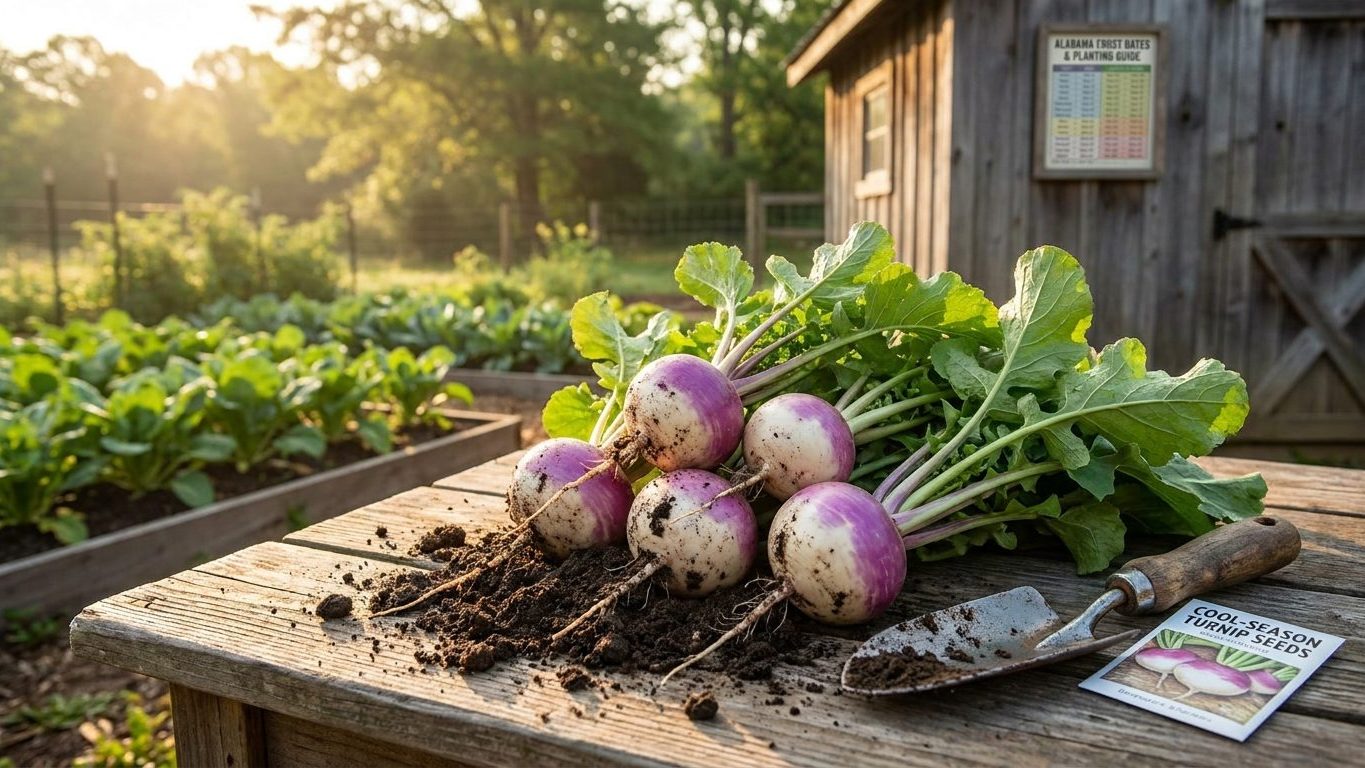

Idaho gardeners get two sowing windows for turnips: a spring one tied to soil that has thawed and dried enough to work, and a fall one counted backward from the first freeze. Because turnips shrug off light frost, the safe dates run wider than most root crops, but the exact days depend on where in the state you’re standing.
The short answer for Idaho
Turnips are one of the few root crops that tolerate a frost after emergence, which changes how you should read the frost-date numbers. The reference station for this page, Boise, carries a last spring frost window of April 23 to May 7 and a first fall freeze between October 7 and October 21. Those are 30-70% probability bands from NOAA’s 1991-2020 climate normals, meaning a freeze is likely somewhere inside that window but not guaranteed on any single day.
For a spring crop, turnips can go into the ground two to three weeks before the last-frost window closes, since the seedlings handle a light freeze once they’re up. In the Boise valley that puts sowing in early-to-mid April as a reasonable starting point, with the understanding that the plants may sit through one more cold snap before settling in.
The fall crop is the one where the math actually matters. Turnip roots need roughly 45 to 60 days from seed to a harvestable bulb. Counting back from the earlier end of the fall frost band, October 7, a 60-day variety needs to be in the ground by early August to size up before the cold arrives. A faster 45-day variety buys another two weeks of slack.
Neither of these numbers is a state-wide fact. They come from one station, in one low valley, and the page’s own caution is blunt about it: Boise sits lower and warmer than most of Idaho. A reader in the Panhandle, the Camas Prairie, or anywhere above 4,000 feet is working with a shorter season and colder nights than these dates describe, and should treat the Boise window as the mild end of the state’s range rather than a default.
What will not work here

Rutabaga is the crop that exposes Idaho’s split personality fastest. It needs a longer season than turnip, often 90 days or more to bulk up a proper root, and the state’s hardiness range runs from 3b up into 7b. In the colder end of that range, a rutabaga sown on a turnip’s fall schedule simply runs out of season before the roots reach a usable size. Where the growing window is already tight, rutabaga is the crop to drop first, not the one to gamble on.
The other failure mode is watering rhythm in the dry valley heat. Boise’s summers are hot and dry enough that a fall-sown turnip crop, going into the ground in early August, is germinating during the hottest stretch of the year. A once-a-week watering schedule, which might carry a crop through a humid summer elsewhere, is not enough here: turnip seed needs the top inch of soil kept consistently damp to germinate at all, which in this climate usually means watering every two to three days until seedlings are established, sometimes daily during a heat spike.
Where slow varieties lose the race
The same short-season logic that rules out rutabaga at altitude also rules out the slowest turnip varieties there. A variety bred for a long, mild season and marketed at 60-plus days to maturity is a poor match for a mountain garden where the frost-free stretch itself may not reach 90 days. In those spots, the crop that fails isn’t the wrong plant, it’s the wrong maturity date on the seed packet.
None of this is a knock on turnips as a crop for Idaho. They’re one of the more forgiving vegetables on this list precisely because they tolerate frost and germinate fast. The failures tend to come from applying a valley timeline to a mountain garden, or a humid-climate watering habit to an arid one.
What changes across Idaho
A hardiness range of 3b to 7b is not a small spread. It covers everything from high mountain valleys where winter lows regularly sit well below zero, to the warm river canyons near Lewiston and the Boise bench where citrus-zone gardeners elsewhere would recognize the climate. That is the USDA Plant Hardiness Zone Map’s system, built on one number, the average annual extreme minimum temperature, and it’s the clearest single signal for how much the state’s growing conditions actually vary.
Practically, that spread means the frost dates cited above for Boise describe one end of Idaho’s growing season, not its middle. A garden at 3b or 4b is working with a season that can be shorter by a month or more on both ends, the last spring frost arriving later and the first fall frost arriving sooner. A gardener in one of those colder zones should shift spring sowing back and treat the fall sowing deadline as arriving earlier, not later, than the Boise-derived date above.
There’s no way to give a single statewide sowing date that means anything across a spread this wide, and this page won’t pretend otherwise. What it can say is the direction of the shift: colder, higher zones push both windows inward, shrinking the usable season from both directions at once, which is exactly why the rutabaga and slow-variety warnings above matter more the higher up you garden.
Where you personally land inside that 3b-to-7b range isn’t something this page can tell you. That takes the USDA’s zone map, checked against your own county, not a state average.
Where to check this for your own county
The state-level numbers on this page are a starting point, not a finish line. For county-specific detail, the source to use is University of Idaho Extension, the land-grant extension service for the state.
Two things are worth pulling from that site specifically. First, a local planting calendar, if your county office publishes one, which will reflect the actual frost record for your elevation rather than the Boise station used here. Second, a list of turnip and rutabaga varieties that extension agents have actually trialled in your part of the state, since a variety that performs well in the Snake River Plain isn’t automatically the right pick for a shorter-season county further north or higher up.
A county-level recommendation beats a state-level one every time, because it’s built from local frost records and local trial results rather than a single reference station. This page works at the state level on purpose, to give you the mechanism and the range, but the specific date for your own garden is a county question, not a state one. If your county extension office publishes a planting calendar, treat that as the source, and treat everything on this page as the reasoning behind it, useful for understanding why the date is what it is, not for overriding it.
Worth calling out the office’s other services while you’re there: soil testing, pest identification, and often a hotline staffed by master gardeners familiar with the specific microclimates in your county, all of which go further than any frost-date table.
The Moon calendar is a separate, older custom: see when to plant turnips by the moon, written as tradition rather than fact.
Checking this against your own garden
Every date on this page is a probability built from thirty years of station data. Your own garden, on any given year, may run a week or two ahead of or behind that average, and there are three signs that tell you which way, none of which need a thermometer.
Soil warmth by feel is the first. Turnip seed germinates poorly in soil that still feels cold to the back of your hand at a two-inch depth, even if the calendar says the sowing window has opened. If the ground still feels like early spring rather than warming spring, waiting a few more days costs less than a poor germination rate.
Speed of emergence is the second. Turnip seed sown into properly warmed soil typically shows its first true leaves within a week to ten days. If it’s taking noticeably longer than that, the soil is colder than the calendar assumes, and it’s worth pushing your fall sowing date a few days earlier next year to compensate.
Early bolting is the third, and the one most specific to Idaho’s dry heat. If a spring-sown crop throws up a flowering stalk before the roots have sized up, that’s a heat-stress signal, telling you the plants hit hot, dry conditions too early. It’s a cue to either move next year’s spring sowing a little earlier, or shift more of the crop to the fall window, where the plants are maturing into cooling weather instead of into a heat spike.