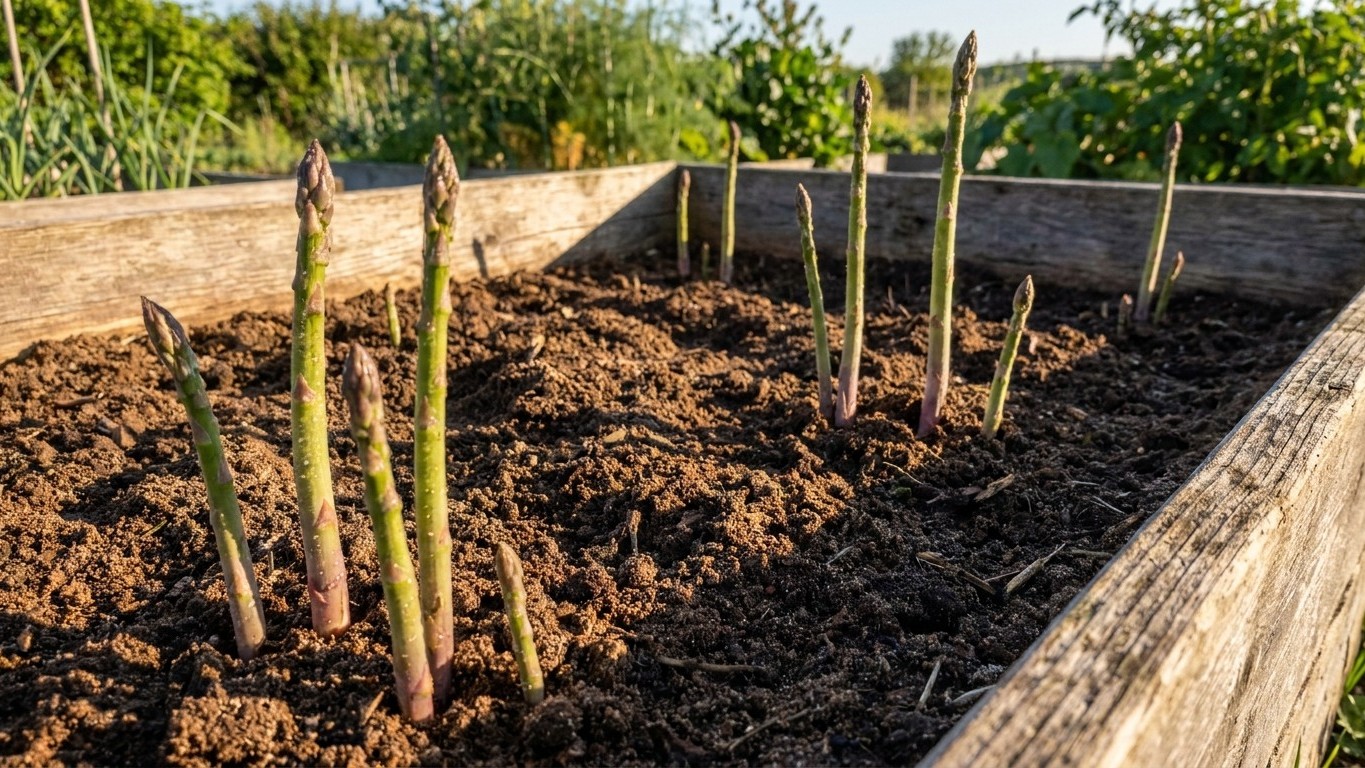

Stop cutting when most of the spears coming up are thinner than a pencil. That signal matters more than any calendar date, in Illinois or anywhere else. Then keep what you cut cold, between 32 and 35°F, with the cut ends standing in water. Both rules apply only to a bed that has earned them. A new Illinois bed gets no harvest until year 3, and that first season is 4 weeks long.
The short answer
A bed lasts 10 to 15 years, so this is the one crop in the garden where you pick a spot and live with it. The only soil requirement in the Utah State University Extension guidance is that the ground drains. Most soils will do, it says, provided they are well drained. That one condition is where Illinois gardeners need to pay attention.
The state soil is the Drummer series, a Mollisol. It is the deep, dark prairie ground that built the Corn Belt, and Illinois made it the official state soil by law. USDA’s representative values for the surface layer, across 106 mapped components, run 8 percent sand, 31 percent clay and 61 percent silt, with organic matter around 5.5 percent. The surface pH is about 6.7, near neutral. The classification is poorly drained.
So does the dominant soil drain well enough? No, not by default. Rich, dark, fertile ground is a gift for most vegetables. For a crop that stays put for fifteen years and asks only that water not hang around, a clayey, poorly drained soil is the wrong starting point. Elsewhere in the garden, heavy soil is an annual nuisance you amend each season. Here it is a decision you cannot easily undo.
That said, the Drummer series represents the state. It is not the ground in every yard. River bottoms, hill country and any lot a builder has scraped or filled can differ completely, and the pH above describes mapped surface ground, not your bed. Dig a hole where the bed would go, fill it with water after a wet week, and watch how long it takes to empty. A soil test then gives you your own numbers. The longer treatment is in Will Illinois Soil Hold an Asparagus Bed for Fifteen Years?
If the hole stays full, move the bed or build it up above the surrounding grade. Do not plant in the low corner and hope. A raised, well-drained bed fixes the problem before the crowns go in. Fixing it afterward means digging up a bed you have already waited on.
The wait is real. Nothing is harvested until year 3, and the first cutting season is 4 weeks. Year 4 gets 6 weeks, and after that the bed produces for 8 weeks. Taking “a few spears” early is not what the guidance says, and it trades the long run of the bed for a handful of meals. In every season the end of cutting is marked by an object, not a date. When most spears come up thinner than a pencil, put the knife away and let the ferns grow. For the full picture of the crop in this state, see Growing Asparagus in Illinois.
Will the summer here water it for you?
Mostly, on paper. The bed wants 1 to 2 inches every other week for its first two years, then every three weeks. Illinois summers come close to supplying that, but the details matter.
- Set the target. Aim for 1 to 2 inches every other week for two years, then 1 to 2 inches every three weeks.
- Compare it with the normals. NOAA’s 1991-2020 normals for the reference station give about 12.1 inches across June, July and August (4.1 in June, 3.71 in July, 4.25 in August), out of 37.9 inches for the year. That works out to a little under an inch a week. July is the driest month, at roughly 1.7 inches per two weeks. In an average summer, rain alone lands inside the 1 to 2 inch range.
- Discount the rain. Normals are averages, and one thunderstorm that drops an inch in twenty minutes mostly runs off. Days at or above 90°F pull water out of the ground quickly. Clay holds water longer than sand, which is a plus in a dry spell and a minus in a wet one. On poorly drained ground, extra watering can do harm if rain has already soaked the bed.
- Measure your own plot. Set a straight-sided can or a rain gauge beside the bed and read it every two weeks. If it shows less than 1 inch, add the difference by hand, slowly enough that it soaks in. In a dry fortnight the shortfall can approach the full 1 to 2 inches.
- Stretch the schedule after two years. The same check applies, only the interval changes to every three weeks.
These are normals for one reference station over thirty years. They are not a forecast, and they are not your garden. A slope, a windbreak or a city heat island changes what actually falls, which is why the can beside the bed settles the question better than any table. A gardener on the Drummer series is more likely to be fixing a water-holding problem than a water-shortage one, so check the soil before reaching for the hose. The beds that struggle with pests and stress often need more attention than more water, and What Eats Asparagus in Illinois, and When covers what to look for.
When to put the crowns in
Crowns go in early in spring. For the reference airport station, NOAA’s 1991-2020 normals put the last 32°F freeze at around April 11 to April 22, using the 30 to 70 percent probability band. That is a mean, so some years the last frost comes earlier and some years it comes later.
Those dates describe an airport, not your yard. Suburban and rural gardens typically see the last spring frost one to two weeks later than the reference city, and gardens at higher elevation can see it later still. Look up your own county before you commit, and treat the figures above as a place to start counting from, not a guarantee for the whole state.
The crowns are planted in furrows 8 inches deep. The furrow is not filled in at planting. Backfill it gradually across the year, about 2 inches of soil every other month, so the shoots always have room to grow into the gap. Dumping the soil back in all at once defeats the purpose. And since this is a bed you commit to for years, the drainage decision from the first section comes before the shovel does.
The Utah State guidance names four varieties and gives only their sex. Jersey Giant and Jersey Knight are all-male. UC 157 F1 and Purple Passion are male and female. It publishes nothing on flavor, yield or any reason to prefer one over another, so any claim you read elsewhere about which is best is not backed by this source. Pick a variety by what you can find and plant what the nursery has in stock.
Seed is the alternative to crowns. This page’s source gives no seed schedule or timing, so follow the seed packet for sowing dates and keep the year-3 harvest rule in mind either way. Start from crowns if you can, since they skip the earliest stage.
Common questions
How do I know it is time to stop cutting this season?
Look at the spears. When most of them are thinner than a pencil, stop. There is no week number attached to this rule, because the signal is the spear itself. The bed needs the thin ones to grow into ferns and feed the crown for next year. The cutting window is 4 weeks in year 3, then 6 weeks in year 4, then 8 weeks after that, but the pencil test overrides the calendar.
How should I keep spears once they are cut?
Aim for 32 to 35°F with air near saturation, 95 to 100 percent relative humidity. UC Davis Postharvest notes that high humidity is essential to prevent desiccation. In a home kitchen, that means standing the cut ends in a jar of water, the way you would hold flowers, or wrapping the butts in a damp towel. The cut end is where spears lose water fastest. This page does not give a shelf life, since none is published in the sources used here.
Can I just use the coldest part of the fridge?
Both edges of the window bite. Above 50°F, spear toughening occurs rapidly, so a counter in a warm kitchen costs you tenderness within hours. At about 31°F (UC Davis lists 30.9°F) or lower, freezing injury sets in, which shows as a water-soaked look and then extreme softening. Check the back of the fridge with a thermometer before parking spears against the wall.
Which variety should I plant for the best spears?
The source does not say. It lists Jersey Giant and Jersey Knight as all-male, and UC 157 F1 and Purple Passion as male and female, and stops there. Flavor and yield are not published, so the choice comes down to what you can find. Whichever you plant, the bed will not be ready for cutting until year 3.