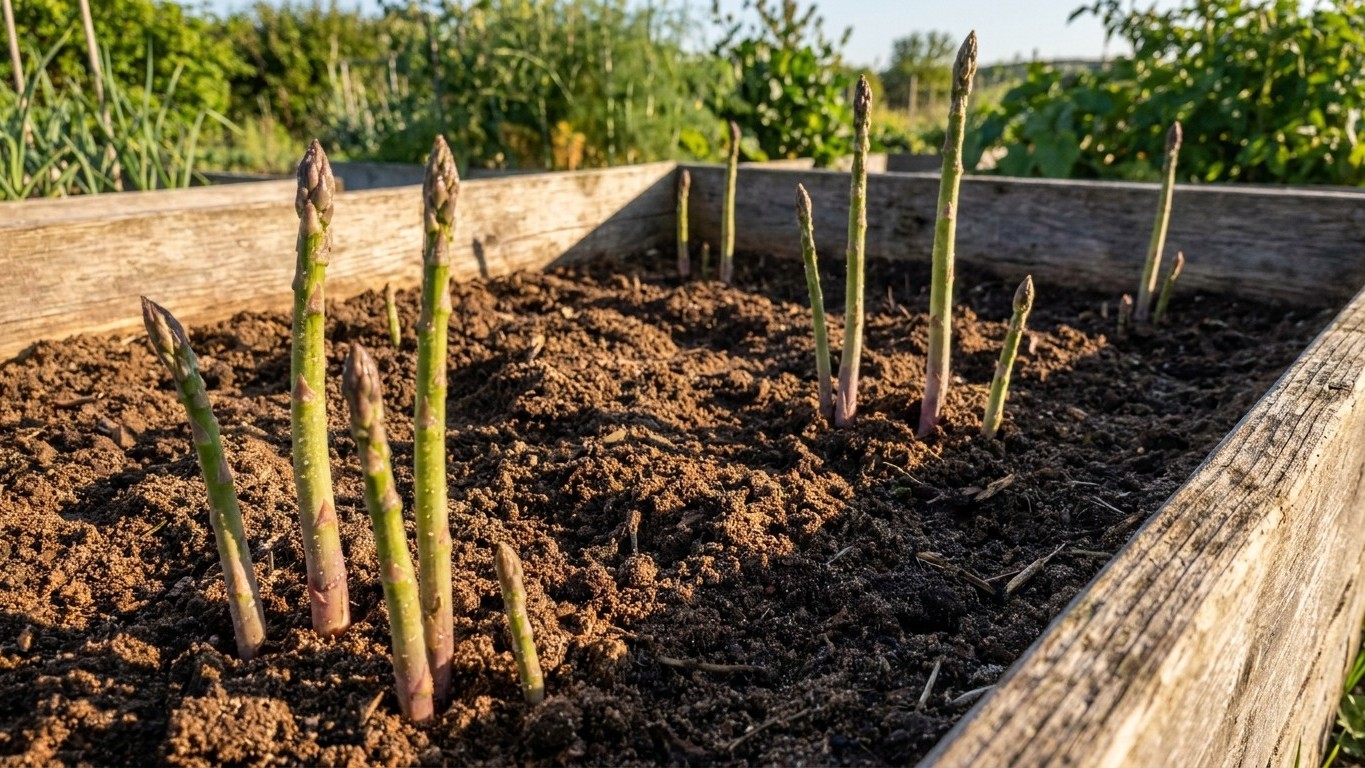

Yes, mostly. Asparagus can stay in the same Illinois bed for the full 10 to 15 years the crop expects, but the answer turns on one soil trait: drainage, not fertility or pH. The state’s official soil, the Drummer series, is rated poorly drained, which is the single condition Utah State University Extension flags as a dealbreaker for a permanent bed. Whether that description matches your yard, and what to do if it doesn’t, is worth working through before any crowns go into the ground.
The short answer
Illinois carries the Drummer series as its official state soil, a Mollisol formed under a century of tallgrass prairie roots and now mapped across huge stretches of the Corn Belt. USDA’s representative sampling of the series puts the surface horizon at 8 percent sand, 31 percent clay and 61 percent silt, with organic matter around 5.5 percent and a surface pH near 6.7, close to neutral. On paper, that’s a soil built to hold nutrients and moisture. The trouble for a fifteen-year asparagus bed is exactly that: Drummer soil is officially classified poorly drained.
Asparagus doesn’t ask much of soil chemistry. Utah State University Extension notes that most soils will grow a productive bed, provided one condition is met: the ground drains. That’s a low bar for a lot of crops, but it’s the one bar asparagus can’t clear if the answer is no. The crown sits about 8 inches down and stays there for a decade and a half; standing water at that depth for even a few weeks during the dormant season can rot a crown that a shallow-rooted annual would have shrugged off after replanting the following spring. A poorly drained soil is an annual nuisance in a vegetable garden. In an Asparagus Bed, it’s closer to a fifteen-year sentence.
What the state soil doesn’t tell you
That doesn’t mean a Drummer-soil garden is out. It means the decision needs a step the annual garden skips: a look at how water actually moves through that specific patch of ground, not the county average. Silty ground over clay can drain fine on a slope or a raised spot and pool badly six feet away in a low corner of the same yard. The state soil describes what the region’s ground tends to do, not what any one backyard does. Illinois covers hundreds of soil series, and river-bottom ground, hill country, and anywhere a foundation or driveway has compacted the topsoil will behave nothing like the mapped Drummer surface.
Gardeners working genuinely heavy, slow-draining ground have two practical routes. One is a raised bed, four inches to a foot above grade, filled with a mix that drains faster than the native clay underneath. The other is picking the highest, best-drained corner of the property and testing it after a hard rain: if water is gone within a few hours, it’s a candidate; if it’s still standing the next morning, move the bed or raise it. Either way, the fix has to happen before planting. There’s no amending a fifteen-year-old crown out of standing water once it’s down there.
Will the summer here water it for you?
an Asparagus Bed‘s water needs change with age, and the schedule doesn’t line up neatly with how Illinois rain actually falls across a growing season. Utah State University Extension’s guidance is specific: 1 to 2 inches every other week for the first two years, then 1 to 2 inches every three weeks once the bed is established. Set against 30-year averages for June, July and August, it’s the young-bed schedule that tends to run short.
- Years one and two, growing season. The bed calls for roughly 1 to 2 inches every 14 days, which works out to somewhere near 2 to 4 inches a month spread evenly. June’s normal of 4.1 inches and August’s 4.25 inches land inside that range on paper, but July, the driest of the three at 3.71 inches, sits right at the edge, and none of these totals actually arrive on an every-other-week schedule. Midwest rain tends to come as a handful of thunderstorms rather than a steady drip, so a three-week dry stretch inside an otherwise normal July is common even in a year that finishes close to average.
- Year three and beyond, established bed. Once the every-three-weeks schedule kicks in, the math gets easier: 1 to 2 inches over 21 days is a lower bar than what June, July and August each deliver in a normal year. An established bed is far less likely to need supplemental water than a young one, even though the young stretch is precisely when the roots are shallowest and least forgiving of a dry week.
- What to actually check. Averages describe the region, not the week you’re living through. A rain gauge on the bed itself, checked every two weeks through the first two seasons, tells a gardener whether July’s usual 3.71 inches showed up on schedule or arrived as one storm followed by seventeen dry days. When it’s the latter, the difference has to come from a hose.
When to put the crowns in
Crowns go into Illinois ground in early spring, timed around the last frost rather than a fixed calendar date. For the reference weather station behind federal climate normals, the average window for the season’s last 32°F freeze runs from around April 11 to April 22, a mean built from three decades of data, not a promise for any single spring. Suburban and rural gardens away from that station often see their own last frost run later, sometimes by a week or two, so treating late April as the safer target is reasonable for anyone outside the immediate area those normals describe.
The crowns themselves go down in furrows about 8 inches deep. Rather than filling that furrow in one pass, the soil goes back in gradually across the season, roughly 2 inches every other month, as new growth pushes up through it. It’s a detail easy to skip and one that matters: burying a young shoot under a full 8 inches of soil in a single afternoon smothers the above-ground growth the plant needs to build a root system that has to last through year fifteen.
Choosing a variety, and what’s actually published about them
Buying crowns means picking a variety, and the published information on the common ones is limited to a single fact: sex. Jersey Giant and Jersey Knight are all-male varieties. UC 157 F1 and Purple Passion carry both male and female plants. Utah State University Extension, the authority behind these growing figures, doesn’t publish flavor, yield, or a reason to prefer one over another among these four, and no nursery source is cited here either.
| Variety | Type |
|---|---|
| Jersey Giant | All-male |
| Jersey Knight | All-male |
| UC 157 F1 | Male and female |
| Purple Passion | Male and female |
Seed is the alternative to crowns, and it’s the slower route: seedlings need a season in the ground before they reach the size of a purchased crown, pushing the eventual three-year wait for a first harvest out further still. For a fifteen-year commitment, most home gardeners choose the head start crowns provide.
Common questions
Can I harvest anything in the first two years?
No. Utah State University Extension is explicit that asparagus isn’t harvested until year three. After that, the harvest window expands in stages: about 4 weeks in year three, 6 weeks in year four, and 8 weeks in the years after that. Cutting earlier weakens the crown that has to keep producing for a decade or more.
How do I know when to stop cutting each season?
Not by counting weeks. The rule is a physical one: stop harvesting once most of the spears coming up are thinner than a pencil. That signals the plant needs to switch from producing spears to building the fern growth that feeds next year’s crown.
Does the state soil’s pH of 6.7 mean my bed will be fine?
Not automatically. The pH figure describes the surface of the Drummer series as mapped by USDA, not any one garden, and the asparagus growing guidance itself is silent on a pH requirement. A soil test on the actual bed site is the only way to know your own number.
Does Illinois’s hardiness zone tell me anything about winter chilling needs?
No, and this guidance doesn’t cover chilling requirements at all. Hardiness zones describe minimum winter temperatures for survival, not the chilling hours a plant needs to break dormancy, and no chilling figure for asparagus is published in the source behind these growing numbers.