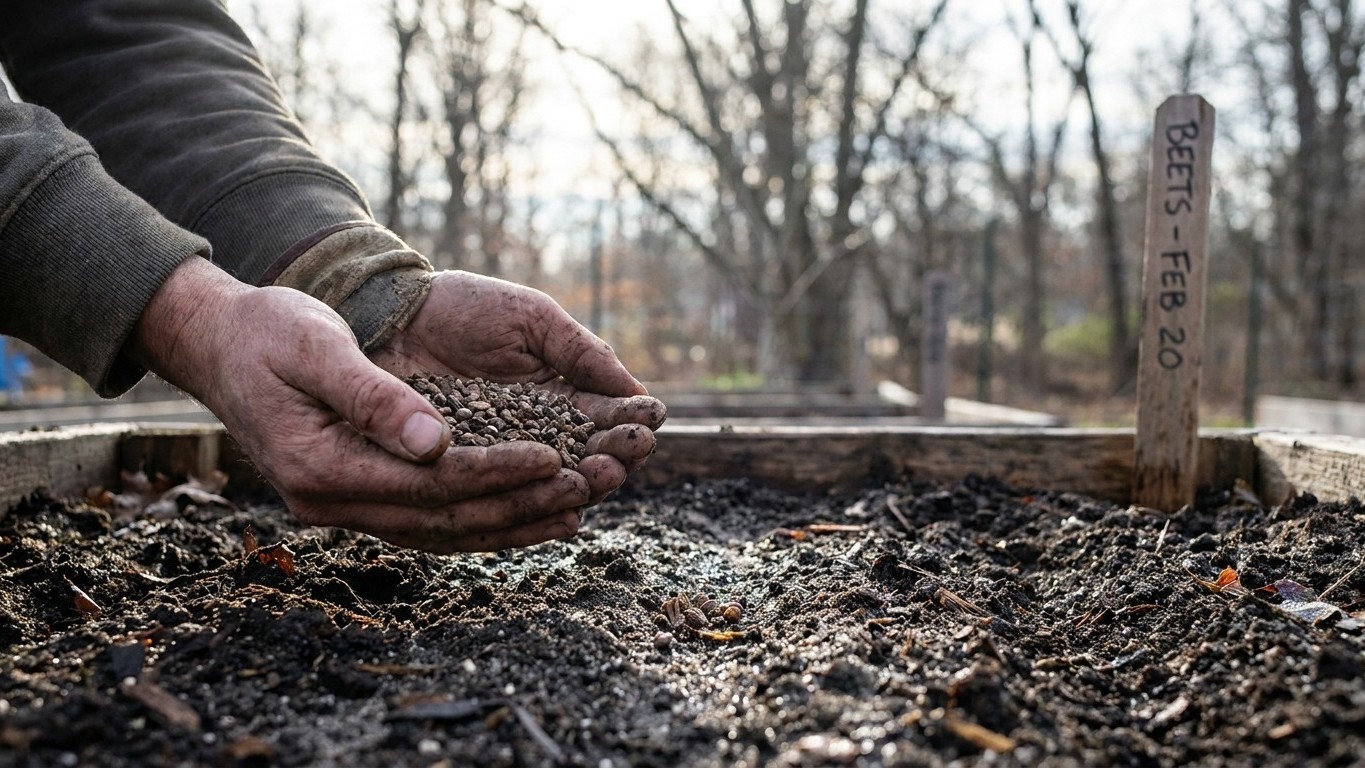

Illinois gardeners get a real shot at sweet, tender beets by sowing directly in the ground about two to three weeks before the last spring frost, which at the Chicago reference station falls between April 11 and April 22. That puts most seeding dates somewhere in the back half of March through the first days of April, with harvest arriving 60 to 80 days later depending on the variety.
The short answer
Start with the ground itself. Illinois’ official state soil is the Drummer series, a Mollisol, the dark, deep prairie soil that built the Corn Belt. Its surface horizon runs about 8 percent sand, 31 percent clay and 61 percent silt, with organic matter near 5.5 percent and a surface pH close to 6.7, right in the neutral range beets tolerate well. The catch is drainage: Drummer is classified poorly drained. Beets, according to Utah State University Extension, want the opposite: deep, sandy, well-drained soil loaded with organic matter, amended with no more than 1 inch of composted material per 100 square feet. A clay-heavy, silt-heavy soil that holds water the way Drummer does is not a beet’s natural preference, even though the fertility and pH are generous.
That mismatch matters most in the first six weeks after seeding, and it matters again later in the season when heat shows up. Utah State’s research is specific on this: water stress in those early weeks pushes beets toward premature flowering, what gardeners call bolting, while temperatures above 85 F combined with water stress later on make the root turn woody and unpleasant. Those are two separate failure points, not one problem with one fix. A precise count of how many days a year Chicago spends above 90 F is not published in the data behind this page, so it will not be guessed at here. What the sowing calendar can do is keep the early growth window, the part most sensitive to drought stress, inside Illinois’ cooler spring stretch rather than pushing it into the hotter, more erratic weeks of early summer.
None of this is a substitute for knowing your own dirt. Illinois spans hundreds of mapped soil series, and Drummer is simply the one the state legislature named official in 2001 through the USDA NRCS State Soils program because it is so widespread and so tied to the region’s farming history. A garden on a river terrace, a hillside, or any lot a builder graded and refilled will likely behave nothing like the Drummer profile above. Treat the numbers here as a description of what the regional ground tends to do (hold water, run close to neutral, resist quick drying) and then pull an actual soil test for the bed you are planting.
The six weeks that decide it here
Sow beets two to three weeks ahead of the Chicago-area last frost window of April 11 to April 22, and the first six weeks of growth land somewhere between mid-March and mid-May. That stretch is when Illinois spring tends to show its full range: wet snowmelt and rain in the early part, followed by the swings the region is known for, a run of raw, damp days broken by a sudden dry, windy stretch that pulls moisture out of the topsoil fast. Because Drummer-type ground is naturally slow to drain, seedlings can start in soil that is saturated at the surface, which sounds safe for a young beet but often means shallow, poorly developed roots once conditions flip toward dry.
That flip is where the bolting risk concentrates. Utah State’s finding that water stress in the first six weeks triggers premature flowering lines up directly with the pattern of an Illinois spring that starts wet and turns dry without much warning. A bed that looked well-watered in late March can be dust-dry by the third week of April if a dry spell hits, and a beet seedling with underdeveloped roots feels that stress immediately. The remedy is not complicated, but it does require attention rather than a one-time setup: check soil moisture by hand through those first six weeks rather than assuming spring rain will carry the crop, especially once the weather turns from soggy to breezy and bright.
Because the last frost date itself is only measured at one airport station, treat April 11 to April 22 as a reference point, not a county-by-county guarantee. Suburban and rural gardens sitting away from that station’s urban heat tend to see a later last frost and an earlier first fall frost, sometimes by a week or two, more if the property sits at higher elevation or in a low frost pocket. Sowing on the early edge of the two-to-three-week window makes sense near Chicago; gardeners farther out, or at elevation, may want to lean toward the later edge of that window and confirm against their own county’s typical frost pattern before committing seed to the ground.
What goes wrong here
- Surface crusting blocks germination. Drummer-type clay-silt soil (31 percent clay, 61 percent silt) can crust hard after a rain, and beet seedlings, which push through with a fairly delicate hypocotyl, struggle to break through a dried crust. Work in up to 1 inch of composted organic matter per 100 square feet before sowing, and keep the top inch of soil loose and lightly moist until seedlings emerge.
- Early dry spells trigger bolting. A wet start followed by a sudden dry snap, common in an Illinois spring, stresses young roots exactly when Utah State’s research says premature flowering gets set in motion. Check soil moisture by hand through the first six weeks after sowing rather than relying on rainfall, and water deeply rather than lightly and often.
- Poor drainage invites rot in low spots. Because Drummer is mapped as poorly drained, garden beds on flat or low ground can hold standing water after heavy spring rain, which rots germinating seed before it ever gets a chance to stress from heat or drought. Raised beds or ridged rows solve this without changing the soil’s underlying chemistry.
- Late-season heat makes roots woody. Sow too late, or let harvest slide past the 60-to-80-day window from seeding, and the crop can run into stretches above 85 F while soil moisture is already tight, the exact combination Utah State ties to woody roots. Track days from the actual seeding date, not from when seedlings first appeared, and pull roots on schedule rather than leaving them in the ground to size up further.
- Heavy clay produces misshapen roots. Compacted, clay-rich ground resists the beet’s natural root expansion, leading to forked or flattened roots even when fertility and pH are fine. Loosen the bed to a full spade’s depth before sowing and avoid working the soil while it is still wet from spring rain, which compacts Drummer-type clay even further.
Common questions
Can I sow beets earlier than three weeks before the last frost in Illinois?
Utah State’s guidance centers on avoiding water stress in the first six weeks rather than setting an absolute earliest date, so the two-to-three-week window before the local last frost (April 11 to April 22 near Chicago) is the practical starting point. Pushing much earlier risks cold, saturated Drummer-type soil that slows germination rather than speeding it up.
Does the Drummer soil’s near-neutral pH mean I don’t need a soil test?
No. The pH of about 6.7 and organic matter near 5.5 percent describe the mapped surface horizon of a representative series, not the bed a gardener is actually working. Illinois contains hundreds of other soil series, and any lot that has been graded, filled, or sits on a different landscape position can read very differently. A soil test on the actual garden bed is the only way to know the real number.
Is bolting the same problem as a woody root?
No, and treating them as one problem leads to the wrong fix. Bolting comes from water stress in the first six weeks after sowing and shows up as premature flowering. Woodiness comes later, when temperatures climb above 85 F while the plant is also short on water. Consistent early watering addresses the first; timely harvest before late-season heat and drought overlap addresses the second.
How many days should I count from sowing to harvest?
Count 60 to 80 days from the day seed goes into the ground, not from any later stage of growth, since beets are grown as a direct-seeded crop rather than transplanted. That window, combined with the local last-frost date, is what determines whether a given sowing date lands the harvest before Illinois’ hotter, drier summer stretch sets in.