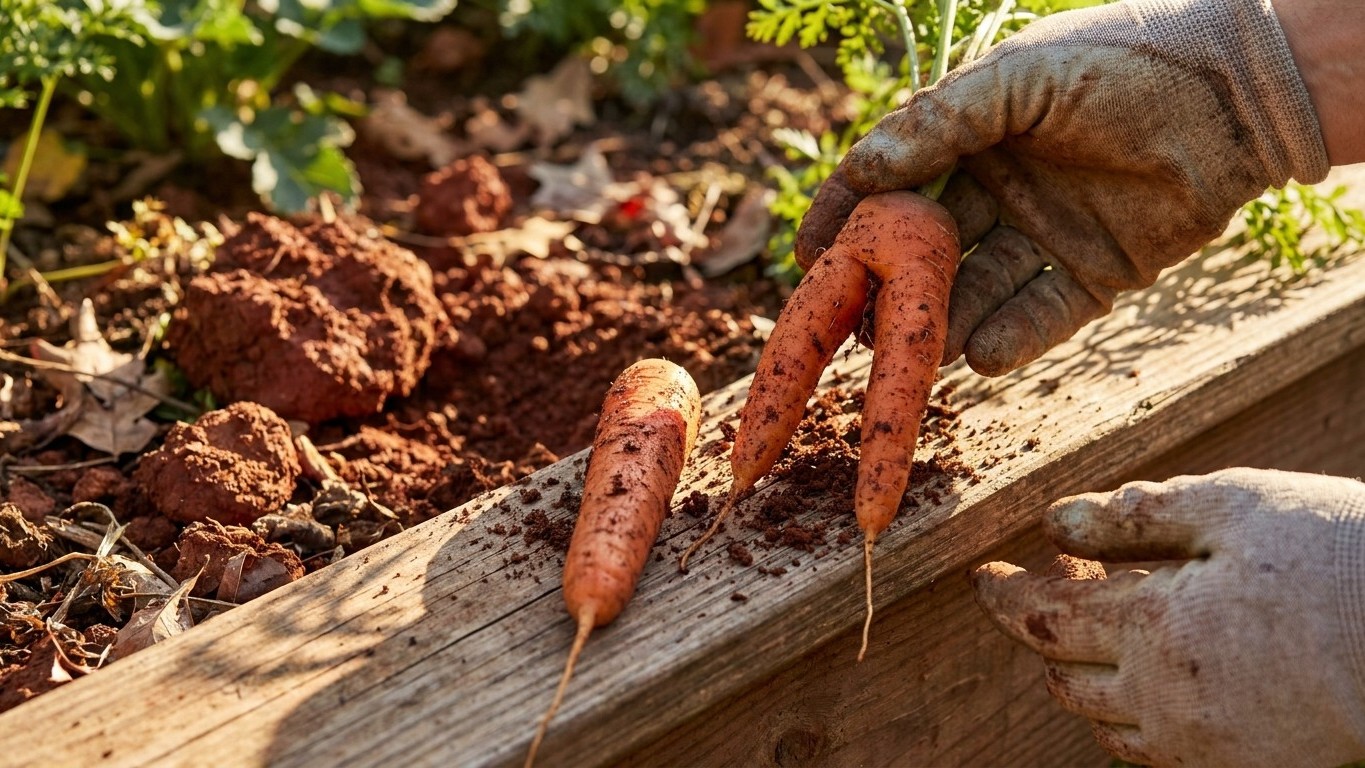

Yes, in Illinois’s benchmark soil, a carrot is likely to fork. The state soil, the Drummer series, is a poorly drained, clay-heavy Mollisol built for corn and soybeans, not for a straight, single taproot. That does not mean your bed is doomed. It means you need to know your own dirt before you drop seed, and build around what you find with compost, double digging, or a raised bed.
The short answer
Illinois’s official state soil, named by state law, is the Drummer series, a Mollisol, the deep, dark prairie soil that built the Corn Belt. Its surface layer runs close to neutral, about 6.7 pH, and carries roughly 8 percent sand, 31 percent clay and 61 percent silt, according to representative values from USDA’s Soil Survey Geographic Database. Organic matter sits around 5.5 percent, and the drainage class is poorly drained. That is a rich, dark soil, the kind that made this state one of the country’s most productive farm belts. It is also, in texture terms, close to the opposite of what a carrot wants.
Utah State University Extension is blunt about it: carrots want deep, sandy, well-drained soil rich in organic matter, and heavy or rocky soil makes the root fork. Drummer soil is heavy by definition, more silt and clay than sand, and poorly drained by classification. Push a carrot’s taproot down into ground that dense and slow to shed water, and it will meet resistance before it gets six inches deep. The tip stalls, a side root takes over, and you pull up a carrot with two or three legs instead of one straight cone. Sometimes the fork is subtle, a slight bend and a hairy split near the tip. Sometimes it looks like a small root system trying to be a carrot.
The organic matter figure is worth a second look, because 5.5 percent is not a bad number on its own. Compost-rich garden soil often runs in that range or higher, and organic matter is exactly what loosens heavy ground and helps water move through it. The problem in Drummer soil is not a lack of organic content, it is the clay and silt fraction working against that organic matter, plus a drainage class that keeps the profile wet longer than a carrot’s root wants. Utah State’s fix for heavy ground is not a different variety of carrot, it is changing the bed itself: work in plenty of compost, double dig to break up the dense layer below the surface, or skip the native soil altogether and build a raised bed filled with a loose, sandy mix.
None of this is a verdict on your particular yard. Illinois spans hundreds of mapped soil series, from river-bottom silt loams to hillside soils with far more sand, to whatever mix of native ground and hauled-in fill sits under a subdivision built in the last few decades. The Drummer series is the state’s representative soil, the one chosen to describe what made the region agriculturally famous, not a soil sample from your backyard. Treat it as a starting assumption, a reason to check your own ground before you plant, not as a diagnosis of what you will pull out of the earth in the fall.
The test that settles it in your own garden
The only way to know if your soil will fork a carrot is to look at it, not at a state map. A shovel and twenty minutes will tell you more than any statewide figure.
- Dig a hole at least a foot deep where you plan to plant. Carrots need that much open root room, and a shallow test hole will hide a hardpan or clay layer sitting just below where a trowel usually reaches.
- Check the depth of loose soil. If you hit dense, compacted ground, a rock layer, or heavy clay before you reach twelve inches, that is where a root will hit resistance and fork or stop growing straight down.
- Look for stones and debris. Small rocks, construction rubble, tree roots, even old brick fragments buried by a previous owner will deflect a taproot exactly the way heavy clay does.
- Feel the texture. Grab a handful of moist soil and squeeze it. If it forms a slick, sticky ribbon that holds its shape, you are dealing with clay-heavy ground, the kind that resists a straight root. If it crumbles and falls apart, sandier and looser, that favors a clean carrot.
- Watch how water drains. Pour a bucket of water into your test hole and time how long it takes to disappear. Water that lingers for hours points to poor drainage, the same trait the Drummer series carries at the state level, and poor drainage keeps soil dense and airless right where a root needs to push through.
- Decide your fix based on what you found. Loose, deep, well-draining soil needs little more than routine bed prep. Heavy, shallow, slow-draining ground calls for compost worked in generously, double digging to break up the lower layer, or a raised bed with a loose, sandy fill if the native soil is too far gone to amend.
Skip the shovel work and you are guessing. Two yards on the same street can carry different soil, one scraped and filled during construction, one left with its original profile, and no statewide figure will tell you which one you have.
What goes wrong here
- Forking in heavy, clay-rich ground. This is the headline risk in a state whose representative soil runs 31 percent clay and poorly drained. A taproot meeting dense, compacted earth splits or bends instead of growing straight. The remedy Utah State University Extension points to is working in plenty of compost and double digging before you sow, or building a raised bed filled with a loose, sandy mix if the native ground is too heavy to fix in place.
- Poor germination during a hot spell. Carrot seed is small and sits shallow, and it dries out fast in warm, exposed soil. A stretch of hot weather right after sowing can crust the surface and stop seeds from sprouting evenly, leaving bare gaps down the row. Keeping the top inch of soil consistently moist until seedlings emerge, with light, frequent watering rather than one heavy soak, is the practical fix.
- Splitting from uneven watering. Heavy soil like the Drummer series holds water once it gets wet, then can crack and dry hard on the surface between waterings. A root that grows through a dry spell, then gets hit with a heavy rain or a deep watering, can split along its length as it swells suddenly. Even, steady watering on a set schedule, rather than sporadic soaking, keeps growth even and the root intact.
- Slow, stunted growth in cold, wet clay. Poorly drained soil stays cold and saturated longer into the season, and carrot seed and young roots are slow to get going in cold, airless ground. Raising the bed a few inches, or working organic matter deep into the row, warms and dries the soil faster and gives roots the loose column they need to push down cleanly.
Common questions
Does Illinois’s state soil mean my garden will definitely fork carrots?
No. The Drummer series is the soil chosen to represent the state, mapped from the surface horizon of its major components, not a measurement of any single backyard. A state contains hundreds of soil series, and your own bed, especially if it sits on filled or graded ground, may behave nothing like it. Dig your own test hole before you decide.
What is the actual fix for heavy, clay soil before I plant carrots?
Utah State University Extension recommends working in plenty of compost and double digging the bed to break up dense ground beneath the surface. Where the native soil is too heavy or shallow to fix that way, a raised bed filled with a loose, sandy, well-drained mix sidesteps the problem entirely.
Are carrots transplanted, and does that change the timeline?
No. Carrots are sown directly in place; they are not started elsewhere and transplanted. Any days-to-maturity figure you see for carrots counts from the seeding date, not from any transplant date, because there is no transplant step in this crop.
Does a high organic-matter number always mean better soil for carrots?
Not automatically. The Drummer series carries organic matter around 5.5 percent, a healthy figure, but its clay content and poor drainage still push toward forking. Organic matter helps loosen and aerate soil, but it works alongside texture and drainage, not in place of them. A figure noted well above 20 percent in a soil survey usually signals a natural organic layer, like peat or muck, not ordinary garden ground.