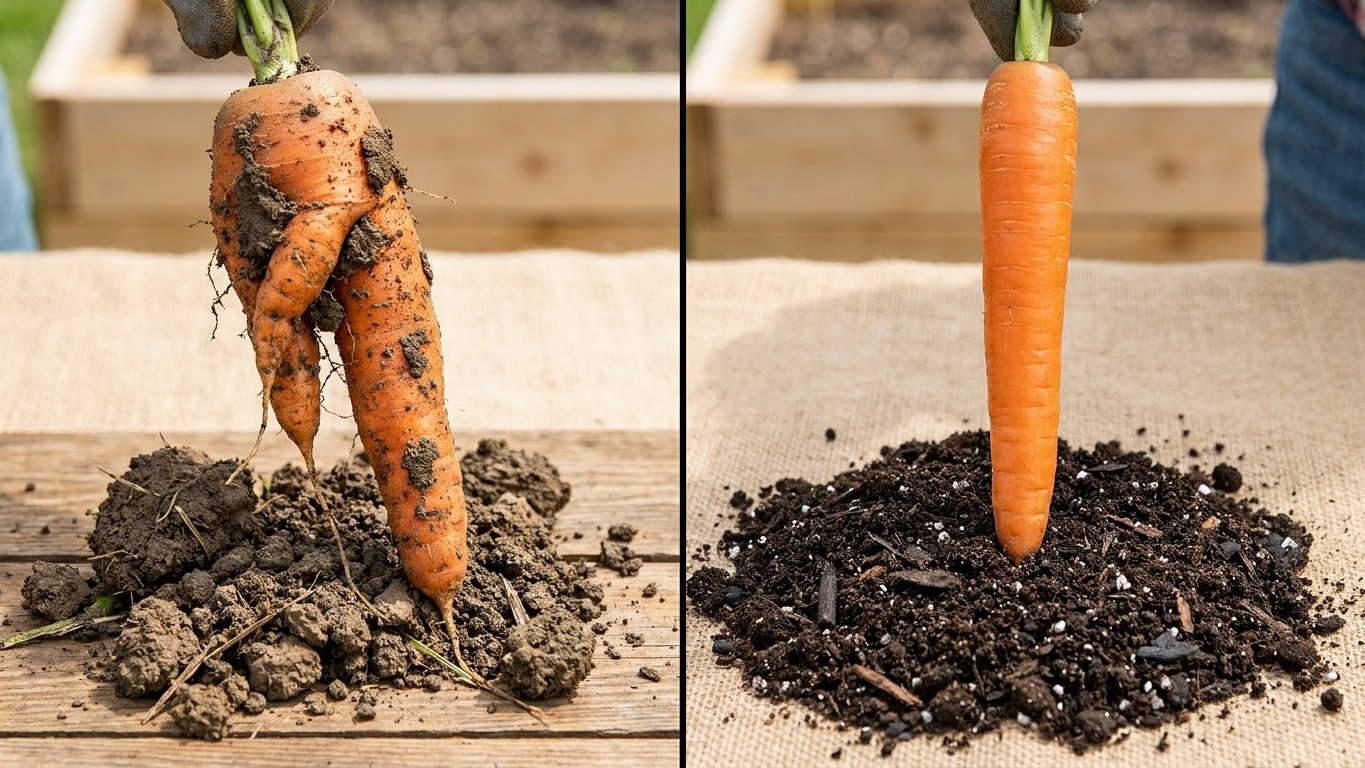

Illinois carrots face one big obstacle: the state’s own famous soil. Drummer series ground is heavy clay and silt, poorly drained, built for corn and soybeans rather than a straight, unforked taproot. The fix isn’t a different variety, it’s raised beds, compost and depth. Sow from seed two to three weeks before your last frost date once the ground itself warms past 40 F.
The short answer
Illinois’s official state soil is the Drummer series, a Mollisol, the deep, dark prairie soil that built the Corn Belt. Its surface horizon runs 8 percent sand, 31 percent clay and 61 percent silt, with organic matter around 5.5 percent and a surface pH near 6.7, close to neutral. It’s classified as poorly drained. That combination, heavy on clay and silt, thin on sand, slow to drain, describes a lot of the ground under Illinois lawns and vegetable patches, and it is close to the opposite of what a carrot wants.
Carrots need deep, sandy, well-drained soil rich in organic matter, according to Utah State University Extension. Put a carrot seed into dense clay and the root does the only thing it can: it splits, curves or forks around whatever resistance it hits, whether that’s compacted clay, a buried stone or a hardpan a few inches down. Heavy soil doesn’t kill the plant, it just ruins the shape of the thing you’re growing it for.
| Criterion | Drummer series (Illinois state soil) | What a carrot wants |
|---|---|---|
| Sand | 8 percent | High, loose and sandy |
| Clay | 31 percent | Low |
| Silt | 61 percent | Moderate to low |
| Drainage | Poorly drained | Well-drained |
| Organic matter | About 5.5 percent (surface) | Rich, loose organic matter |
The gap between those two columns is the whole story. Utah State University Extension’s answer for heavy or rocky ground is plenty of compost worked in and double digging, loosening and enriching the soil a full spade’s depth or more so the root has somewhere loose to travel. Where the native ground is this dense, many gardeners skip the wrestling match entirely and build a raised bed filled with a lighter, sandier mix, which sidesteps the clay problem instead of fighting it season after season.
None of this means your yard is Drummer soil. Illinois spans hundreds of mapped soil series, from sandy stretches along river terraces to rocky till in the north and organic muck soils in old wetland basins. Drummer is the series chosen to represent the state, not a survey of every backyard in it. Treat these numbers as a starting point that tells you what the region’s ground tends toward, heavy, wet, clay-rich, and then confirm what’s actually under your own carrot bed before you decide how deep to dig or whether to bother.
The test that settles it in your own garden
State averages tell you what to expect, not what you have. A few minutes with a shovel answers the question a soil series name never can.
- Dig a hole about a foot deep where you plan to sow. Note where the color or texture changes, that’s often where a compacted layer or clay band starts, and it’s exactly where a carrot root will hit trouble.
- Check for stones and depth to hardpan. Pull out anything larger than a pebble as you go, and note how far down the soil stays loose before it turns dense or resistant to the shovel. A carrot can only grow as straight as the loosest layer allows.
- Feel the texture. Take a moist handful and try to roll it into a ribbon between your fingers. Soil that ribbons long and stays slick is clay-heavy. Soil that falls apart and feels gritty leans sandy. Something in between, silky but crumbly, is closer to loam.
- Watch how water drains. Fill the hole with water and let it soak in once, then fill it again and time how long it takes to disappear. Water that lingers for hours points to the same poor drainage that defines heavy, clay-rich ground; water that vanishes quickly points to a sandier, faster-draining bed.
Run through those four checks before you commit to double digging, raised beds or nothing at all. The answer is usually obvious once you’ve actually put a shovel in the ground, no matter what the map says about the county you live in.
When to sow here
Carrots go into the ground as seed, direct-sown where they’ll grow, never transplanted. Every date below counts from that seeding, not from setting out a start.
- Start with the frost window. NOAA’s 1991-2020 climate normals put the last spring 32 F freeze at the reference station between April 11 and April 22. That’s a station-level figure, and suburban and rural gardens nearby often see their own last frost run one to two weeks later, sometimes more at higher elevation, so treat this as a reference point to check against your own county rather than a guarantee for your yard.
- Count backward two to three weeks. Carrot seed goes in the ground before that last frost date, not after it. Working from the April 11 to April 22 window, that puts a typical sowing window somewhere in the second half of March into the first half of April, adjusted for whatever your own local last-frost date turns out to be.
- Check the soil temperature, not just the calendar. Soil needs to have warmed to at least 40 F before carrot seed will do anything useful sitting in it. Cold, wet clay soil like Drummer series ground warms slowly in spring, often lagging well behind air temperature, so a thermometer pushed a couple inches into the bed tells you more than the date on a seed packet.
- Aim for the germination sweet spot. Seeds sprout best in soil between 55 and 65 F. That’s warmer than the 40 F minimum, which means the earliest possible sowing date often isn’t the best one; a slightly later sowing, once soil has climbed into that range, tends to germinate faster and more evenly than an early, cold planting.
Put together, the arithmetic favors patience over the earliest possible start. Wait for soil, not air, to hit that 40 F floor, sow two to three weeks ahead of your area’s own last frost date, and expect the best germination once the ground itself has warmed closer to that 55 to 65 F range.
What goes wrong here
- Forking in heavy ground. Drummer-type clay and silt resist a growing taproot, and the root splits or curls around the resistance instead of pushing straight down. The remedy is the same one Utah State University Extension gives for any heavy or rocky soil: work in generous compost and double dig the bed, or skip the clay entirely with a raised bed filled with a lighter mix.
- Poor germination during a hot spell. Seed sown when soil temperature has jumped well above the 55 to 65 F sweet spot, during a sudden warm stretch, often germinates unevenly or not at all. Watch the soil thermometer rather than the air temperature, and water lightly and often to keep the top inch from drying out and crusting over while seeds are trying to sprout.
- Splitting from uneven watering. Poorly drained, clay-heavy soil holds water unevenly, staying soggy after rain and then baking hard between waterings. That swing, dry then suddenly wet, makes roots split as they expand too fast after a dry stretch. Consistent, moderate watering on a regular schedule does more to prevent this than any amount of extra water applied all at once.
Checking this against your own county
Everything above starts from a single representative soil series and a single weather station. Your county’s extension office can tell you what’s actually mapped under your address and what local growers are seeing this season. University of Illinois Extension, at extension.illinois.edu, is the state’s land-grant extension service and the right place to ask about soil testing, local frost timing and any carrot problems specific to your part of the state. A five-minute call or a look at their county pages beats guessing from a state average every time.
Common questions
Can I grow carrots straight in Illinois clay without amending it?
You can sow them there, but expect forked, stubby or split roots. Drummer-type soil is 31 percent clay and poorly drained, conditions Utah State University Extension flags as a direct cause of forking. Compost and double digging, or a raised bed, address the problem at the root.
What is the earliest safe date to sow carrot seed in Illinois?
There’s no single statewide date. Work from your own area’s last spring frost, sow two to three weeks before it, and confirm the soil itself has reached at least 40 F before you put seed in the ground.
Does a raised bed really solve the forking problem?
A raised bed filled with a lighter, sandier mix bypasses native clay entirely, which is often simpler than trying to double dig and amend heavy ground in place. Either approach follows the same underlying fix Utah State University Extension recommends: give the root loose, well-drained soil to grow through.
Why did my carrots germinate poorly even though I sowed on time?
Soil temperature is the likely culprit. Carrot seed germinates best between 55 and 65 F; soil that’s still too cold or that’s suddenly spiked hot during a warm stretch will germinate slowly or unevenly. Check a soil thermometer rather than relying on the calendar date alone.