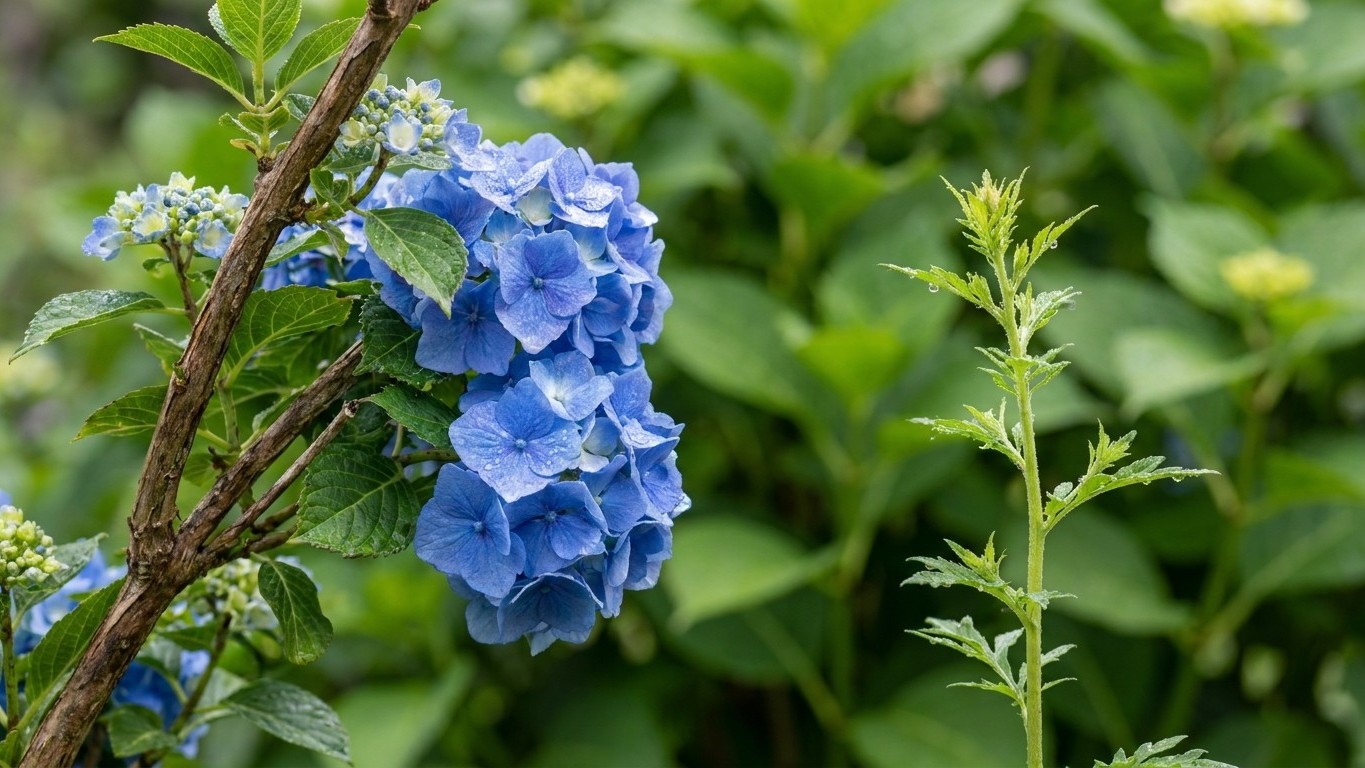

Hydrangeas come out pink in much of Illinois because the soil is close to neutral or alkaline. In that range the plant can’t take up the aluminum that turns bigleaf blooms blue. Lowering soil pH to about 5.5 and keeping it there shifts the color. This works only on certain hydrangeas, takes a full growing season, and starts with a soil test. Here is why the pink happens, how to build your own plan, and where the method goes wrong.
What this comes down to in Illinois

Blue color depends on soil acidity, and the best moment to start adjusting it is spring, once growth has begun after the last freeze. At Chicago, the reference station for the frost figures here, the last spring frost falls between April 11 and April 22, and the first fall frost between October 24 and November 3. Suburban and rural gardens usually run one to two weeks later in spring and earlier in fall, so your own season is a little shorter than those numbers suggest.
The chemistry is simple. Aluminum is present in nearly every soil, but the plant can only absorb it when the soil is acidic. Once pH climbs above about 6.0 to 6.5, aluminum locks into forms the roots can’t use, and the pigment in the sepals (the showy petal-like parts) stays pink or red. Much of Illinois sits on glacial till and wind-deposited silt that formed over limestone and dolomite, so soils run near neutral or higher across large stretches of the state. Many town and city water supplies are hard, which means every watering adds a little more alkalinity.
Which hydrangeas can change color with soil pH?
Only some species respond. Bigleaf hydrangeas (the mophead and lacecap types) shift readily, and mountain hydrangeas shift too, though less dramatically. The others keep their own color no matter what you do to the dirt.
| Type | Responds to soil pH? | What to expect |
|---|---|---|
| Bigleaf (Hydrangea macrophylla) | Yes | Pink in alkaline soil, blue in acidic soil, purple in between |
| Mountain (Hydrangea serrata) | Yes, modestly | Softer shifts between pink and blue |
| Panicle (Hydrangea paniculata) | No | White to cream, often aging to pink on its own |
| Smooth (Hydrangea arborescens) | No | White or green-white |
| Oakleaf (Hydrangea quercifolia) | No | White, aging to pink or tan |
That last point catches people out. A panicle hydrangea that turns rosy in late summer is following its own aging pattern. No amount of aluminum sulfate will make it blue, and it won’t make a true white bigleaf blue either, since white varieties lack the pigment to begin with.
What soil pH turns hydrangeas blue?
Blue shows up reliably when soil pH sits around 5.2 to 5.5. Pink needs roughly 6.0 to 6.2 or higher, and purple or mixed blooms appear in the stretch between. A plant can carry blue and pink flowers at once if the roots reach pockets of different pH, which is common in a bed that has been limed unevenly or sits beside a foundation.
Working it out for your own garden
Start with a soil test, not a bag of amendment. A basic pH test through a lab or your county extension office costs little and tells you how far you have to go. A garden test that reads near 5.8 needs a nudge. One that reads 7.2 needs a long campaign, because the soil will keep pulling back toward its natural level.
Take a worked example. Say the test reads 7.2 and the goal is about 5.5. Elemental sulfur does the heavy lifting, but soil bacteria convert it slowly, over many weeks to months, so it is best worked into the soil around the drip line well ahead of bloom season. Aluminum sulfate acts faster. It supplies aluminum directly and acidifies the soil at once, which makes it the tool for the current season’s flowers. Many gardeners use both: sulfur for the slow change, aluminum sulfate as a fast supplement. Follow the label rate and start on the weak side. Roots burn easily when the dose is heavy.
Now the timing, as a range. If the reference station’s last spring frost falls between April 11 and April 22, add one to two weeks for a typical suburban or rural garden and you get roughly April 18 to May 6. Begin drenching once leaves have fully opened and the plant is clearly growing, which in most gardens falls in that stretch or soon after. Repeat on the label’s schedule through late spring and early summer. Stop well before the first fall frost, which at the reference station arrives between October 24 and November 3 and earlier in many yards. Late feeding pushes soft growth that winter will punish. For protecting those stems, see Protecting Hydrangeas Through a Illinois Winter.
The same method shows where the line falls. A plant sitting in beds with a low natural pH, say a test near 6.0, needs a pH of 5.2-5.5 to reach blue, and a sulfate drench will not get it there in a single season. A plant against a concrete foundation, in a lawn edge that gets limed, or watered with hard tap water will not finish the job. The pH there rebounds within weeks. For those spots, the easier path is a large container filled with an acidic potting mix, or accepting pink and choosing a different bed for the blue plants.
Check your progress by watching new flower buds as they color up in early summer, then retest the soil the following year. Color follows pH with a lag, so a bloom that opens purple this year often becomes blue the next if the soil holds.
What changes across the state
Illinois runs from the Wisconsin line to the Ohio River, and hydrangea color shifts with that stretch. USDA hardiness zones range from 5a to 7b, a spread that reflects the average annual extreme minimum temperature. Cold sets the bloom risk more than color does, but it affects both. In the colder north, bigleaf varieties that bloom on old wood often lose their flower buds over winter and give leaves with few blooms, so the color question never even comes up.
The soil story differs too. Northern Illinois, including the Chicago area, sits over limestone and dolomite bedrock, so soils lean alkaline, and pink is the default. Farther south, the older and more weathered silt loams tend to be more acidic, so blue comes with less effort and sometimes arrives without any help. The middle of the state is mixed, and a test is the only dependable guide. Even within one county, a yard built on fill from a construction site can read very differently from the farm field beside it.
Proximity to Lake Michigan softens the winter cold a little along the shore, and it also supplies water for irrigation in many northern communities, usually hard water. A rain barrel is a small but real fix for anyone fighting alkaline tap water, since rainwater is mildly acidic and carries no lime.
The mistakes this state punishes

Early warm spells cause the first trouble. A stretch of mild weather in March can tempt gardeners to feed and drench early, and then a freeze arrives during the April 11 to April 22 window at the reference station, or later in many yards. Cold, wet soil holds amendments poorly, and any new growth pushed by the warmth gets nipped. Wait for leaf-out, and for the days of repeated frost to pass, before you start.
Over-dosing is the second. More aluminum sulfate does not mean bluer flowers. Too much burns roots, stunts the shrub, and can leave leaf edges brown. Measure, water the soil in first, and keep to the label schedule.
The third is fertilizer. High-phosphorus blends bind aluminum in the soil, so a plant fed this way stays pink even in acidic dirt. Choose a fertilizer low in phosphorus and higher in potassium. Lime, wood ash, and fresh concrete dust all push pH the wrong direction, so keep them away from the root zone.
Fourth is expecting a quick change. Soil pH shifts over a season, not a week, and plants set their bloom color through the roots over many weeks. A gardener who tests once in May and gives up in June has not given the method a fair try.
Last, pruning at the wrong time removes next year’s buds regardless of color. Bigleaf types that bloom on old wood should be cut with care, and When to Prune Hydrangeas in Illinois covers the timing in detail.
Checking this against your county
The frost range here comes from one airport station in Chicago, so it is a starting point rather than an instruction for your yard. Your county’s soil, elevation and nearest large body of water all move the real dates and the real pH. Call or visit your county office of University of Illinois Extension for a soil test and local advice on timing. For the wider picture on site, soil and care, the state’s own guide to growing hydrangeas in Illinois covers the basics this article skips.
Common questions
Can I turn any pink hydrangea blue?
Only bigleaf and, to a lesser degree, mountain hydrangeas respond to soil chemistry. Panicle, smooth and oakleaf types keep their natural colors. Check the plant tag, or look at the leaf shape and bloom form, before spending money on amendments.
How long does it take to turn hydrangeas blue?
Expect most of a growing season, and often two. Aluminum sulfate can show results in the same year if started at leaf-out, while sulfur works more slowly. Retest the soil the following year to see where the pH settled.
Will coffee grounds or pine needles make hydrangeas blue?
They help a little at best. A mulch of pine bark or needles acidifies the surface slowly, but in alkaline Illinois soil it rarely changes pH enough to matter. Treat mulch as a supporting step, and rely on a soil test and a measured amendment for the real change.
Why did my blue hydrangea go back to pink?
The soil drifted back toward its natural pH. Hard tap water, nearby concrete, lime from the lawn, or a high-phosphorus fertilizer are the usual causes. Retest, repeat the treatment on schedule, and consider a rain barrel for watering.