
At 41.99 degrees north, the reference city for this page sees 15 hours and 4 minutes of daylight on the summer solstice. That single number decides almost everything: in Illinois, onions go into the ground in late winter to early spring, not fall, because the state’s hard winters would wipe out a fall-planted crop long before it built any size. Get the timing wrong here and the mistake doesn’t just delay harvest. It shrinks it.
The short answer for Illinois

Onions don’t respond to temperature the way tomatoes or peppers do. They respond to day length. Once daylight hours cross a variety’s threshold, the plant stops putting energy into leaves and starts building a bulb, whatever size it happens to be at that moment. That’s why the calendar matters more than the thermometer for this crop.
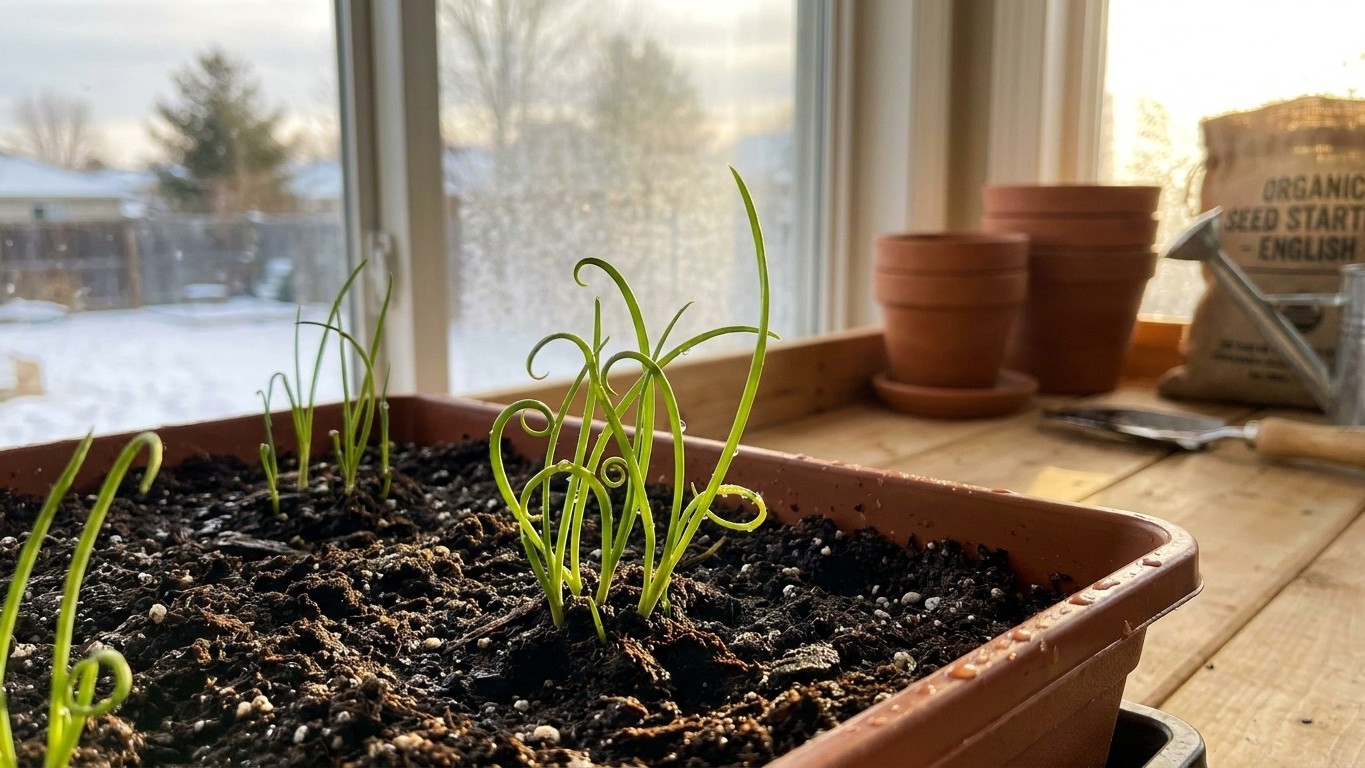
In mild-winter states farther south, gardeners plant onions in fall, let them overwinter as small seedlings, and let them resume growth in early spring before the days lengthen enough to trigger bulbing. Illinois can’t do that. Winters here are cold enough to kill young onion plants left in open ground, so the sequence flips: seed goes in indoors in January or February, and transplants move outside four to six weeks before the last expected frost, once the soil can be worked. Sets and small transplants can also go in directly around that same window.
Why the reference city sets the rule
Chicago, at 41.99°N, is the reference point behind the figures on this page. At that latitude, the longest day of the year delivers 15 hours and 4 minutes of daylight, well above the roughly 14-to-16-hour range that triggers bulbing in long-day onions and comfortably past the 12-hour mark that starts short-day types. That’s the day-length group Illinois gardens are built around: long-day and intermediate-day onions, planted early enough that the plants have real size on them by the time the solstice arrives and bulbing kicks in.
Miss that early planting window and the plant is still small when day length flips the switch. There’s no catching up once bulbing starts, because leaf growth all but stops.
What will not work here
Planting onions late in Illinois is a common mistake, and it’s worth stating plainly what it actually costs: it does not push the harvest back a few weeks with the same size onions at the end. It produces smaller onions, permanently, because bulb size is locked in by however much leaf growth the plant managed before day length crossed its threshold. A transplant that goes in three weeks late doesn’t get three extra weeks of growing time before harvest. It gets three fewer weeks of growth before the plant switches modes, and that’s the size it stays.
The other way to guarantee disappointment is planting the wrong day-length group. Short-day onions are built for latitudes well south of Illinois, where the 12-hour trigger arrives while the plant still has time left in a long, mild growing season. At 41.99°N, that same 12-hour day length shows up in early spring, while a short-day plant is still tiny. The result isn’t a smaller-than-usual onion. It’s a marble-sized bulb, or leaves all season with no bulb at all, followed by rot once the plant gives up.
- Candy (intermediate-day, published range 33-40°N): sits south of Illinois’s reference latitude; bulbing triggers too early here for the plant to reach useful size.
- Gabriella (short-day, 20-35°N): a Deep South variety; at 41.99°N it bulbs while still a seedling.
- Madalyn (short-day, 20-35°N): same mismatch as Gabriella; the day-length trigger arrives far too soon for Illinois’s climate.
- Red Rock (short-day, 30-36°N): built for latitudes a full state or more south of Illinois; expect tiny bulbs or none.
- White Castle (short-day, 30-38°N): the least mismatched of this group but still well south of 41.99°N; unreliable bulbing here.
None of these are “risky” choices that might struggle. They’re the wrong tool for this latitude, full stop.
What changes across Illinois
Illinois isn’t one latitude, and Chicago sits near the very top of it. The state runs roughly five degrees of latitude from the Wisconsin border down to Cairo at its southern tip, and Chicago (41.99°N) represents the far northern edge of that range, not the middle. Most Illinois gardens actually lie south of the reference city, which matters because day length and winter severity both drop as you move down the state.
| Location | Latitude | Daylight, longest day | What that changes |
|---|---|---|---|
| Chicago (reference city) | 41.99°N | 15h 04min | Baseline for this page; long-day and intermediate-day varieties suit, spring transplanting only |
| Northern border area | ~42.5°N | Slightly longer than reference | Varieties with a 43°N+ lower bound (Powell, Redwing, Safrane, Talon) edge into workable range |
| Southern Illinois (Cairo area) | ~37°N | Noticeably shorter than reference | Milder winters, planting window shifts earlier; more intermediate-day varieties fit comfortably |
That north edge matters for four varieties whose published ranges start just above 41.99°N: Powell (43-47°N), Redwing (43-65°N), Safrane (42-50°N), and Talon (42-50°N). None of these fail outright at the reference latitude, but none of them are a safe bet either. A gardener in far-northern Illinois, near Rockford or the Wisconsin line, is close enough to their lower bound that these varieties may bulb reliably. A gardener in central or southern Illinois is further from that range and takes on more risk planting them.
Southern Illinois gardeners, by contrast, have milder winters and a longer effective growing season before the solstice, which gives intermediate-day varieties more room and softens some of the timing pressure that defines gardening farther north.
Sweet now, or onions that last
Every Illinois onion grower eventually runs into the same trade-off, and it isn’t a matter of taste alone. It’s chemistry. The volatile sulfur compounds that give an onion its sharp bite are the same compounds that protect the bulb during long storage. A variety bred to be mild and sweet simply has fewer of those compounds, which makes it better eaten fresh and worse at surviving months in a pantry. According to University of Missouri Extension, sweet onion varieties do not store as well as more pungent types, and that’s a direct consequence of lower sulfur content, not an accident of breeding.
Illinois, sitting well up in long-day territory, leans toward varieties suited to longer summer daylight, several of which run sharper and keep longer than the short-day sweet onions grown across the Deep South. That’s not a coincidence either: short-day types, built for southern latitudes with shorter summer days, tend to run sweeter, while long-day types built for latitudes like Chicago’s tend to store longer.
The practical upshot for an Illinois pantry: onions harvested from long-day varieties and cured properly can realistically still be usable in March, months after harvest, while a sweeter variety grown for fresh eating needs to be used up well before then. If storage matters more to you than a milder bite at the table, that’s the direction to lean when choosing seed for this latitude. If fresh, mild flavor matters more, expect a shorter shelf life and plan to use those onions up first.
Checking this against your own garden
Every figure on this page comes from Chicago at 41.99°N. That’s a reasonable stand-in for northern Illinois, but a poor one for a garden near Carbondale or Cairo, several degrees of latitude south. Before locking in a planting date or a variety, a few things are worth checking against your own location rather than taking the reference city’s numbers at face value.
- Look up your own latitude if you’re more than an hour’s drive from Chicago, especially if you garden in central or southern Illinois.
- Check your local average last-spring-frost date, since transplanting timing is built around that date, not a fixed calendar day.
- Call or visit your county extension office; Illinois has offices statewide, and they track frost dates and local growing conditions specific to your county.
- Read the day-length rating on any onion seed or set before buying it, and compare it to your own latitude rather than assuming a variety sold locally is automatically suited to your garden.
- If you’re considering one of the edge varieties like Powell, Redwing, Safrane, or Talon, treat it as a trial planting in a small bed rather than your main crop, since these sit right at the margin for most of the state.