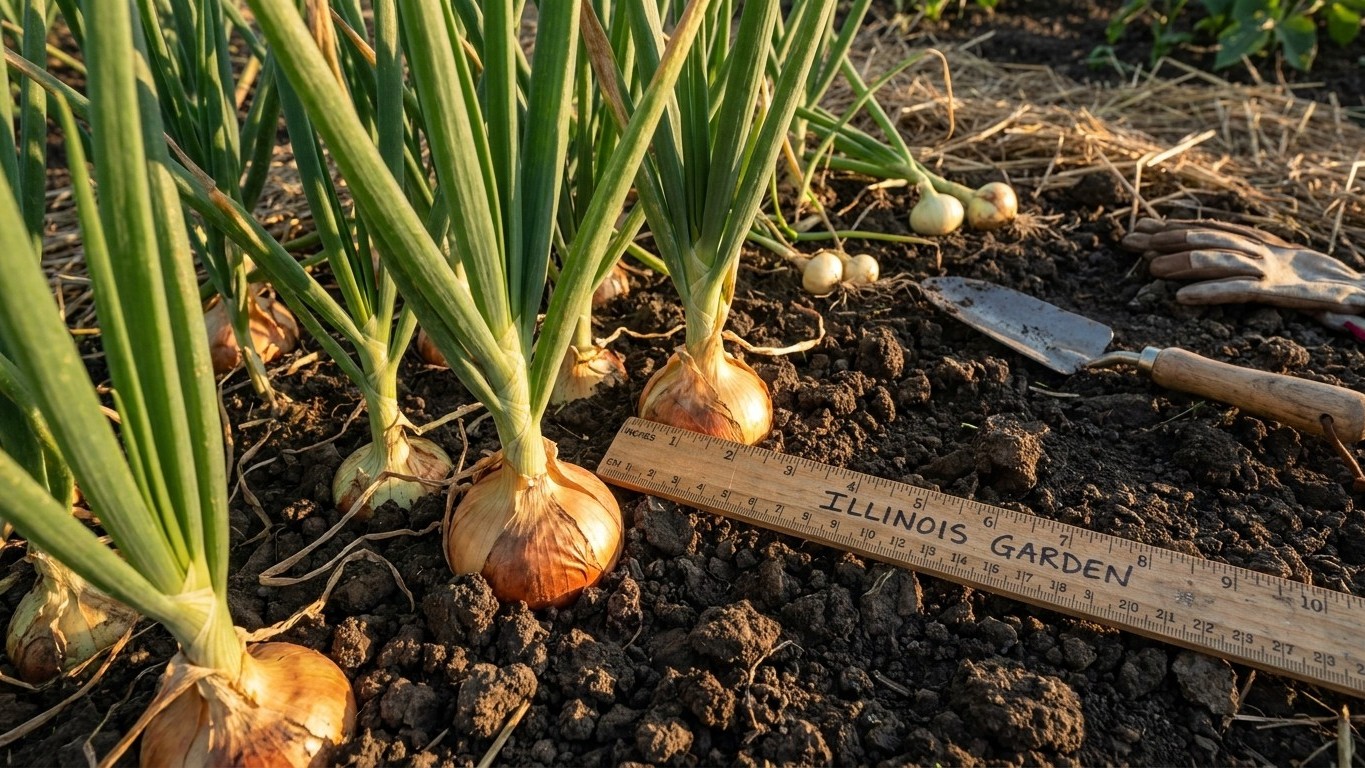

Illinois sits at 41.99 degrees north latitude, measured at the Chicago weather station, and that single number decides which onions will actually form a bulb in your garden. Onions don’t bulb because of heat or soil richness, they bulb when daylight hours cross a threshold the variety is genetically set to detect. Get the variety wrong for this latitude and you’ll harvest green tops and nothing underneath.
How long your longest day is

At 41.99 degrees north, the longest day of the year delivers 15 hours and 4 minutes of daylight. That figure puts Illinois squarely in long-day onion territory, and it rules out short-day and most intermediate-day varieties before you’ve even bought seed. Long-day onions need somewhere between 14 and 16 hours of daylight before they’ll stop growing leaves and start swelling a bulb. Illinois clears that bar comfortably in June. Short-day onions, by contrast, start bulbing around 12 hours of daylight, a threshold documented by Clemson Cooperative Extension’s Home & Garden Information Center. In Illinois, that 12-hour mark arrives so early in the season that a short-day plant bulbs while it’s still a seedling with three or four leaves. The result is a marble-sized onion, not the storage bulb you were hoping for.
This one paragraph is really the whole answer to whether a given variety works here. Everything below is detail on top of it. But Illinois is a long state, stretching from the Wisconsin border down past the Kentucky line, and 41.99 degrees north describes Chicago, not Cairo or Carbondale. A gardener near the northern border gets a bit more summer daylight than this figure; a gardener near the southern tip gets a bit less. The difference across the state is real but modest, usually well under half an hour of daylight at the solstice, so it rarely flips a variety from “will bulb” to “won’t.” Still, if you garden near either edge of the state, it’s worth checking your own latitude against the ranges below rather than assuming Chicago’s number applies exactly to you.
The practical upshot: day length, not the calendar and not the thermometer, is the filter to run every variety through first. A seed packet that doesn’t list “long-day,” “intermediate-day,” or “short-day” somewhere on it is a packet you should be suspicious of buying for an Illinois garden. Once you’ve settled on the right day-length type, see When to Plant Onions in Illinois for the timing that goes with it.
Which varieties bulb in Illinois
Of the 28 onion varieties documented on this site, 19 have published latitude ranges that cover 41.99 degrees north. That’s the good news: Illinois gardeners have real choice here, spanning classic storage onions, sweeter slicing types, and a handful of red and Italian heirlooms. For a closer look at how these varieties compare, see The Best Onion Varieties for Illinois.
- Ailsa Craig (long-day, 38-60N)
- Barolo (long-day, 38-55N)
- Blush (long-day, 38-55N)
- Bridger (long-day, 35-50N)
- Cabernet (intermediate-day, 35-45N)
- Calibra (intermediate-day, 35-45N)
- Elsye (intermediate-day, 32-45N)
- Expression (intermediate-day, 32-45N)
- Frontier (long-day, 40-50N)
- Monastrell (intermediate-day, 35-46N)
- New York Early (long-day, 38-50N)
- Patterson (long-day, 38-55N)
- Red Carpet (long-day, 40-45N)
- Red Long of Florence (intermediate-day, 38-50N)
- Red Long of Tropea (intermediate-day, 35-48N)
- Rossa di Milano (long-day, 38-50N)
- Scout (intermediate-day, 32-46N)
- Sierra Blanca (intermediate-day, 32-45N)
- Walla Walla Sweet (long-day, 35-55N)
Four more sit close enough to a published boundary that they fall in a blurred zone rather than a clear yes: Powell (long-day, 43-47N), Redwing (long-day, 43-65N), Safrane (long-day, 42-50N), and Talon (long-day, 42-50N). These aren’t a flat no. Illinois at 41.99N is right at the edge of their catalogue ranges, so they may bulb reliably for you, especially if you’re gardening in the northern third of the state where daylight runs slightly longer. Treat them as a trial planting, not a sure thing, and don’t build your whole onion patch around them the first year.
What happens if you plant the wrong ones
Five varieties documented here are published for latitudes well below Illinois and will not bulb: Candy (intermediate-day, 33-40N), Gabriella (short-day, 20-35N), Madalyn (short-day, 20-35N), Red Rock (short-day, 30-36N), and White Castle (short-day, 30-38N). If you’ve ever bought a bag of loose onion sets at a big-box store in spring, planted them, and ended up with tall healthy tops and thin little bulbs that went soft in storage by December, this is almost certainly why. It isn’t a watering problem or a fertilizer problem. It’s a variety mismatch, the plant hit its day-length trigger while it was still small, shut down leaf growth, and never had the size to make a real bulb. Left in the ground too long after that, the undersized bulb often starts to rot rather than mature.
When to plant onions in Illinois
Because Illinois falls in the long-day group, planting follows a spring-focused calendar rather than the fall planting common in mild-winter southern states. Long-day onions need a long runway of cool growth before the June solstice pushes them into bulbing, so the goal is getting plants or sets in the ground as early as the soil allows.
The Chicago-area weather station shows a last spring frost falling between April 11 and April 22, and a first fall frost between October 24 and November 3. Those are averages built from 30-year climate normals, not promises, and they describe the reference station specifically, not the whole state. Suburban and rural gardens away from the airport’s heat-holding pavement typically see frost linger later in spring and arrive earlier in fall, sometimes by one to two weeks, with even bigger swings at higher elevation or in low-lying frost pockets. Check your own county extension office for a locally adjusted date before you set a calendar reminder.
In practice, most Illinois gardeners start onion seed indoors in late winter, around eight to ten weeks before that April frost window, then transplant young plants outside a few weeks ahead of the last frost date since onions tolerate a light freeze far better than most vegetable seedlings. Sets (small dormant bulbs) go in the ground on a similar early schedule. Planting too late is the more common mistake here: a long-day onion put in the ground in May has lost weeks of leaf-building time before the solstice forces it to bulb, and it will simply make a smaller onion than one planted in March or early April.
Sweet onions or onions that keep
Illinois’s long-day status doesn’t just decide which varieties will grow, it shapes what kind of onion you’ll be eating by winter. The trade-off is chemistry, not marketing. University of Missouri Extension puts it plainly: “As a rule, ‘sweet’ onions do not store as well as the more pungent types.” The bite in a sharp onion comes from volatile sulfur compounds, and those same compounds double as the bulb’s natural defense against rot in storage. A sweet variety has fewer of them, which makes it milder on a sandwich and also makes it break down faster in a root cellar or pantry drawer.
This same chemistry tracks with day length across the country. Short-day varieties, grown in the Deep South, tend to run sweeter and are meant to be eaten within weeks of harvest. Long-day varieties, the kind Illinois growers plant, tend to run sharper and hold in storage for months. That doesn’t mean every Illinois onion tastes fierce : Walla Walla Sweet and Ailsa Craig are both long-day varieties on the milder end — but as a general rule, an Illinois garden is better positioned to fill a pantry through the winter than a southern garden is.
What that means for your kitchen in March: an onion pulled from an Illinois garden in August, cured properly and kept cool and dark, has a real shot at lasting into late winter, especially the firmer, more pungent storage types like Patterson or Frontier. If you want something to slice raw on a burger in July, plant Walla Walla Sweet or Blush and plan to eat them within a couple months of harvest rather than counting on them for the pantry. Growing a mix of one sharp keeper and one milder slicer, rather than a single variety, is the simplest way to get both a March onion and a July onion out of the same garden.