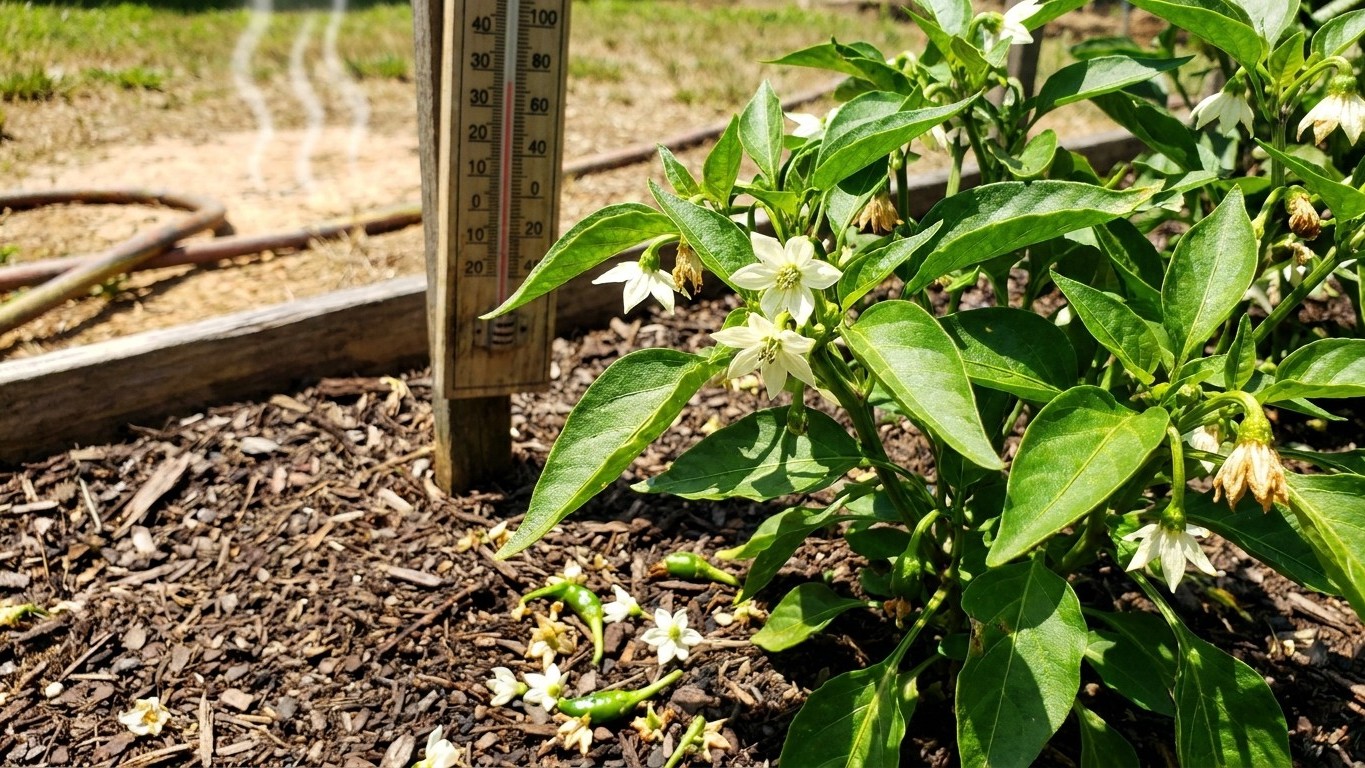

Illinois peppers stall for one of two opposite reasons: heat that shuts down pollen at the top of the thermometer, or chilly nights that do the same thing at the bottom. The Chicago reference station logs 14.0 days a year at 90 F or hotter, and that heat load alone explains a good share of empty pepper plants across the state. But cold snaps below 55 F cause identical blossom drop, and this site doesn’t track summer night lows for you.
The short answer
Start with the number: 14.0 days a year at 90 F or above, averaged from the 1991-2020 NOAA NCEI Climate Normals at the Chicago reference station. That’s not a single heat wave. It’s roughly two weeks scattered across a typical Illinois summer, usually bunched into one or two stretches in July and August rather than spread evenly. Pepper flowers are sensitive to that kind of heat almost immediately. When daytime highs push past 90 F, especially with humid air holding the heat into the evening, pollen becomes sterile or fails to release from the anther. The plant may still bloom. It just won’t set fruit from those blossoms. Growers sometimes describe this as the plant “sulking,” but there’s nothing mysterious about it: it’s a straightforward heat-driven reproductive failure, and 14 days a year is enough to wipe out a meaningful chunk of a plant’s flowering window if the timing lines up with peak bloom.
The other end of the problem gets less attention, but it’s just as real. Pepper fruit set fails at nights below 55 F the same way it fails above 90 F during the day. Early transplants set out in a cool spring, or a late-season cold snap that dips overnight lows into the low 50s, will drop blossoms just as readily as a July heat spike does. This matters more than gardeners expect in a state where spring weather swings hard from week to week.
Here’s the catch: this site carries the daytime heat data for Illinois territories, but it does not carry summer night minimum temperatures. There’s no reliable way to infer how cool your nights run from your latitude, from your county’s average frost dates, or from how cold your winters get. Microclimate matters too much. A yard near a lake, a low spot that collects cold air, or an exposed rural field can all run several degrees cooler overnight than a nearby town just a few miles away. If you want to know whether your nights are dipping under 55 F during bloom, the only real answer is to put a min-max thermometer in the garden and read it yourself for a few weeks. Guessing from a map isn’t good enough here.
When to start seed here
Working backward from the transplant date is the most reliable way to time pepper seed-starting in Illinois, and the math is simple enough to redo for any county once you know your own numbers.
- Find your last spring frost window. At the Chicago reference station, the 1991-2020 NOAA NCEI freeze-probability data puts the last spring frost between April 11 and April 22, based on the 30 to 70 percent probability band for 32 F. That’s the airport-station figure, not a statewide guarantee. Suburban and rural gardens typically see their last frost land later than this, often by one to two weeks, and more if you’re at higher elevation or in a low-lying spot that collects cold air.
- Don’t transplant on frost date alone. Peppers also need the soil itself to reach 60 F before they go in the ground, according to Utah State University Extension. Frost can clear before the soil warms up, especially in a cool, wet spring, so check soil temperature with a simple probe thermometer rather than relying on the calendar.
- Set your working transplant date. Combine the two: wait until after your local last frost and until soil hits 60 F, whichever comes later. For a garden near the Chicago reference station, that often lands somewhere in late April to mid-May, but confirm it against your own soil readings rather than assuming.
- Count back 8 to 10 weeks for seed-starting indoors. Utah State University Extension recommends starting pepper seed indoors 8 to 10 weeks before that transplant date. If your target transplant date is around the first week of May, that puts indoor seed-starting somewhere in late February to early March.
- Re-check the date against your own county records. Because the frost window above comes from a single airport station, gardeners outside the immediate Chicago area should nudge their seed-starting date a week or two later to match a realistically later local frost, rather than transplanting into ground that’s still too cold.
What goes wrong here
Illinois’s combination of humid summer heat and unpredictable spring cold snaps produces a specific, repeatable set of pepper failures. Knowing which one you’re looking at changes what you do about it.
- Blossom drop from a hot spell. When daytime highs climb into the 90s during one of Illinois’s roughly 14 annual days at or above that mark, flowers open, wilt, and fall without setting fruit. The remedy is timing and shade: avoid heavy nitrogen feeding right before a forecast heat spell (it pushes leafy growth instead of fruit set), and use 30 to 40 percent shade cloth over plants during the hottest afternoon stretch to knock a few degrees off leaf and flower temperature.
- Blossom drop from a cool night. The same dropped-flower symptom shows up when nights fall below 55 F, which is common with an early transplant or a late cold snap. Because this site doesn’t track night minimums for you, the fix starts with monitoring: keep a min-max thermometer in the bed during bloom, and if a cold night is forecast, cover plants with a lightweight row cover or cloche overnight rather than waiting to see if flowers drop.
- Sunscald on exposed fruit. Illinois summer sun is strong enough that peppers left uncovered by foliage, especially after aggressive pruning or leaf loss from disease, can develop pale, papery patches on the sun-facing side. Keep the plant’s natural leaf canopy intact rather than stripping leaves for “better airflow,” and stake or cage plants so fruit stays shaded by its own foliage.
- Blossom-end rot. This shows up as a sunken, leathery brown-black spot on the bottom of the fruit, and it’s a calcium-delivery problem tied to inconsistent watering rather than a soil calcium shortage in most cases. Uneven watering, common during Illinois’s swings between soaking rain and dry, hot stretches, interrupts the plant’s ability to move calcium into developing fruit. Keep soil moisture even with a 2 to 3 inch mulch layer and a consistent watering schedule rather than letting the bed dry out between heavy rains.
Common questions
How many days does it take an Illinois pepper plant to set fruit after flowering?
Fruit set generally follows 35 to 45 days after flowering, according to Utah State University Extension. That window starts at bloom, not at transplanting or seed-starting, so a plant that flowers late because of a cool spring will push its harvest back by the same amount.
Can I just wait until it’s safely warm to transplant and skip the frost-date math?
You can, but you’ll likely lose growing days you don’t need to lose. Transplanting too late shortens the window before Illinois’s hot stretch arrives, which raises the odds that early bloom collides with one of those 90 F-plus days. Working from the local frost window and 60 F soil temperature keeps the timing tighter.
Does the 90 F day count mean my whole summer is too hot for peppers?
No. 14.0 days a year at 90 F or above is an average spread across the season, usually concentrated in a couple of short stretches rather than the whole summer. Most Illinois summers have plenty of pepper-friendly weather in between; the goal is managing those short heat spikes with shade cloth and steady watering, not writing off the season.
Why does this site not tell me my nighttime lows?
Because reliable summer night minimum data varies too much by micro-site, lake proximity, elevation, and even how close a yard sits to pavement that holds heat, to publish a single number that would hold true across an Illinois county. A basic min-max thermometer placed in your own garden gives a far more accurate picture than any regional estimate could.