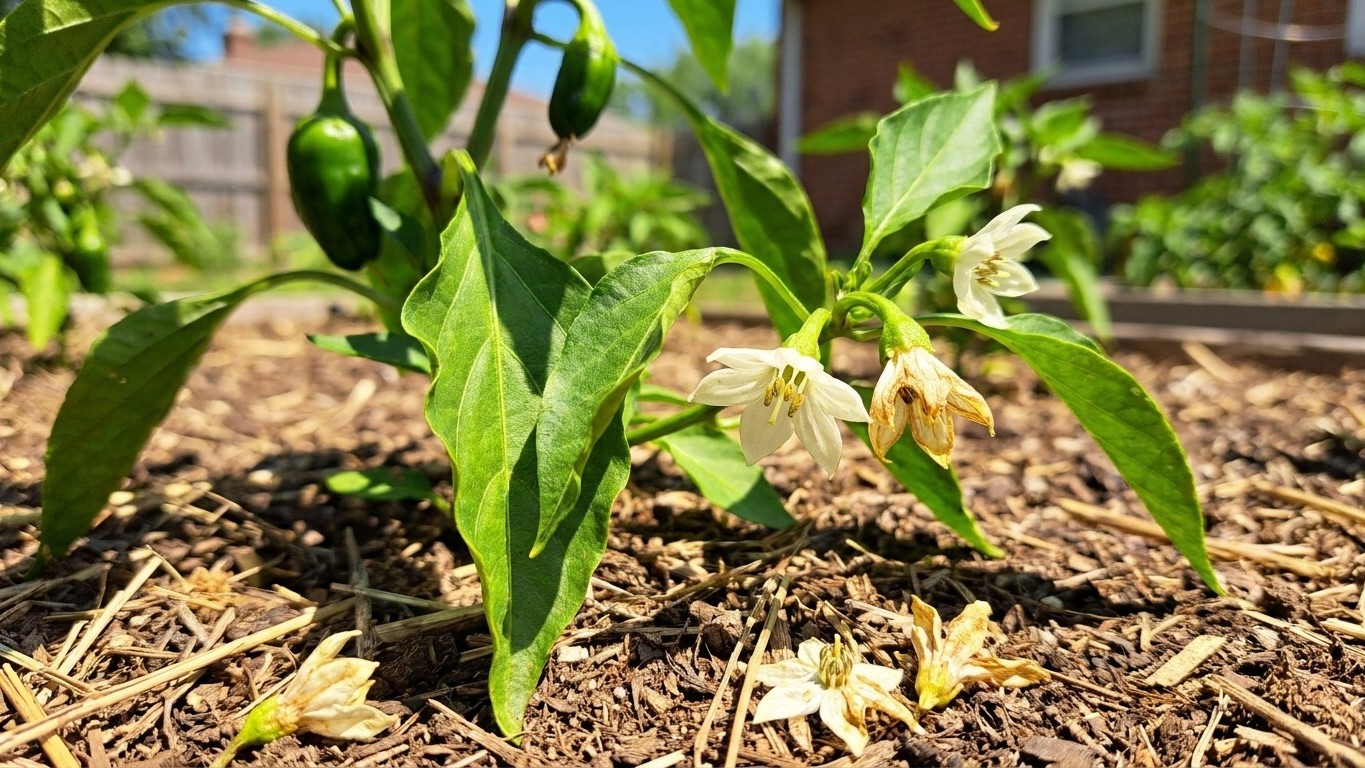

In Illinois, pepper fruit set runs into trouble at both ends of the thermometer. Summer days push past 90 F often enough to stall pollination, and cool nights can do the same damage from the other direction. Get transplants in the ground at the right soil temperature, after frost, and you sidestep the timing mistakes that cause blossom drop later.
The short answer

Start with the number that actually predicts trouble: at the Chicago reference station, NOAA’s 1991-2020 Climate Normals put the average at 14.0 days a year reaching 90 F or higher. That’s not a heat wave here and there. Spread across a typical summer, it means a two-week stretch, sometimes broken into shorter runs in June, July and August, where daytime highs cross the line that pepper plants don’t tolerate well during flowering.
Here’s the mechanism, and it’s central to understanding Why Peppers Fail to Set Fruit in Illinois. Pepper flowers rely on pollen that stays viable within a fairly narrow temperature band. Push daytime highs above roughly 90 F, especially with the flower cluster exposed to direct sun for hours, and the pollen degrades before it can do its job. The plant responds by dropping the blossom outright. No pollination, no pepper. You’ll see the flower yellow, curl, and fall within a day or two, often after a plant looked completely healthy the week before. Fourteen days a year isn’t dramatic on paper, but if even half of those days land during the plant’s main flowering window in July, the fruit set for that stretch can stall almost entirely, even while the plant keeps growing new leaves and looking fine.
The other failure point sits at the opposite end, and it’s just as real. Nights that drop below 55 F interfere with pollen the same way excessive heat does, just through a different pathway: cool temperatures slow pollen tube growth enough that fertilization doesn’t complete in time. This matters most in spring and early fall, when a transplant goes out too early or a late-season cold snap arrives before the last fruit has set.
This is where a state-level heat count runs out of usefulness. This site tracks days at or above 90 F because that data exists in a consistent, station-based format across territories. Summer night minimums don’t have the same standardized public record at this scale, and there’s no reliable way to back into them from latitude, from the coldest month of the year, or from any other proxy. A county forty miles north or south, or a garden in a low spot that collects cold air, can run several degrees cooler on a given night than a station report would suggest. If your peppers are flowering and the forecast calls for a night in the 40s or low 50s, that’s the number to watch yourself, not something to estimate from where Illinois sits on a map. Given these constraints, choosing among Pepper Varieties That Ripen in a Illinois Season can make the difference between a garden that struggles against the local temperature swings and one that produces a reliable harvest despite them.
When to start seed here
Working out a sowing date for peppers means starting from the transplant date and counting backward. Utah State University Extension recommends starting pepper seed 8 to 10 weeks before transplanting, with transplants going into the garden only after frost risk has passed and soil temperature has reached 60 F. Here’s how that arithmetic plays out for an Illinois garden:
- Find your frost window. At the Chicago reference station, NOAA’s 1991-2020 Climate Normals place the last spring freeze (32 F) between April 11 and April 22, based on the 30 to 70 percent probability band. That’s a station figure, not a statewide guarantee, and it’s the starting point, not the finish line.
- Add a margin for your actual location. Suburban and rural gardens away from the airport station typically see their last frost run later, often by one to two weeks, and more at higher elevation or in low-lying cold pockets. A garden that “should” be frost-free by late April may realistically clear frost in early May.
- Wait for 60 F soil, not just clear air. Frost date and soil temperature don’t move on the same schedule. Soil that’s been shaded or waterlogged through spring can lag well behind the air temperature. Peppers set back by cold soil often just sit there for weeks rather than growing, so it’s worth checking soil temperature directly rather than guessing from the calendar.
- Set your transplant date from whichever comes later. Once both conditions are met, frost risk cleared and soil at 60 F, that’s your transplant date. For many Illinois gardens working from the reference window above, that lands somewhere in the second half of May, though your own frost margin may push it later.
- Count back 8 to 10 weeks for sowing indoors. If your transplant date lands in mid-to-late May, that puts indoor seed starting somewhere in mid-to-late March. Peppers are slow germinators compared to many garden vegetables, so the full 8 to 10 week window matters. Starting too late means small, underdeveloped transplants going out right as the season’s heat begins to build.
Redo this math for your own county rather than borrowing the reference dates directly. The frost window and the 8 to 10 week backward count are the two fixed anchors; everything else adjusts around your specific ground.
What goes wrong here
- Blossom drop during a hot spell. When daytime highs push into the 90s during flowering, plants shed blossoms rather than set fruit, since pollen viability breaks down at that temperature. There’s no fix for the heat itself, but afternoon shade cloth over the plants during a multi-day hot stretch, and keeping soil moisture consistent so the plant isn’t also fighting drought stress, reduces how many flowers get dropped.
- Blossom drop after a cool night. The same failure, opposite cause: a night that drops below 55 F during flowering slows pollen tube growth enough that fertilization doesn’t finish. This shows up most often with early transplants set out before nights have reliably warmed, or during a late cold snap. Floating row cover pulled over the plants on a forecasted cold night, removed the next morning, protects the flowers without needing to guess a state-level number that this site doesn’t carry.
- Sunscald on exposed fruit. Illinois summer sun is strong enough that fruit exposed directly, especially on plants that have lost leaves to disease or pruning, develops pale, papery patches on the sun-facing side. The fix is keeping the plant’s own foliage canopy intact rather than over-pruning, since leaves are the fruit’s natural sunshade.
- Blossom-end rot on developing fruit. A dark, sunken patch at the blossom end of the fruit signals a calcium delivery problem, almost always tied to inconsistent watering rather than a true calcium shortage in the soil. Even, regular watering, especially through the hot stretches when 90-degree days pull moisture out of the soil fast, does more to prevent this than any soil amendment.
Checking this against your own county
Everything above comes from station-level and reference-city data. It’s a starting point, not a substitute for what’s happening in your own yard. Soil warms differently under full sun than in shade, a low spot collects cold air a hillside doesn’t, and a garden near a lake or river can run its own microclimate entirely.
University of Illinois Extension covers county-level guidance, local frost patterns, and variety performance specific to your part of the state. Their office network is a direct way to check the reference figures here against what growers nearby are actually seeing this season, before you commit a full tray of pepper seedlings to a date built purely from averages.
Common questions
Can I speed up fruit set by fertilizing more during a hot spell?
No. Blossom drop from heat is a pollen viability problem, not a nutrient shortage, and extra fertilizer during a hot stretch tends to push leafy growth rather than fix flowering. Consistent watering does more good than an extra feeding.
Does a shorter, cooler summer mean fewer of these problems?
Fewer days above 90 F does reduce how often heat-driven blossom drop happens, but it doesn’t remove the cool-night risk at the other end. Both thresholds matter regardless of how mild the overall summer runs.
Should I start seed earlier than 8 to 10 weeks to get ahead of the heat?
Starting much earlier than 8 to 10 weeks usually produces leggy, stressed transplants that struggle after transplanting, which sets fruiting back rather than moving it up. The window exists because it matches how peppers actually develop.
Is blossom-end rot caused by the same heat that causes blossom drop?
No. Blossom-end rot comes from uneven watering interrupting calcium delivery to developing fruit, not from temperature directly. Heat can make watering inconsistency worse by drying soil faster, but the underlying cause is moisture management.