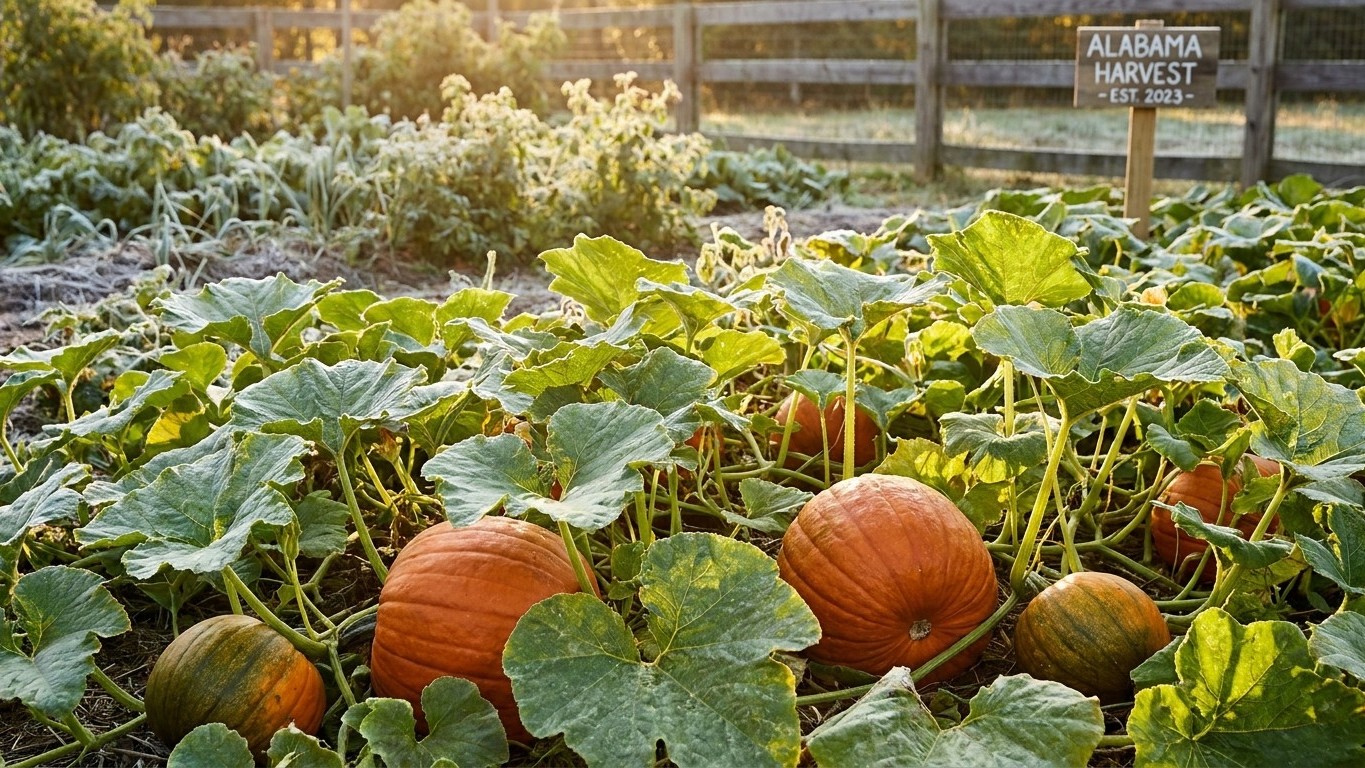

Yes, most years, if the flowers open by early September. Illinois’ first fall frost typically lands between October 24 and November 3, and a pumpkin needs 45 to 55 days from the day its flower opens to reach full color and a hardened rind. That leaves a workable but unforgiving window for sowing, one that shifts depending on which corner of the state you garden in and how quickly your soil warms each spring.
The short answer
Start with the frost date, because everything else in the pumpkin patch works backward from it. According to NOAA NCEI’s 1991-2020 Climate Normals, the reference station used for this calculation sees its first fall freeze somewhere between October 24 and November 3. That’s not a single day on a calendar you can circle. It’s a range, and your own yard could land anywhere inside it, or outside it, depending on how it sits relative to that airport station.
Now subtract the maturation window. Utah State University Extension puts pumpkin development at 45 to 55 days measured from flowering, not from the day the seed goes in the ground. Run the math on both ends of the frost range and both ends of the maturation range, and you get a spread rather than one tidy answer. Using the earliest frost date (October 24) paired with the longer 55-day maturation period, a flower needs to open by around August 30. Using the latest frost date (November 3) paired with the shorter 45-day period, a flower opening as late as September 19 could still finish in time. So the real cutoff for flowering, statewide, falls somewhere between August 30 and September 19.
That’s a three-week swing, and it matters. A grower whose vines start setting flowers in mid-August has plenty of margin. A grower whose first blooms don’t show until the last week of September is gambling on the late end of the frost window, and a cold snap arriving on schedule (or early) will catch green fruit that never colors up.
Keep in mind the frost dates above come from one weather station, not from every county in the state. Suburban yards and low-lying rural gardens tend to see their first fall frost earlier than an airport reading, sometimes by a week or two, and gardens sitting in a frost pocket or at higher ground can see it earlier still. If your property has a history of early cold snaps, treat September 19 as wishful thinking and aim for flowers opening closer to that August 30 mark instead. The safest approach is to track when your own vines actually start flowering, count forward 45 to 55 days, and compare that projected ripening date against your own garden’s typical first frost, not the airport’s.
When to sow here
Sowing date is where a lot of the flowering-window math gets decided, and it hinges on soil temperature, not air temperature. Utah State University Extension recommends waiting until soil reaches 65 F before putting pumpkin seed in the ground. That threshold has nothing to do with the last spring frost date, and treating them as the same thing is the most common timing mistake in the whole process.
- Let the last spring frost pass first. For this region that typically falls between April 11 and April 22. Air temperature clearing freezing range is the first checkpoint, not the finish line.
- Wait for the soil, not the calendar. Soil lags behind air temperature by weeks, since dirt holds cold longer than the atmosphere does. A yard that clears its last frost in mid-April may not see 65 F soil at a 2-inch planting depth until well into May.
- Check with a soil thermometer rather than guessing. Push it into the bed where seeds will go, take a morning reading, and don’t sow until it holds 65 F for several consecutive days.
- Use row covers or dark mulch to speed things along. Warming the bed ahead of planting with row cover or black plastic can effectively buy about two weeks, letting you hit that 65 F mark sooner than bare soil would on its own.
- Count forward from your actual sowing date. Once seed goes in around 65 F soil, track the calendar toward flowering, and compare that against the August 30 to September 19 flowering cutoff worked out above. If the math looks tight, the row-cover head start is what closes the gap.
The takeaway: a late last-frost date doesn’t automatically push your sowing date later by the same amount. Soil temperature is its own clock, and in a cool, wet spring it can run weeks behind what the frost calendar suggests.
What goes wrong here
- A late flower that never colors. Fruit that sets from a bloom opening after mid-September is racing a 45-to-55-day clock against a frost date that could arrive as early as October 24. The remedy is sowing as soon as soil legitimately hits 65 F, using row cover to get there faster, and choosing seed known locally for setting flowers early rather than late.
- A fruit caught by frost before the rind hardens. Even a fruit with good color can still have a soft rind if frost lands early in the window. Utah State University Extension’s guidance is to harvest with the stem attached before frost hits, rather than leaving fruit on the vine hoping for a few more warm days that may not come.
- A vine that collapses before the pumpkin finishes. Foliage stressed by disease, drought, or squash bugs can die back weeks before the fruit is ready, leaving pumpkins exposed and stalled mid-ripening. Watching vine health through late summer matters as much as watching the calendar. For pest identification and control, see this site’s pages on squash bugs and cucumber beetles, both of which can weaken vines during this exact stretch.
- Harvesting too early out of frost anxiety. Pulling fruit ahead of the 45-to-55-day mark just because a cold night is forecast can end the same way as waiting too long, with a pumpkin that’s sized up but under-ripe. If a light frost threat appears before fruit is ready, cover vines overnight rather than harvesting prematurely.
- Storing ripe pumpkins somewhere they still freeze. Utah State University Extension’s guidance on this point is limited to keeping harvested fruit “where they will not freeze,” without a published temperature or humidity target, so an unheated porch or garage that dips below freezing overnight defeats the purpose of getting the fruit off the vine in time.
Common questions
Can I still get a ripe pumpkin if my flowers didn’t open until late September?
It’s possible if your local first frost lands on the later end of the October 24 to November 3 range and your fruit set from an early-blooming flower rather than a late one, but it’s a tight margin. Cold nights arriving on the early side of that window will likely catch the fruit green.
Does starting seeds indoors help beat the frost math?
The 45-to-55-day clock starts at flowering, not at germination, so an indoor head start only helps if it gets the plant to bloom earlier outdoors, which usually means getting transplants into 65 F soil as soon as that threshold is reached rather than rushing them out into still-cold ground.
What if a frost warning comes before my pumpkins finish coloring?
Cover vines overnight with blankets or row cover rather than harvesting early. A single light frost on foliage isn’t the same as the hard freeze that ends the season, though once real cold sets in, fruit still attached to a stem should come off the vine.
Is soil temperature really more important than the last frost date?
For sowing, yes. The 65 F soil threshold from Utah State University Extension is the actual planting trigger, and it consistently arrives later than the last spring frost since soil warms slower than air. Treating the frost date as your green light to sow is the most common way gardeners end up sowing into soil that’s still too cold.