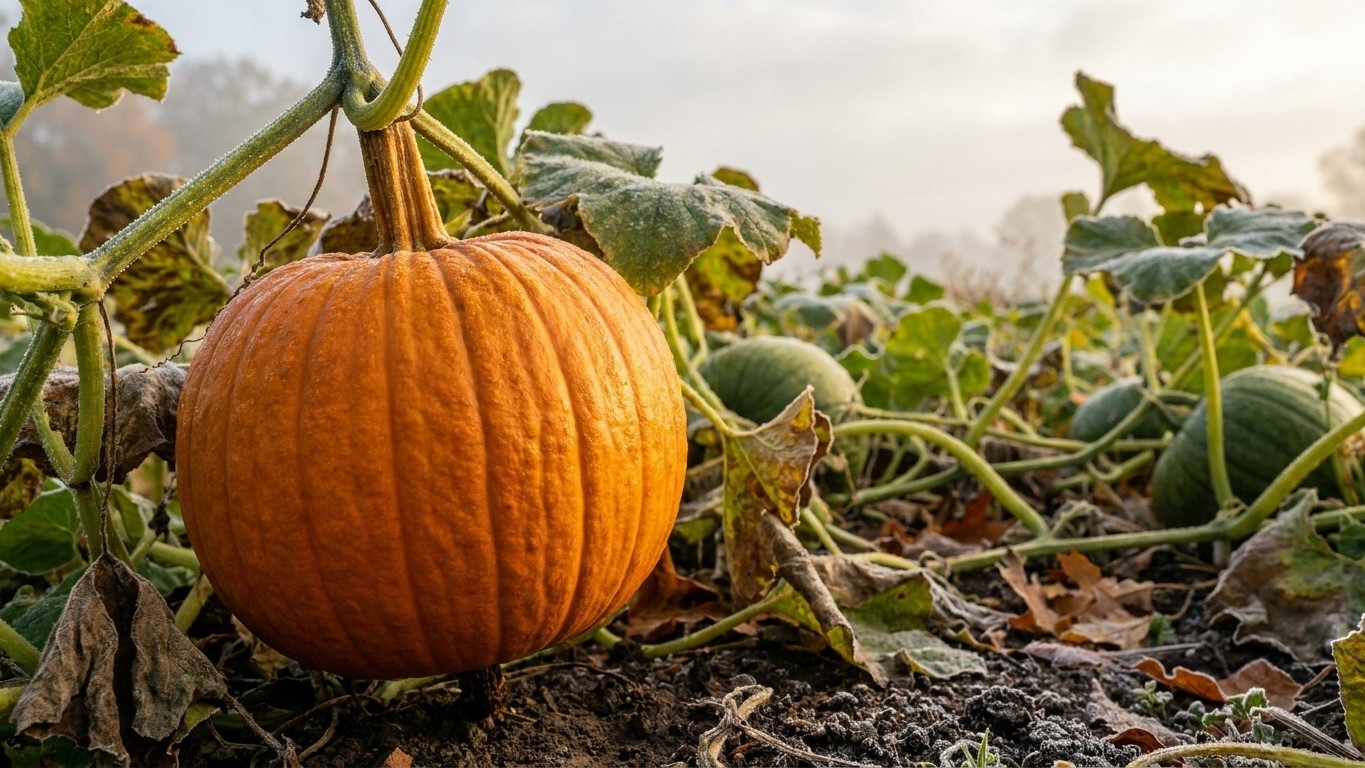

Yes, but the finish line matters more than the start line. In Illinois, a pumpkin’s fate gets decided by the day its flower opens, not the day you drop the seed in the ground. Line that flowering date up against the first fall frost, and you’ll know within a couple of weeks whether your pumpkin turns orange in the patch or gets hauled inside green ahead of a hard freeze.
The short answer
Start with the frost, because that’s the fixed point. Across the Illinois reference station tracked by NOAA’s National Centers for Environmental Information, the first fall freeze arrives somewhere between October 24 and November 3, based on the 1991-2020 Climate Normals. That’s a ten-day window, not a single date, and it’s the wall every pumpkin vine in the state is racing toward, which is exactly why the question of Will Pumpkins Ripen Before Frost in Illinois? comes down to timing rather than luck.
Now work backward. Utah State University Extension’s guidance on pumpkin timing puts the maturation period at 45 to 55 days after flowering, not after seeding, not after transplanting. That distinction changes everything about how you plan a season. Two vines planted on the same day can flower two or three weeks apart depending on heat, moisture stress, and how many male flowers show up before the females do. The clock that actually matters starts when a female flower opens and gets pollinated, not when the packet says “days to maturity.”
Run the math against both ends of the frost window and both ends of the maturation range, and you get a band rather than a date. Using the earliest frost (October 24) and the longer 55-day maturation, the last safe flowering falls around the end of August. Using the latest frost (November 3) and the shorter 45-day maturation, a flower opening as late as mid-September could still finish. That’s the honest range: somewhere between the final days of August and roughly the middle of September, a pumpkin flower in Illinois either has enough runway left, or it doesn’t.
The wider the gap you leave between your actual flowering date and the earliest end of that frost window, the more insurance you’re carrying. A flower that opens in the first half of August is coasting. A flower that opens in the third week of September is gambling on the later, milder end of the frost window holding, and on the vine staying healthy enough to finish the job. Neither the frost data nor the maturation figures come with a promise; they come with a range, and the safest gardening decision is to plan for the early side of both.
When to sow here
Here’s where a lot of Illinois gardeners get the arithmetic backward, and getting When to Sow Pumpkins in Illinois right depends on more than just the calendar. The last spring frost at the reference station falls between April 11 and April 22, but that date tells you almost nothing about when to sow pumpkin seed. Air temperature and soil temperature don’t move together. Bare ground in central Illinois can still sit in the 40s and 50s for weeks after the air stops threatening frost, and pumpkin seed sown into cold, wet soil is far more likely to rot than to sprout. Utah State University Extension’s baseline for sowing pumpkins is soil at 65°F, measured at planting depth, not the calendar and not the thermometer on the porch.
- Treat the April 11-22 frost window as the earliest possible marker on your calendar, never as the sowing date itself.
- Expect the soil to lag behind the air by several weeks. A morning that feels warm enough for short sleeves can still sit over ground too cold for pumpkin seed to germinate reliably.
- Check soil temperature directly with a probe thermometer pushed to about two inches deep, rather than guessing from the forecast.
- Sow once the soil holds at 65°F for several consecutive days, not just a single warm afternoon.
- To move that date earlier, lay row cover or dark plastic mulch over the bed roughly two weeks ahead of your expected soil-ready date. Covered soil traps heat and typically buys back about two weeks compared with bare, uncovered ground.
- Whatever variety lands in the ground, whether it’s Jack Be Little, Connecticut Field, Baby Bear, Casper, Lumina, Cinderella, Autumn Gold, Wolf, or Rock Star, the 65°F soil threshold comes first. The 45-to-55-day flowering clock doesn’t start until well after that.
Skipping straight from “frost is over” to “seed goes in the ground” is the single most common miscalculation in this whole process. The frost date protects the seedling from a killing cold snap. The soil temperature determines whether the seed grows at all.
What goes wrong here
- A flower opens too late in the season. If pollination happens after that early-to-mid-September cutoff, the fruit may swell but never fully color before frost cuts the vine down. The remedy is tracking bloom dates through the season and, if a patch is clearly running late, accepting that some fruit will finish as decorative green pumpkins rather than jack-o’-lantern orange ones.
- A nearly finished pumpkin gets caught by an early frost. Because the fall frost window opens as early as October 24, a fruit that’s colored but still soft can get nipped before the rind hardens. Watch the extended forecast in the back half of October and harvest early, with the stem attached, rather than betting on the later end of the frost window.
- The vine dies back before the skin hardens. Powdery mildew, drought stress, or a hard early frost on the foliage can kill the leaves while the fruit is still soft-skinned. Once the vine is gone, the pumpkin stops developing. Keeping the vine healthy as long as possible, through even watering and disease management, buys the fruit the last bit of curing time it needs.
- Pests weaken the vine before the fruit finishes. Squash bugs and cucumber beetles are common causes of early vine collapse in Illinois pumpkin patches, and both already have dedicated coverage on this site. See the state pages on squash bugs in Illinois and cucumber beetles in Illinois for identification and management specific to this state.
Checking this against your own county
Every figure above comes from a single airport weather station, and suburban and rural gardens routinely see the last spring frost later and the first fall frost earlier than that station records, sometimes by one to two weeks, more if the garden sits at higher elevation or in a low frost pocket. That gap can be the difference between a pumpkin that finishes and one that doesn’t.
Before locking in a sowing date or a “safe” flowering cutoff for your own yard, check with the University of Illinois Extension. Local extension offices track frost patterns and planting windows at the county level, which is a far better match for your actual soil and microclimate than any statewide average.
Common questions
Can I still get a ripe pumpkin if my vine flowers in late September?
It’s a long shot in most of Illinois. Even at the shorter end of the 45-day maturation window and the latest end of the frost range, late September flowering leaves very little margin. Expect some fruit to finish green rather than fully colored.
Does a light frost kill the vine outright?
The facts referenced here don’t publish a separate light-frost threshold, only the first fall freeze window itself. Treat any frost risk in that October 24 to November 3 window as a reason to check the patch, rather than assuming the vine will bounce back.
Should I harvest pumpkins before the first frost, just in case?
If the fruit is already colored and the stem is starting to dry, harvesting a few days early with the stem attached is safer than risking a freeze catching a nearly finished pumpkin still on the vine.
How long will an Illinois-grown pumpkin store after harvest?
Utah State University Extension’s guidance doesn’t publish a specific storage temperature or keeping time for this crop, only that pumpkins should be kept somewhere they won’t freeze. Beyond that, no verified figure is available here.