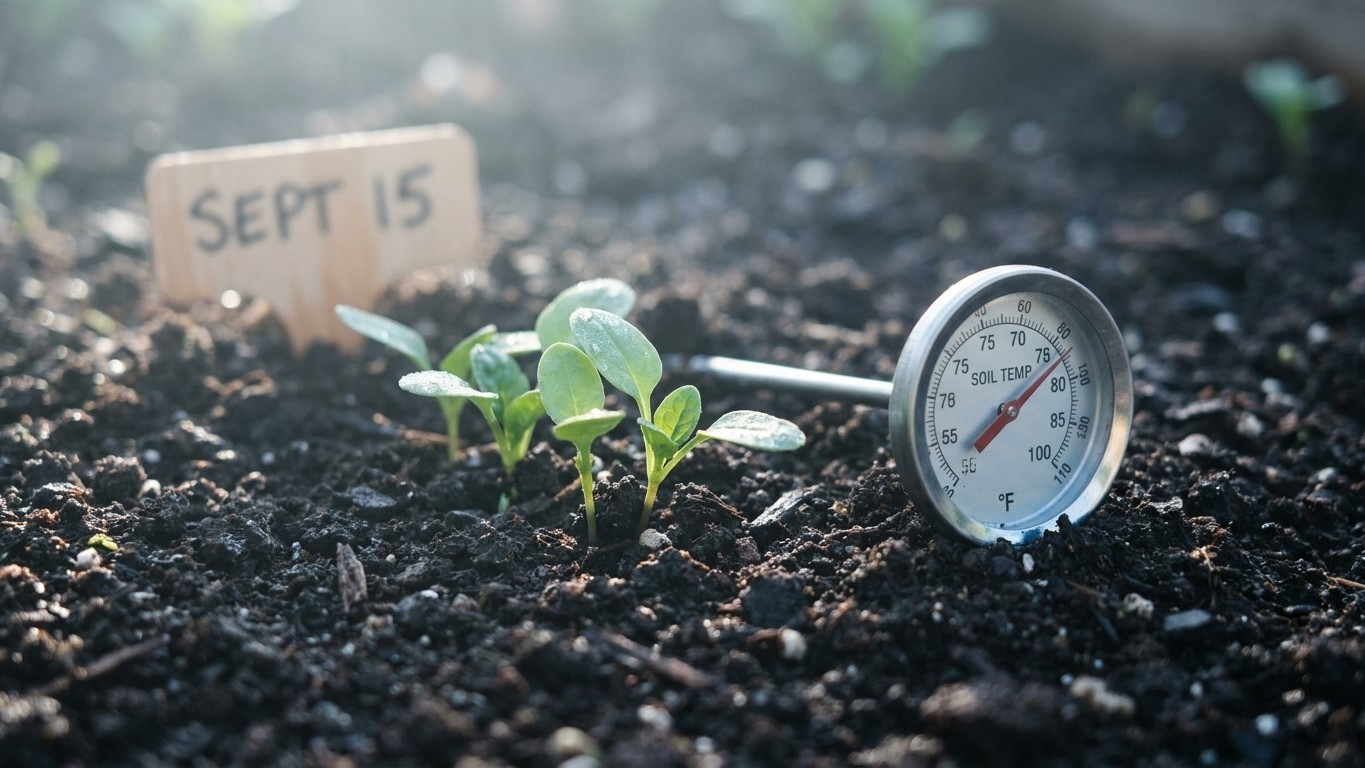

Illinois gardeners get one real shot at fall spinach: seed goes in from mid-August through mid-September, timed to soil that has finally cooled below the germination ceiling and to a harvest that lands before the first hard frost. Miss that window either direction and the crop either refuses to sprout or runs out of season.
The short answer
Chicago sits at a latitude where the longest day of the year holds 15 hours and 4 minutes of daylight. That number matters more than most gardeners expect, because spinach bolts under long days and warm temperatures together, not under heat alone. A cool summer here does not buy extra weeks of harvest the way it might for a crop that only cares about temperature. Once the days stretch past a certain length, the plant starts pushing up a flower stalk no matter how mild the afternoons feel.
So what actually limits the spinach season in Illinois? Both day length and heat, and they hit at different points in the year. In late spring and early summer, the long days do the damage first, often before the thermometer even gets extreme. Then summer heat piles on: the reference station averages 14.0 days a year at 90 F or above, and spinach growth stops being good anywhere above 75 F. That 75 F line is not just a growth ceiling, it is also the point where the leaves start turning bitter, so the plant is punishing you twice for the same stretch of warm weather.
That combination is exactly why Illinois gardeners split spinach into two separate crops instead of one long season. Spring spinach has to race the calendar before days lengthen and heat arrives. Fall spinach waits for the opposite conditions: shortening days and cooling soil. The catch with fall sowing is that the soil takes its time releasing summer heat. Spinach seed germinates poorly once soil temperature climbs above 80 F, and August soil in Illinois is routinely well past that mark. That is the real gatekeeper for autumn sowing, not the calendar page, not the air temperature, and not the first cool morning. It is soil temperature, full stop.
Put together, the practical answer for most Illinois gardens is to start watching soil temperature in mid-August, sow as soon as it drops back under 80 F, and keep sowing in succession through about mid-September. Wait much longer than that and there is not enough runway left before the first frost arrives to bring a crop to harvest size.
How long the spring window really is
Working out the spring spinach window in Illinois takes a few steps, but each one is straightforward once you have the two limiting numbers in hand: the last spring frost date and the 75 F growth ceiling.
- Start with the frost date. At the reference station, the last spring frost falls somewhere between April 11 and April 22, though suburban and rural gardens away from the airport station often see frost linger one to two weeks longer, so a county check is worth doing before committing seed to the ground.
- Move the sowing date earlier. Spinach seed goes in 2 to 3 weeks before that last frost date, which places the earliest sowing somewhere around late March to the first days of April for most of the state, and a bit later for gardens that run consistently colder than the airport reference point.
- Mark the point where growth stops being good. That happens once daytime temperatures settle above 75 F, and with 14.0 days a year reaching 90 F or higher at the reference station, that ceiling typically gets crossed for good sometime in late May to early June across much of Illinois.
- Add it up. That leaves a usable spring window of roughly eight to ten weeks between the earliest safe sowing and the point where heat and lengthening days push the crop toward bolting and bitterness.
- Treat the window as a moving target. Because both frost timing and heat arrival shift year to year and county to county, the safest approach is to sow in succession every couple of weeks through that window rather than betting everything on a single sowing date.
The autumn crop, and when the soil lets you sow
Fall spinach flips the spring problem around. Instead of racing lengthening days and rising heat, the gardener is waiting out the tail end of summer heat while racing the calendar toward the first freeze. Two separate obstacles control the sowing date, and they sit at opposite ends of the season.
Soil still too warm to germinate
Spinach seed struggles once soil temperature climbs above 80 F, and Illinois soil in early and mid-August is very often sitting right at or above that line, especially in a year that has already logged its share of 90 F days. This is the reason fall spinach cannot simply be sown the moment summer heat starts to feel like it is breaking. The soil itself needs to cool, and that cooling tends to lag noticeably behind the first comfortable evening. Checking soil temperature directly, rather than guessing from air temperature, is the only reliable way to know the fall window has actually opened.
The frost that ends the season
At the other end, the first fall frost at the reference station arrives somewhere between October 24 and November 3, though again, gardens outside the immediate Chicago station footprint often see that first frost show up one to two weeks earlier. Working backward from that date using the published guidance of sowing 50 to 75 days before the desired harvest gives a sowing window that starts around August 10 to August 20 on the early end, and stretches to about September 4 to September 14 on the late end, depending on which frost date and which harvest target a gardener is planning around.
Splitting the difference between the warm-soil constraint and the frost countdown, most Illinois gardens land on a realistic fall sowing window from roughly mid-to-late August through mid-September. Sowing in succession across that stretch, rather than all at once, spreads the harvest and hedges against a soil that cools later than expected or a frost that arrives earlier than the reference dates suggest.
Several spinach varieties commonly grown in home gardens, including Bloomsdale, Melody, Teton, and Olympia, are worth knowing by name if you are comparing seed packets, but no maturity data or performance figures for any of these four are published in the sources behind this guide, so treat variety choice as a separate decision from the timing questions covered here.
Common questions
Can I sow fall spinach in early August in Illinois?
Usually not successfully. Soil temperature in early August is typically still above the 80 F point where spinach germination drops off, so seed sown that early often fails to come up reliably even though there is technically enough time before frost.
Does a cooler-than-average summer extend the spring spinach harvest?
Not on its own. Bolting in spinach is triggered by long days as well as by warmth, so even a mild summer will not stop the plant from flowering once the days reach the length that triggers it.
What happens if I sow fall spinach too late in September?
The plants may not reach harvestable size before the first fall frost arrives, since the source guidance calls for 50 to 75 days between sowing and the intended harvest date, and Illinois gardens typically see that first frost between October 24 and November 3, sometimes earlier away from the reference station.
Should I trust the exact frost dates for my whole county?
Treat them as a starting point rather than a guarantee. The last spring frost and first fall frost figures come from a single reference weather station, and suburban and rural gardens, along with any location at higher elevation, commonly see frost arrive later in spring and earlier in fall than that station records.