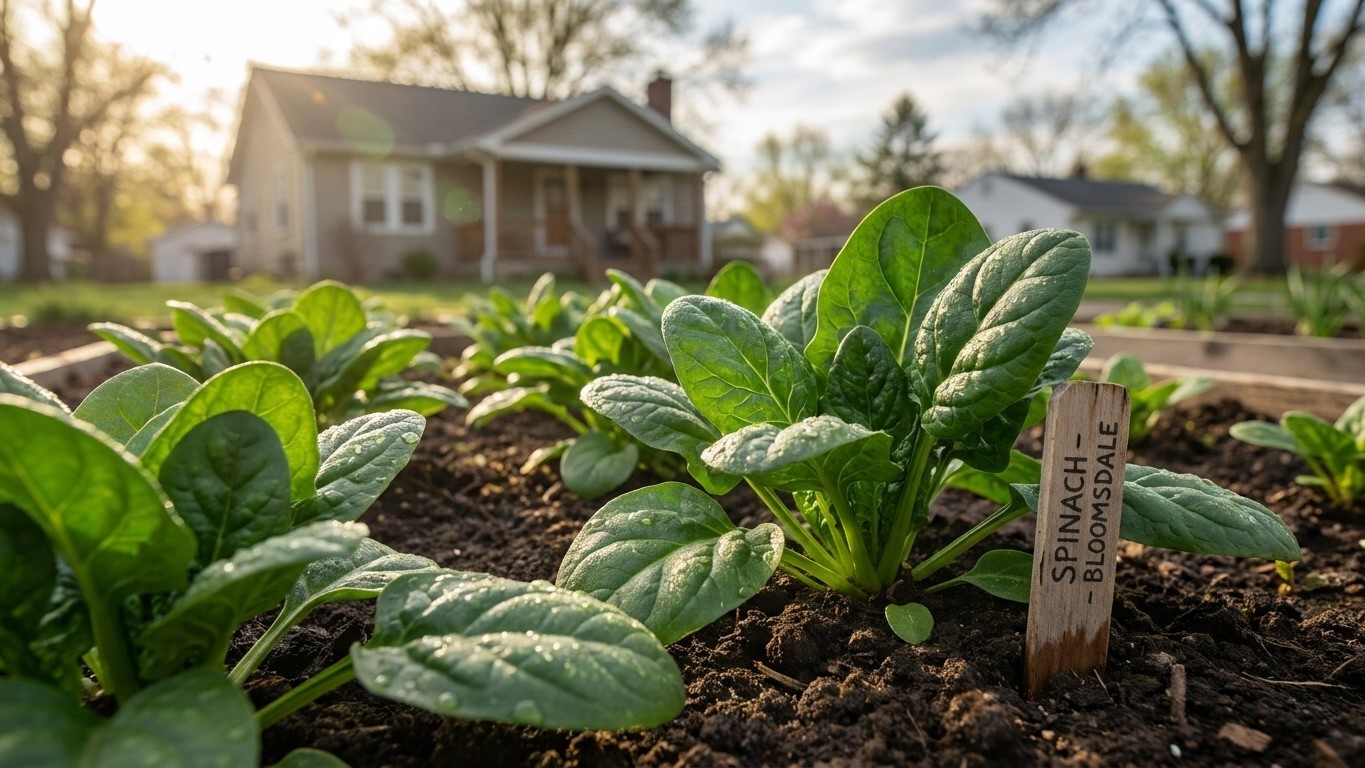

Spring-sown spinach in Illinois generally bolts by late May or the first half of June, once daylight climbs past 15 hours near the solstice and afternoon highs start pushing past the mid-70s. Nothing about a mild June changes that calculus much. The practical response isn’t fighting the trigger, it’s sowing early enough to harvest ahead of it, then planning a second, autumn round timed off the season’s first hard frost instead of the summer heat—see When to Sow Autumn Spinach in Illinois for that timing.
The short answer
On the longest day of the year, the Chicago area sees 15 hours and 4 minutes of daylight. That number matters more than most gardeners assume, because spinach doesn’t wait for a heat wave to flower. Long days alone are enough to flip the plant from leaf production into seed production, a response called bolting. A cool, cloudy June in northern Illinois does nothing to postpone this. The day length is doing the work regardless of what the thermometer reads that afternoon.
Layered on top of that is the heat itself. Spinach grows best where temperatures stay under 75 F, and above that ceiling the leaves turn bitter even before the plant sends up a seed stalk. Illinois summers don’t spare this crop on that front either: the Chicago reference station averages 14.0 days a year at 90 F or hotter. That’s not the whole growing season overheating, but it’s enough heat load, arriving right as day length peaks, to make the two triggers land close together.
So the honest answer is both, and it’s worth asking directly, Will Spinach Bolt Early in Illinois? Day length sets the outer limit on how late into early summer spinach can be grown here, and the accompanying heat load makes sure that limit gets hit hard rather than gently. A gardener in a shadier microclimate or at a slightly higher elevation might buy a few extra days, but nobody in Illinois is buying extra weeks. The 75 F ceiling and the 15-hour-plus daylight aren’t working against each other; they arrive together, which is exactly why the spring spinach season here is short and the fall season exists as a separate opportunity rather than an extension of the first.
Understanding which trigger is which also explains why some gardening advice sounds contradictory. Recommendations written for warmer, shorter-day regions sometimes suggest pushing spinach later into the season. That doesn’t transfer here. In Illinois, the day-length clock and the heat clock are set to nearly the same alarm, and once either one goes off, the plant is going to seed whether you’re ready for it or not.
How long the spring window really is
- Start with the frost date. The 1991-2020 NOAA climate normals put the last spring freeze at the Chicago reference station between April 11 and April 22. That’s the anchor point for everything that follows.
- Move the sowing date earlier. Spinach seed goes in the ground 2 to 3 weeks before that last frost, meaning a sowing window that runs roughly from late March into the first days of April, since the crop tolerates cold soil far better than heat.
- Count the weeks of good growth. From that late-March or early-April sowing, spinach keeps growing well as long as conditions stay under the 75 F ceiling and before day length crosses the bolting threshold, which in practice covers most of April and May.
- Watch for the overlap point. By late May, day length in Illinois is already well past 14 hours and climbing toward that 15-hour-plus peak, and afternoon highs are increasingly likely to clear 75 F. That’s the point where the crop stops being reliable.
- Total window. Sowing in late March to early April and expecting bolting risk to rise sharply by late May to mid-June leaves roughly 8 to 10 weeks of usable spring growing time in a typical year here.
One honest gap: Utah State University Extension, the source behind these thresholds, names four spinach varieties, Bloomsdale, Melody, Teton, and Olympia, but publishes no days-to-maturity figures for any of them. There’s no seed-company countdown to lean on here. Gardeners are better off watching leaf size and the calendar pressure described above than counting days from a packet.
The autumn crop, and when the soil lets you sow
A fall spinach crop sidesteps the day-length problem entirely, since days are shortening rather than lengthening as autumn approaches. But two separate obstacles still bracket the window, and they aren’t the ones people expect.
Soil still too warm to germinate
Spinach seed germinates poorly once soil temperature climbs above 80 F, and Illinois soil holds summer heat well into August. This is a warm-soil problem, not a cold one. A gardener who sows in early August, right when the calendar says “fall garden,” may find seed sitting in soil that’s still too hot to sprout well. Waiting until soil temperature has actually dropped, rather than going by the date alone, matters more here than in most spring plantings.
The frost that ends the season
The first fall frost at the Chicago reference station arrives between October 24 and November 3. Utah State University Extension’s guidance for a fall crop is to sow 50 to 75 days before the date you want to harvest. Counting back from that frost window puts the sowing date somewhere between mid-August and mid-September, depending on whether the goal is a 50-day quick harvest or a fuller 75-day crop, and depending on which end of the frost window a given year lands on.
That leaves a workable but narrow slot: sow once soil has cooled from summer’s peak, but early enough that 50 to 75 days still lands before frost shuts things down. In practice, most Illinois gardeners aiming for a fall spinach harvest are sowing in late August, splitting the difference between the two obstacles rather than chasing the earliest or latest edge of the window.
Checking this against your own county
Every figure above comes from a single reference station, and frost dates in particular shift with geography. Suburban and rural gardens typically see the last spring frost arrive later and the first fall frost arrive earlier than the reference-station dates, sometimes by one to two weeks, and more at higher elevation or in low-lying frost pockets. That shrinks both the spring and fall spinach windows compared to what’s laid out here.
The reliable next step is a local check rather than a statewide assumption. University of Illinois Extension maintains county-level offices across the state and can confirm local frost timing and soil conditions specific to a given garden, which matters more for a short-season crop like spinach than for almost anything else grown in an Illinois backyard.
Common questions
Can shade cloth stop spinach from bolting in Illinois?
Shade cloth can lower soil and air temperature somewhat, which helps against the 75 F heat ceiling, but it does nothing about day length. Since long days alone trigger flowering, shade buys some relief but won’t prevent bolting once daylight itself has crossed the threshold.
Is fall-sown spinach less likely to bolt than spring-sown spinach?
Yes, because days are shortening through a fall crop’s growth period rather than lengthening. The main risks shift instead to warm soil blocking germination early on and frost ending the season before harvest.
Why do spinach varieties matter if there’s no days-to-maturity data?
Utah State University Extension names Bloomsdale, Melody, Teton, and Olympia as spinach varieties without publishing comparative data on any of them. Without a published maturity figure, timing decisions have to rest on the sowing and frost windows described above rather than on a variety-specific countdown.
What’s the practical difference between the spring and fall spinach seasons in Illinois?
Spring spinach is capped by rising day length and heat arriving together in late May and June. Fall spinach avoids the day-length trigger but has to be sown after soil cools below 80 F and still early enough, 50 to 75 days, to mature before frost between October 24 and November 3.