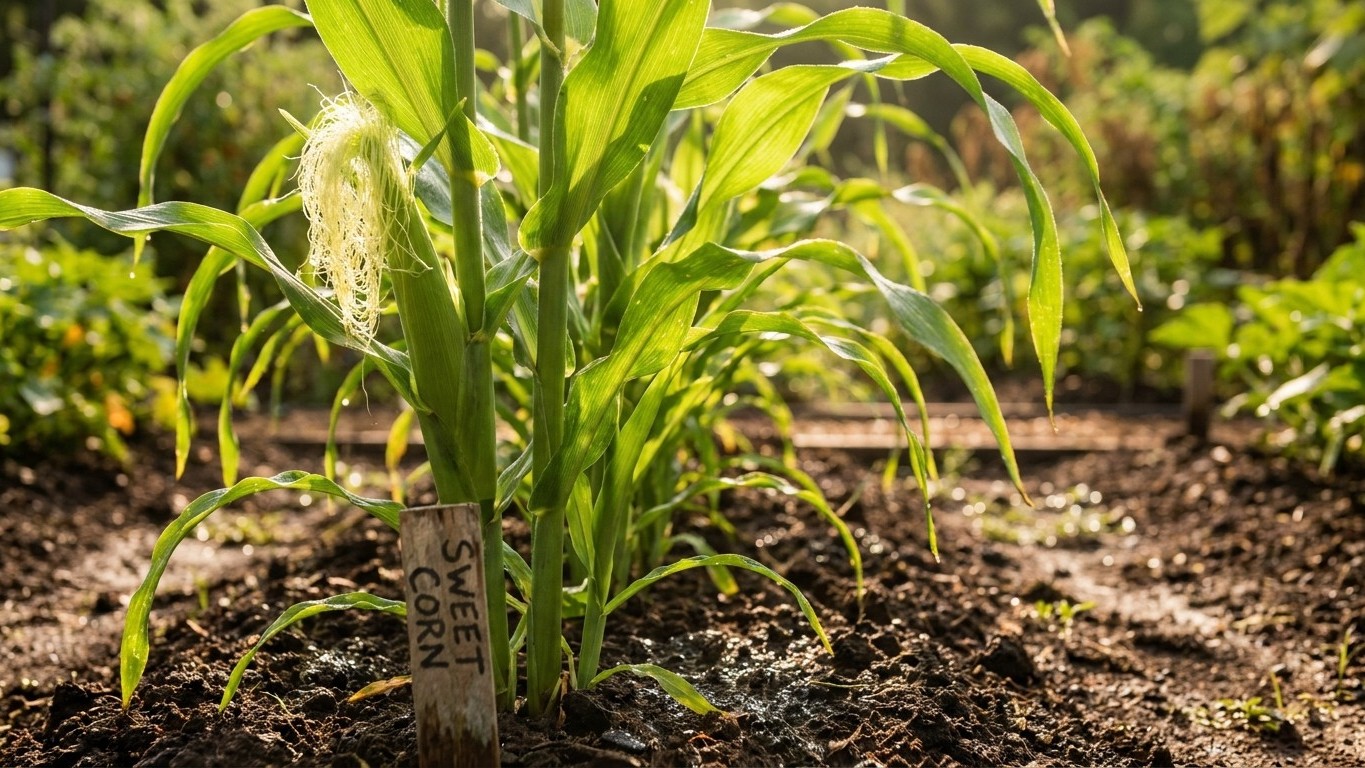

Yes, sweet corn ripens reliably in Illinois. The state’s frost-free stretch runs long enough for even a slow-maturing variety, provided the soil has actually warmed before you plant. The catch isn’t the calendar’s edges, it’s the gap between when the last frost clears and when the ground is truly ready for corn seed.
The short answer
Start with the number gardeners usually skip: soil temperature, not air temperature. Sweet corn seed won’t germinate reliably until the soil sits above 60°F, and that threshold arrives well after the last spring frost has passed, not on the same day. Around Chicago, the reference station used for climate normals shows the last spring frost falling between April 11 and April 22. Soil doesn’t jump to planting temperature the moment that frost date passes. It takes weeks of warming sun and longer daylight before the top few inches of a garden bed hold steady heat, so count on 60°F soil arriving sometime in May for most Illinois gardens, not in April.
On the other end of the season, the first fall frost at that same reference station lands between October 24 and November 3. That gives a working window from mid-spring soil warm-up to autumn’s first freeze that stretches close to five months. Sweet corn needs 60 to 90 days from planting to harvest, depending on the variety. Stack that against a window this wide and the math is forgiving: even the slowest 90-day type has room to spare, with weeks of cushion left over on both ends.
Heat load matters too, though it works differently than the frost dates do. The same reference station averages 14.0 days a year at 90°F or hotter. That’s not a threat to the season’s length, but it does affect pollination. Sweet corn tassels and silks are sensitive to extreme heat spells, and a run of 90-degree days right when a planting is trying to pollinate can thin out the kernel set on the ear even though the plant itself is perfectly healthy. Timing plantings to avoid peak heat during silking is worth more thought than worrying about whether the season is long enough.
One more caution before assuming this applies everywhere in the state: these frost dates come from a single airport weather station. Suburban yards and rural gardens away from that station typically see the last spring frost arrive later and the first fall frost arrive earlier, sometimes by one to two weeks, more if the garden sits at higher elevation or in a low spot that collects cold air. Treat the dates above as a starting reference, then check your own county’s typical pattern before locking in a planting date.
Does a late variety fit here?
With a season window running roughly from mid-May soil warm-up to late October or early November frost, the question isn’t whether corn fits at all, it’s whether a longer-season variety still leaves enough margin for a rough spring or an early fall cold snap.
A 60-day variety
A fast-maturing sweet corn planted once the soil holds steady at 60°F, call that a mid-May start for a typical Illinois garden, would be ready to pick somewhere in the second week of July. That leaves the entire rest of summer and all of early fall as open cushion. A 60-day type is the safest bet for anyone who wants an early harvest, wants to plant a second succession crop later in summer, or gardens somewhere on the cooler edge of the state where spring soil warms even later than the reference dates suggest.
A 90-day variety
A slower variety planted at that same mid-May window would mature around mid-August. Measured against a first fall frost landing between October 24 and November 3, that still leaves roughly ten weeks of buffer, far more than the crop needs to finish filling out its ears and dry down properly. In plain terms: the late variety fits here. Illinois’s frost-free stretch is long enough that a 90-day sweet corn isn’t a gamble the way it would be in a state with a shorter growing season. The bigger risk with a 90-day type isn’t the calendar, it’s whether the planting date got pushed too late by a wet spring, which eats into that cushion fast.
| Variety type | Days to maturity | Typical harvest if planted mid-May | Cushion before first fall frost |
|---|---|---|---|
| Fast (60-day) | 60 days | Early-to-mid July | Very wide, room for a second planting |
| Slow (90-day) | 90 days | Mid-August | About ten weeks, comfortable margin |
What goes wrong here
- Soil sown too cold. Planting right after the last frost date, rather than waiting for the soil itself to hold 60°F, is the most common failure in this climate. Cold, wet soil rots seed before it germinates or produces a thin, uneven stand. The remedy is patience: check soil temperature directly with a soil thermometer rather than trusting the frost date alone, and wait until it holds 60°F for a few consecutive days.
- A variety pushed too late in the season. The 90-day type fits Illinois’s frost window comfortably when planted on time, but a late spring, a delayed succession planting, or a second sowing attempted too far into summer can eat through that cushion fast. The remedy is to count backward from the typical first fall frost for your specific area, not the reference station, and make sure the maturity days plus a safety margin still lands before that date.
- Sweetness lost to cross-pollination, and this one has nothing to do with weather. Standard (su), sugary-enhanced (se), and supersweet (sh2) types will cross if their tassels shed pollen at the same time nearby, and the result is starchy, disappointing ears regardless of how well the season treated the plants. There’s no published isolation distance to lean on here; the fix is timing and layout, not feet of separation. Stagger planting dates so different types don’t tassel together, or plant only one type per season if the garden is small. Sweet corn also needs to go in blocks of three or more rows rather than a single long row, since that block shape is what allows wind-blown pollen to reach enough ears for full kernel fill.
Common questions
How do I know when to pick, once the plant is growing well?
Look for three signs together: the silks have turned dry and brown, the husks are still moist and green, and juice from a punctured kernel runs milky rather than clear or doughy. Any one sign alone isn’t enough to judge ripeness.
Is the 60-to-90-day maturity window the same as the harvest window after silks appear?
No, and mixing these up causes a lot of confusion. The 60-to-90-day figure counts from planting and tells you whether the crop fits the season at all. A separate count, roughly 17 to 24 days from when silks first emerge, tells you which week to actually start checking ears for ripeness.
Can I plant two different sweet corn types in the same small garden?
Yes, but only if their tasseling doesn’t overlap. Choose varieties with different maturity days so one finishes tasseling well before the other starts, or grow just one type if the garden doesn’t have room to stagger plantings.
Does the frost date for my exact address match the reference station figures above?
Probably not exactly. Those dates come from one airport weather station, and gardens away from that site, especially in low-lying or rural spots, commonly see frost arrive earlier in fall and later in spring, sometimes by one to two weeks. Check local records or a county extension office for a closer estimate.