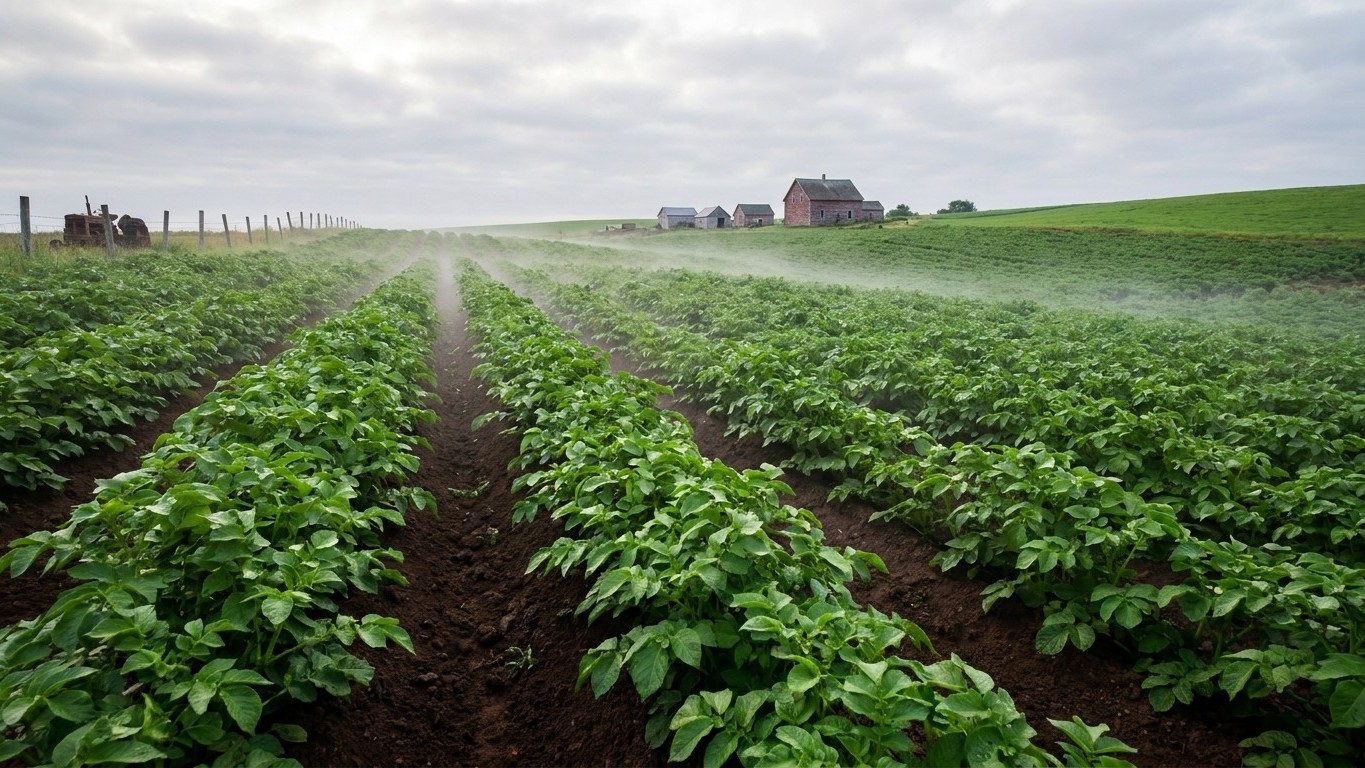

Illinois gardeners can grow sweet potatoes, but the calendar shortcut fails. The crop goes in when the soil is warm, weeks after the last frost, not on it. At the Chicago airport station the last spring freeze falls between April 11 and April 22, and the first fall freeze between October 24 and November 3. Between those dates sits a workable season, provided the slips go out late enough and the summer cooperates.
When the soil is warm enough in Illinois
The date most Illinois gardeners look up first is the last spring frost. For the reference city, NOAA’s 1991-2020 Climate Normals put it at April 11 to April 22, taken from the Chicago airport weather station (the 30-70% probability band for a 32 F freeze). That range is a probability, not a promise, and a late freeze after it is always possible. Suburban and rural gardens usually see the last frost one to two weeks later than an airport does, so check your own county rather than borrowing a city number.
Frost is a proxy, not the trigger
Here the frost date stops helping. Sweet potatoes do not wait for frost to end. They wait for warm soil, and soil warms after the frost risk has passed, not alongside it. Air can reach 60 F on a April afternoon while the ground under a bare bed is still cold enough to stall a transplant. A slip set into cold soil sits there, sulks and invites rot. Gardeners who plant on the frost date tend to meet this problem first.
So treat the frost range as the earliest you could begin thinking about planting, not the day you start. A soil thermometer pushed a few inches into the bed tells you more than any almanac, and your state extension service can give you the soil threshold and the planting window for your region. In practice that means several weeks past the frost range, later still in the northern counties, and later again if a cold, wet May keeps the beds soggy. Warm nights matter as much as warm days, so wait for a run of them rather than one lucky afternoon.
Not a potato, not a yam
Anyone who plants potatoes in cool April soil has learned the wrong lesson for this crop. Sweet potato is not a potato and not a nightshade. It belongs to the morning glory family, it loves heat where potatoes tolerate cool, and it does not rotate with potatoes or tomatoes in any meaningful way. The supermarket label “yam” is also wrong, since true yams are a different plant altogether and rarely sold in Illinois grocery stores.
The same logic applies to the type you choose. Some sweet potatoes are bred to size up in a shorter season and some are not, and that difference matters more the farther north you garden. This page does not name cultivars, because it cannot source which ones have been trialled where you live. The University of Illinois Extension, at extension.illinois.edu, is where that answer lives. How to start and handle the slips themselves is covered in Growing Sweet Potatoes: Slips, Heat, and a Careful Cure.
How long the season lasts here
Put the two frost ranges side by side and the arithmetic is simple. From the latest spring date (April 22) to the earliest fall date (October 24) is 185 days. From the earliest spring date (April 11) to the latest fall date (November 3) is 206 days. Both spans come from the same Chicago airport station and describe the reference city, not a guarantee for your yard.
Now subtract what the paper number hides. A suburban or rural garden that loses one to two weeks at each end could give up as much as four weeks of that window. And the frost-free stretch is not the growing stretch, because sweet potatoes cannot start until the soil is warm. The true working season begins well after April and ends before the first frost blackens the vines, so the practical window is shorter than any figure above. Roots also need time to swell after the vines take off, and a cold snap before digging can damage them in the ground.
What that window allows
Sweet potatoes are not sown from seed, so “succession sowing” means something different here. Slips can be set out in two rounds a couple of weeks apart to spread the harvest and hedge against a bad spell. The general method is in the succession sowing guide on this site. But a true second crop planted in midsummer is a gamble in Illinois, since it would be racing an October frost with a season it cannot count on. Treat the first planting as the crop and the second as insurance.
A tighter window also raises the stakes of the root check. Before transplanting, look at the base of each slip: white roots already forming mean it can take hold quickly, while a slip with none loses days in the ground that the season cannot spare. A slip held in water until roots appear costs a week at home and saves it in the bed. In a longer window that check is a nicety. Here, it matters.
Heat and water in Illinois
Sweet potatoes ask for accumulated warmth and warm nights, and days above 90 F are a rough stand-in for both. The Chicago reference station averages 14.0 days a year at or above 90 F, from NOAA’s 1991-2020 normals. That is a count at one station, not a description of the whole state. It is a modest number, and it says something plain: in the northern part of Illinois, this crop is not routine. It becomes a project of black plastic to warm the soil, raised ridges that drain and heat faster than flat ground, and an early type chosen for a short season.
The southern end of the state is another story. Illinois spans USDA hardiness zones 5a to 7b (USDA Plant Hardiness Zone Map 2023), though that system measures winter minimums, not summer heat, so it hints at the gap without measuring it. A gardener well south of Chicago likely has more heat than the reference station shows, and one in the northern counties has about what it shows. Compare your own numbers with your county extension office.
What a cool, damp summer brings
Where heat falls short, the crop does not simply grow slowly. A cool, wet stretch means slower ripening, fungal problems on leaves and vines, and root diseases that thrive in soggy beds. Michigan gardeners deal with the same northern-tier problem, and Growing Sweet Potatoes in Michigan covers how that plays out across the lake.
Rain that helps and rain that splits
Summer rainfall at the reference station averages about 12.1 inches across June, July and August, out of 37.9 inches for the year. Month by month it runs 4.1 inches in June, 3.71 in July (the driest) and 4.25 in August. On paper that is plenty. In the bed, it depends on the soil and how the rain arrives. A summer thunderstorm can drop an inch and mostly run off, especially after hot days bake the surface. Sandy ground lets rain through within a day and may still need watering every second day, while clay holds it for a week and can drown roots.
Steady moisture lets roots swell evenly, and long dry stretches followed by a soaking rain are what split them late in the season. These are normals from 1991-2020, not a forecast, and a rain gauge on your own plot will tell you more than any station.
Which sweet potatoes suit Illinois
Choose by type, and let the territory’s facts decide. A season that is short in the north favors the earliest-maturing types, the ones bred to size up before cool fall nights arrive. Summers with plenty of rain and humidity put disease resistance at the top of the list, because wet leaves and wet soil are where problems start. Where heat builds, as it does in the south of the state, a type with a spreading vine that shades the soil and lets air move through helps keep the roots from cooking or rotting. Compact, bush-habit types suit small beds and containers but still need warm soil.
Why this page names no varieties
Naming a cultivar would be easy and useless. The varieties that perform in a Chicago suburb are not necessarily the ones that do well in a downstate field, and this page has no local trial data. A name without a source is a guess. Ask the University of Illinois Extension which types have been trialled in your county, either through extension.illinois.edu or your county office. Their answer reflects real soil, real frost dates and real disease pressure. Gardeners in cooler places can compare the approach in Growing Sweet Potatoes in Oregon, where the same logic points at a different set of answers.
After the harvest
Digging comes before the first fall frost, which at the airport station arrives between October 24 and November 3 and earlier in many yards. After digging, roots are cured in warmth and then stored, and that is where good harvests get ruined. Never store sweet potatoes in a refrigerator or a cold cellar. Cold injury below the storage range is real and irreversible, and it is the most common way a home crop is lost after a good season. The details of curing are in the Growing Sweet Potatoes: Slips, Heat, and a Careful Cure guide.
Inspect every root before you eat it and again during storage. A soft patch or a weeping spot ends the question, and the root goes in the trash whatever it looked like a week ago. A root that looks sound is not proof that it is safe, and no keeping time can be promised.
Common questions
Can I plant sweet potatoes on the last frost date?
No. The Chicago airport range of April 11 to April 22 marks when hard freezes usually stop, not when the soil is warm enough. Wait for warm soil and warm nights, and check your county’s dates, since suburban and rural gardens often frost one to two weeks later.
Do I need black plastic in northern Illinois?
It often helps. With only 14.0 days a year at or above 90 F at the Chicago reference station, northern gardens are working with modest heat. Black plastic and raised ridges warm the soil and drain it, and both are worth trying alongside an early type.
Is a sweet potato a kind of yam or potato?
Neither. It is not a nightshade, it is not related to the potato, and it does not rotate with potatoes. Grocery stores often label sweet potatoes as yams, but true yams are a separate plant.
Can I store the harvest in the fridge or a cold cellar?
No. Cold injury is permanent and can ruin roots that looked perfect at harvest. Cure them warm, store them away from cold, and discard any root with a soft patch or a weeping spot.