
Plant Illinois root crops after the soil warms, not the day the frost date passes. At the Chicago reference station, the last spring freeze falls between April 11 and April 22, and the first fall freeze between October 24 and November 3. That leaves roughly six and a half months of growing time. Celeriac, kohlrabi, horseradish, turnips and Jerusalem artichokes all fit inside it, but each uses it differently.
When the soil is warm enough in Illinois
The reference window is April 11 to April 22. It comes from NOAA’s 1991-2020 Climate Normals for an airport weather station near Chicago, and it marks the band where the chance of another 32°F freeze sits between 30 and 70 percent. That is a probability, not a promise. Some years the last freeze arrives earlier, some years well after.
Gardens outside the city rarely match an airport. Suburban and rural plots typically see their last spring frost one to two weeks later, which can push the date into early May. Your University of Illinois Extension county office can tell you where your own ground falls.
Why the frost date is only a proxy
Roots do not care about air temperature at dawn. They care about the soil, and soil warms after the frost risk ends, not with it. A cold, wet seedbed in late April rots seed, stalls germination and, for celeriac and kohlrabi, can trigger a cold-induced rush to flower. A cheap soil thermometer pushed a few inches down in the morning is a better calendar than any date. Match the reading to the minimum germination temperature on the seed packet.
By type, the sequence runs like this. Hardy turnips and rutabagas go in first, as soon as the bed can be worked. Kohlrabi follows. Celeriac goes out as indoor-started transplants once frost danger has clearly passed. Horseradish pieces and Jerusalem artichoke tubers go in during spring, once the soil is workable.
Site Jerusalem artichoke before you plant it
This is the most regretted planting in a vegetable garden. Once established, Jerusalem artichoke is effectively permanent, because every fragment of tuber left in the ground regrows. Give it a corner you can afford to lose: a bed bounded by lawn you mow, a paved edge, or a deep container you accept will never be fully emptied. Keep it out of any bed you plan to rotate.
When you do plant, set whole tubers in spring and expect tall stalks. The tubers store inulin rather than starch, and in many people it causes digestive discomfort. Start with a small first portion to find out how you react.
How long the season lasts here
Count the days between the two reference dates. April 11 to October 24 is about 196 days. April 22 to November 3 is about 195. Pair the earliest spring date with the latest fall one and the window stretches to roughly 206 days. Pair the latest spring with the earliest fall and it shrinks to roughly 185. These are frost-free gaps at the Chicago reference station, and a rural garden can lose a couple of weeks at each end, so subtract with your own county in mind.
What does that length allow? A window this long allows a second sowing. Quick roots such as turnips and kohlrabi can go in once in spring and again in late summer for a fall crop, which often eats better than the spring one because it matures in cooling weather. The succession sowing guide on this site walks through spacing those sowings so you are not harvesting everything in one week.
The window also settles the transplanting question. Where a season is short, the first sowing is the only one, and a transplant that sulks for two weeks after a root check costs you the crop. Illinois is not that tight. Celeriac, kohlrabi and the cabbage-family roots tolerate transplanting, so starting them indoors buys a head start without much risk. Taproots are different. Parsnips and similar long roots resent disturbance, and with six months of room there is no reason to move them, so sow them where they will grow.
A longer window also lets you wait. If April turns cold and wet, holding off two weeks for warmer soil costs little here. For celeriac, the slowest crop in this group, the window is generous enough to make it a reasonable bet. The seed packet’s maturity period, set against your own county’s dates, is the number to check.
Heat and water in Illinois
The verified figures for this page do not include a count of days above 90°F or a summer rainfall total, and I will not guess at them. Any such count describes one reference station, not the whole state, and Illinois runs from the Chicago lakeshore to the southern tip, where summers are noticeably hotter. Look up the normals for the station nearest you on NOAA’s site, or ask your county extension office.
What can be said is how these crops react. Celeriac, kohlrabi and turnips all sulk in prolonged heat: kohlrabi turns woody, turnips turn sharp and pithy, and celeriac slows down. Uneven watering is the other trouble, since a dry spell followed by a soaking splits roots and leaves them hollow. A layer of mulch over the root zone and steady, deep watering matter more than any particular feeding schedule. In humid stretches, space plants for airflow, because wet foliage invites fungal disease. Gardeners near Lake Michigan may find the Growing Unusual Root Crops in Michigan page a useful comparison, and Growing Unusual Root Crops in Oregon shows the same crops under a very different climate.
The winter low decides what stays in the ground
The mean daily minimum of the coldest month at the Chicago reference station is 18.8°F. That is an average, not the record low. The USDA Plant Hardiness Zone Map (2023) puts Illinois across zones 5a to 7b, a wide range, so southern gardens differ from northern ones. For a dated plan, use the reference city rather than the range.
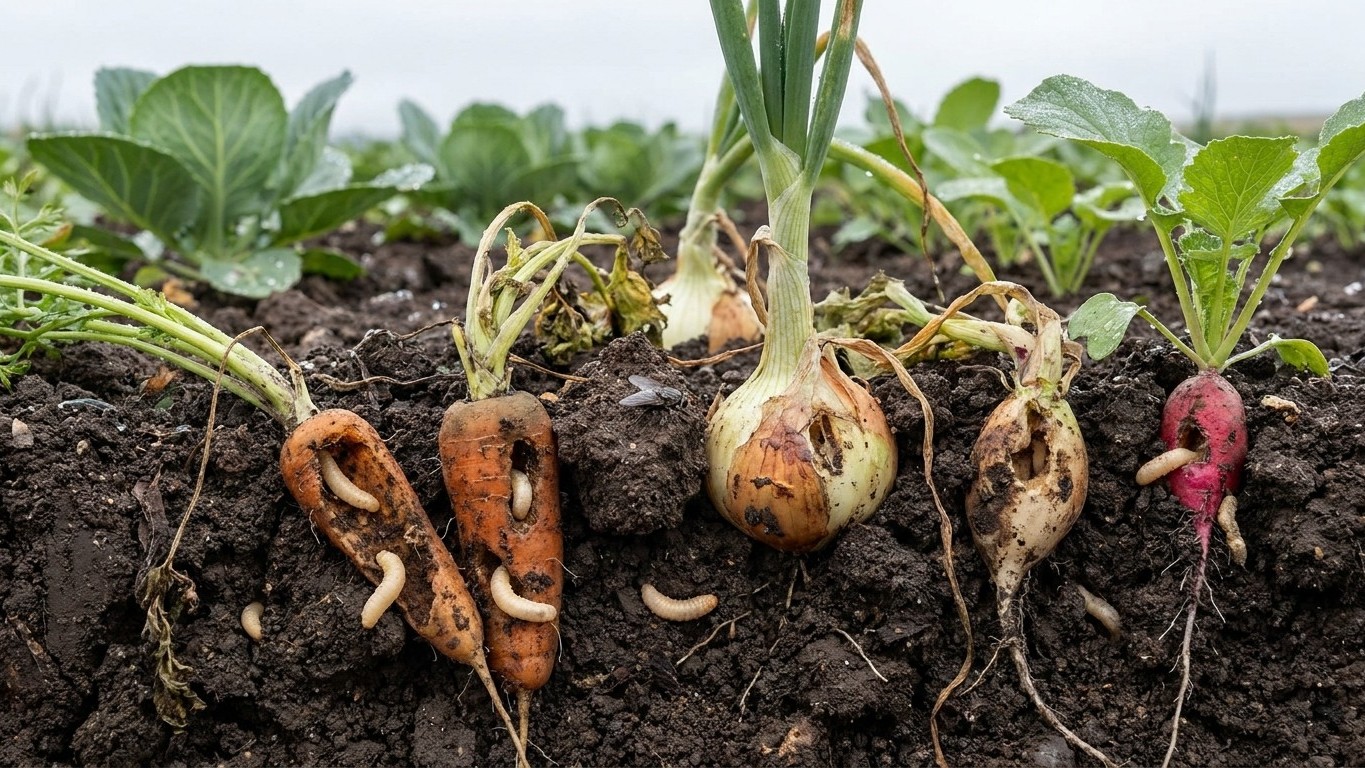
Horseradish and Jerusalem artichoke are perennials and winter in the ground without help. Hardy roots such as parsnips can be left under a thick mulch and dug as the ground allows. Celeriac is the one to lift before the soil freezes. Whatever you lift, inspect it. Discard anything with a soft patch, a weeping spot or a moldy crown, and never treat a root as safe just because it looks sound. Do not count on a root keeping for any set period.
Which these root crops suit Illinois
The choice is by type, and I will not name a single variety. The varieties trialled in Illinois soils and summers are the only recommendation that means anything, and this page does not have those trial results. An invented name would be worse than none. University of Illinois Extension publishes locally tested lists, and its county offices know what grows in your part of the state.
| Type | Fit with the Illinois window | Heat and humidity |
|---|---|---|
| Turnip and rutabaga | Early spring sowing plus a late-summer sowing for fall | Fall crop avoids peak heat; choose disease-resistant types |
| Kohlrabi | Early types suit both spring and fall sowings | Needs even moisture; heat makes it woody |
| Celeriac | Needs indoor-started transplants and the long season | Wants steady water, mulch and airflow |
| Horseradish | Perennial, planted in spring | Tolerates the winter low; give it room |
| Jerusalem artichoke | Perennial, planted in spring | Hardy; must be sited with care |
Turnip, rutabaga and kohlrabi are brassicas. They share their pests and diseases with cabbage, kale and mustard, so rotating them into a cabbage bed has rotated nothing. The rotation page on this site explains how to space these families apart. In a humid state, disease resistance should be your first criterion when you read a seed description, ahead of size or flavor.
Horseradish deserves a plain warning at the kitchen end. Grating a fresh root releases compounds that burn the eyes and airways. Work with the windows open or the fan running, and keep your face away from the bowl.
For the broader picture of how these crops compare, see Celeriac, Kohlrabi, Horseradish and Jerusalem Artichokes.
Common questions
When can I start unusual root crops in Illinois?
Hardy turnips and rutabagas can go in once the bed is workable in early spring. Celeriac transplants wait until frost danger has passed, and the soil thermometer matters more than the calendar. The reference last-freeze band is April 11 to April 22 near Chicago, later in many suburban and rural gardens.
Is the season long enough for celeriac?
The gap between reference frosts is roughly 185 to 206 days, which is generous. Start transplants indoors, compare the packet’s maturity period with your county’s dates, and plan to lift the roots before the soil freezes.
Can I leave Jerusalem artichokes in the ground over winter?
Yes, and you will not be able to stop them from returning in spring, because every tuber fragment left behind regrows. Plant them where permanence is acceptable.
Can turnips follow cabbage in my bed?
No. Turnips and rutabagas are brassicas, so they carry the same troubles as cabbage, kale and mustard. Rotate them with unrelated crops, not into a brassica bed.