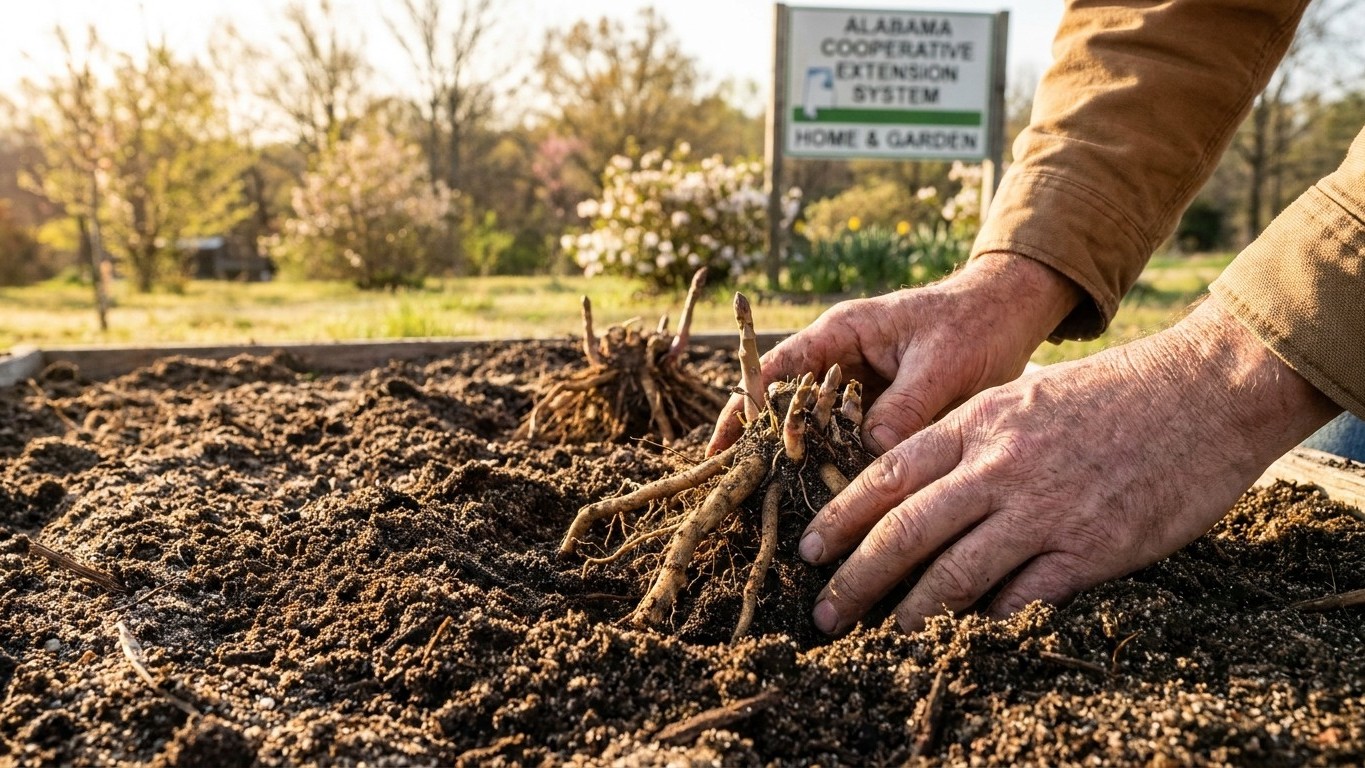

Plant Asparagus Crowns in Indiana in early spring, timed to land around the state’s last frost window rather than on a fixed calendar date. That window runs from April 9 to April 21 at the Indianapolis reference station, and it shifts a bit earlier in the southern counties and later up north. Get the crowns in the ground on that schedule and the plants have a full growing season to build the root system that carries them through winter.
The short answer
Before anything else, understand what you’re committing to. an Asparagus Bed isn’t a spring crop you till under in the fall. Once it’s established, it produces in the same spot for 10 to 15 years. That single fact should shape where you dig the first furrow, because moving an asparagus patch after year five isn’t really an option, it’s starting over.
Utah State University Extension is blunt about what the plant actually needs from the ground: most soils will work, provided they are well drained. That’s the whole requirement. Not a pH number, not a fertility target, just drainage. Asparagus crowns sitting in water for days at a time rot, and a bed that floods every spring will never produce well no matter how much compost you work in.
Indiana’s representative soil, the Miami series that USDA lists as the state’s benchmark, is described as moderately well drained. It’s a loam-to-silt mix, roughly 30 percent sand, 20 percent clay and 49 percent silt at the surface, with organic matter around 2.0 percent and a surface pH near 6.5. On paper, that’s workable ground for a long-term asparagus bed. Moderate drainage isn’t the same as fast drainage, but it clears water at a rate most root crops tolerate.
That said, the Miami series is a state average, not a report card on your backyard. Indiana spans river bottoms that stay soggy into May, glacial till that compacts hard, and any lot where a builder scraped topsoil and left subsoil exposed. None of those behave like the representative series. The only way to know what you’re actually working with is a soil test or, more simply, a shovel test: dig a hole a foot deep, fill it with water, and see how long it takes to drain. If water is still standing after several hours, that spot fails the one test that matters for asparagus.
When the native ground doesn’t drain fast enough, the fix isn’t to abandon asparagus, it’s to raise the bed. A mounded row or a framed raised bed built up 8 to 12 inches above grade lets excess water shed sideways instead of pooling around the crowns. Given that you’re planning for a decade or more in one location, spending an afternoon building a raised bed now is cheap insurance against a problem that would otherwise require digging up mature plants.
Will the summer here water it for you?
Once the crowns are in, water becomes the daily variable. Utah State’s guidance calls for 1 to 2 inches of water every other week for the first two years, tapering to roughly every three weeks once the bed is established. Indiana’s summer rainfall, drawn from 1991-2020 climate normals at the Indianapolis reference station, averages about 12.6 inches across June, July and August, with August running driest at 3.2 inches against June’s 4.95 and July’s 4.42.
- Establishment years (roughly the first two seasons): the bed asks for 1-2 inches every other week, which works out to something like 2-4 inches a month. June and July normals of 4.95 and 4.42 inches come close to covering that on their own, assuming the rain falls evenly rather than in one heavy storm that runs off.
- August is the gap month: at 3.2 inches, August is the driest of the three summer months and the one most likely to fall short of a young bed’s needs, especially in a year that runs even drier than normal.
- Established beds (year three onward): watering every three weeks instead of every other week roughly halves the demand, and at that point a normal Indiana summer likely covers most of it without supplemental irrigation.
- What decides it isn’t the seasonal total, it’s the week: a normal summer can still deliver a three-week dry stretch, and 90-degree days pull moisture out of the soil faster than a single thunderstorm puts it back. A rain gauge on your own property, checked weekly, tells you more than any statewide average.
The Miami series’ moderate drainage cuts both ways here. It holds moisture longer than a sandy soil would, which helps stretch out rain between storms, but it also means a heavy clay pocket in your own yard could stay soggy after a downpour even as the calendar says the region is technically dry. Watch the plants and the soil surface, not just the forecast.
When to put the crowns in
Crowns go into the ground in early spring, and in Indiana that means timing the planting around the April 9 to April 21 last-frost window rather than picking an exact date off a calendar. That range is a mean, an average built from years of freeze data, not a guarantee. Even after the published date passes, there’s roughly a 10 percent chance of another 32-degree freeze, so gardeners who plant on the early edge of that window should keep frost cloth within reach for a cold night in late April.
The planting method itself is straightforward: crowns go into furrows about 8 inches deep. You don’t fill that furrow in one pass. Backfill it gradually over the course of the year, adding roughly 2 inches of soil every other month as the emerging shoots grow taller. That gradual covering protects the crown while still letting the young ferns push up into daylight.
Crowns aren’t the only route. Asparagus can also be started from seed, but that path adds a full extra year to an already patient crop. Seed-grown plants need a season just to become transplant-sized crowns before they even go into the permanent bed, which is why most home gardeners in Indiana skip the seed tray and buy dormant crowns for spring planting instead.
When you’re choosing which crowns to buy, the only reliably published detail across common varieties is their sex, not their flavor or yield. Jersey Giant and Jersey Knight are all-male varieties, while UC 157 F1 and Purple Passion are male-female mixes. All-male varieties put their energy into spears rather than seed production, which is often why gardeners favor them, but no source here publishes a flavor or yield comparison between them, and none is claimed. Whatever variety you choose, remember the year-3 rule that governs every asparagus bed regardless of variety: no harvesting at all in the first two years, a first light harvest of about 4 weeks in year three, extending to 6 weeks and eventually 8 weeks as the crowns mature. And every season, harvest stops not on a fixed date but when most of the spears coming up are thinner than a pencil, a sign the plant needs to shift back into growing foliage for the rest of the year.
Common questions
Can I Plant Asparagus Crowns in fall in Indiana instead of spring?
The guidance behind this article covers spring planting timed to the region’s frost window. Fall planting isn’t addressed here, and given how much a young crown depends on a full growing season to establish before winter, spring remains the planting window this guide can speak to with confidence.
Do I need to know my exact soil pH before planting?
No pH target is published for asparagus in the source behind this guide, and the Miami series’ surface pH of about 6.5 is a state representative figure, not a reading of your garden. If drainage checks out, pH isn’t something this guidance asks you to chase down separately.
How long until I get my first asparagus spears?
Longer than most vegetables. There’s no harvest at all in the first two years after planting crowns. The first light harvest comes in year three and runs about 4 weeks, growing to 6 and then 8 weeks in later seasons as the root system matures.
What if my yard floods every spring?
That’s the clearest sign the site fails asparagus’s one real soil requirement, drainage. Given the bed is meant to last 10 to 15 years, building a raised or mounded bed before planting is a more reliable fix than hoping a flood-prone spot dries out on its own.