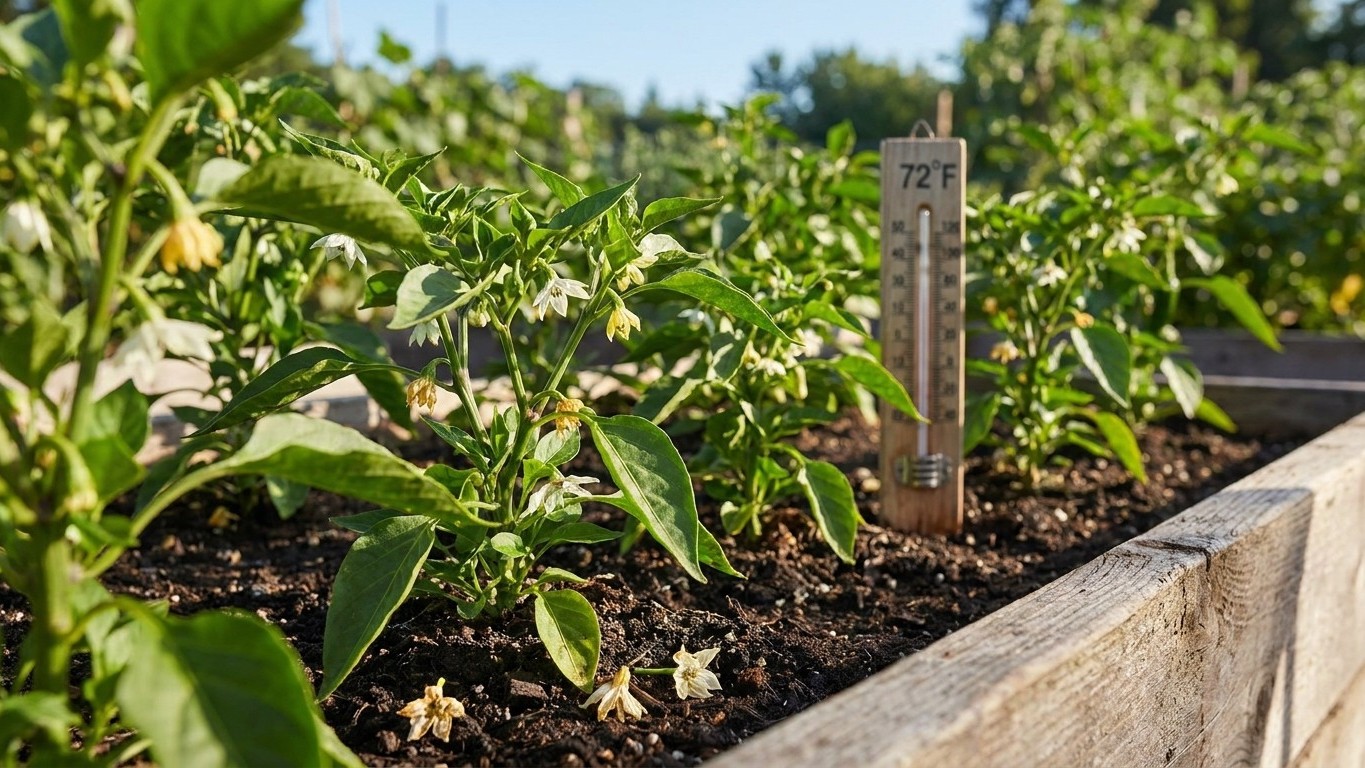

Start pepper seed indoors 8 to 10 weeks before you plan to set transplants outside, which in most of Indiana lands somewhere in the back half of February through mid-March. The exact week depends on your county’s frost date and how fast your soil warms in spring, both of which shift the target transplant date and, with it, the count-back for sowing.
The short answer
Indianapolis averages 14.6 days a year at or above 90 F, based on NOAA’s 1991-2020 climate normals. That’s the number that matters most once peppers are already in the ground and flowering, because pepper fruit set collapses on the hot end when daytime highs push past 90 F for a stretch. Flowers open, but the plant drops them instead of setting fruit, and a July or August heat run of even four or five days over that mark can wipe out a week’s worth of blossoms with nothing to show for it.
The cool end works the same way, just from the other direction. Utah State University Extension notes that pepper fruit set also fails when nights drop below 55 F, which stalls pollen viability even though the plant looks perfectly healthy. Indiana springs are the obvious risk window here: soil can reach 60 F for transplanting while nights are still dipping into the 40s and low 50s, especially in the northern third of the state or in low-lying gardens where cold air pools overnight.
This is where the data available for this state runs out. Indianapolis’s 90 F day count is measured and published, but summer night minimums are not part of that same NOAA normals dataset, and no reliable statewide figure for them exists here. Don’t estimate them from latitude, and don’t assume the coldest month of the year tells you anything about a July night. If you garden in a low spot, near a river bottom, or in one of the state’s cooler northern counties, the only real fix is to track your own nighttime lows with a simple min-max thermometer through the season, because that’s the number that will tell you when blossoms are at risk, not a state average.
Put together, the two thresholds bracket the whole growing season. Too cool in the early weeks after transplant, and flowers won’t set. Too hot in mid-summer, and the same thing happens from the opposite direction. Indiana’s climate puts most gardens comfortably between those two failure points for a solid stretch from June through most of August, but the edges, early June and again in late August, are where a grower needs to be watching both ends at once.
When to start seed here
The math behind a pepper-seeding date is simple once you break it into steps, and it works the same way whether you garden in a Fort Wayne subdivision or a farmhouse plot near Evansville.
- Find your local last spring frost window. NOAA’s 1991-2020 normals put the 32 F freeze probability window for the Indianapolis station at April 9 to April 21. That’s a mid-state reference point only: southern Indiana counties along the Ohio River typically clear frost risk a week or two earlier, while northern counties near the Michigan line often run a week or two later. Check your own county’s frost data rather than assuming the Indianapolis window applies exactly where you live.
- Add a buffer for soil temperature, not just air temperature. Peppers need soil at 60 F before transplanting, and soil almost always trails air temperature by a couple of weeks in spring, especially in clay-heavy ground that holds cold longer than sandy loam. A frost-free date in mid-April doesn’t mean 60 F soil in mid-April; plan on that soil threshold arriving anywhere from one to three weeks after your last frost date, depending on how much sun your bed gets and whether you’ve mulched it dark or left it bare.
- Mark your realistic transplant date. For most of the state, that lands somewhere in the first half of May, later in northern counties, sometimes late April in the far south. This is the date every other step counts back from.
- Count back 8 to 10 weeks from that transplant date to get your seed-starting date. If your transplant target is the first week of May, 8 to 10 weeks back lands seed-starting in late February to early March. If your transplant target slides to mid-May because you’re farther north or your soil runs cold, push seed-starting back correspondingly, into early-to-mid March.
- Build in slack for the 10% risk. Purdue’s guidance flags that there remains roughly a 10% chance of a 32 F freeze event even after the published spring frost date passes. If you’re transplanting on the early edge of your window, have row cover or another frost blanket ready rather than assuming the calendar alone protects you.
Reworking these five steps with your own county’s frost data, rather than Indianapolis’s, is the single most useful adjustment a grower elsewhere in the state can make. A gardener in Vincennes and a gardener in South Bend are working from meaningfully different calendars even though both are technically “Indiana.”
What goes wrong here
- Blossom drop during a heat spell. When daytime highs stack up near or above 90 F, plants can hold their flowers but drop them before fruit sets. Given Indianapolis averages 14.6 such days a year, this isn’t a rare event; it’s an expected mid-summer stretch. The remedy is shade cloth over the row during the worst afternoon sun, deep watering ahead of a forecast hot spell so plants aren’t drought-stressed on top of heat-stressed, and accepting that fruit set will pause and then resume once temperatures ease rather than replanting or fertilizing to try to force it.
- Blossom drop from a cool night. The flip side happens when nights drop below 55 F, most likely in the first few weeks after an early transplant or during a cool snap in late spring. Since this site doesn’t carry summer night-minimum data for Indiana, the only reliable fix is watching your own thermometer and, if a cool night is forecast right after transplanting, covering plants with row cover or cloches until temperatures recover.
- Sunscald on exposed fruit. Indiana summer sun is intense enough that fruit exposed by heavy pruning or leaf loss can develop pale, blistered patches on the side facing the sun. Leave enough foliage cover over developing peppers rather than stripping leaves for “better airflow,” and stake or cage plants so the canopy doesn’t flop open and expose fruit that was previously shaded.
- Blossom-end rot from uneven watering. Peppers grown through Indiana’s uneven summer rainfall, heavy downpour one week, dry stretch the next, often develop a sunken, leathery patch on the fruit’s bottom end. It’s tied to inconsistent moisture disrupting calcium uptake rather than a soil calcium shortage in most gardens. Mulch to even out soil moisture, water deeply and on a regular schedule rather than letting the soil swing between soaked and bone-dry, and avoid heavy nitrogen fertilizer, which pushes leafy growth at the expense of the plant’s ability to manage water demand.
Common questions
Can I start pepper seed too early in Indiana?
Yes. Starting more than 10 weeks before your realistic transplant date usually produces leggy, rootbound seedlings sitting in small pots far longer than they should, and those plants often stall out after transplanting instead of growing on strongly.
Does Indiana’s frost date apply the same way statewide?
No. The April 9 to April 21 window is measured at the Indianapolis station. Southern counties along the Ohio River tend to clear frost risk earlier, and northern counties near the Great Lakes typically run later by a couple of weeks, so treat the Indianapolis dates as a mid-state reference rather than a statewide rule.
What if a cold snap hits right after I transplant?
Cover plants with row cover, a bucket, or a cloche for the night rather than pulling them back inside. A single cool night below the 55 F threshold that USU Extension flags won’t kill an established transplant, but repeated cold nights in a row can stall flowering for the season’s first weeks.
Should I change varieties instead of adjusting timing?
That’s outside what’s verified here. Utah State University Extension names several pepper varieties as garden options but doesn’t publish heat ratings, days-to-maturity figures, or size comparisons for them, so no reliable variety-by-variety timing advantage can be stated. Timing your seed start and transplant date around your local frost and soil data remains the more dependable lever.