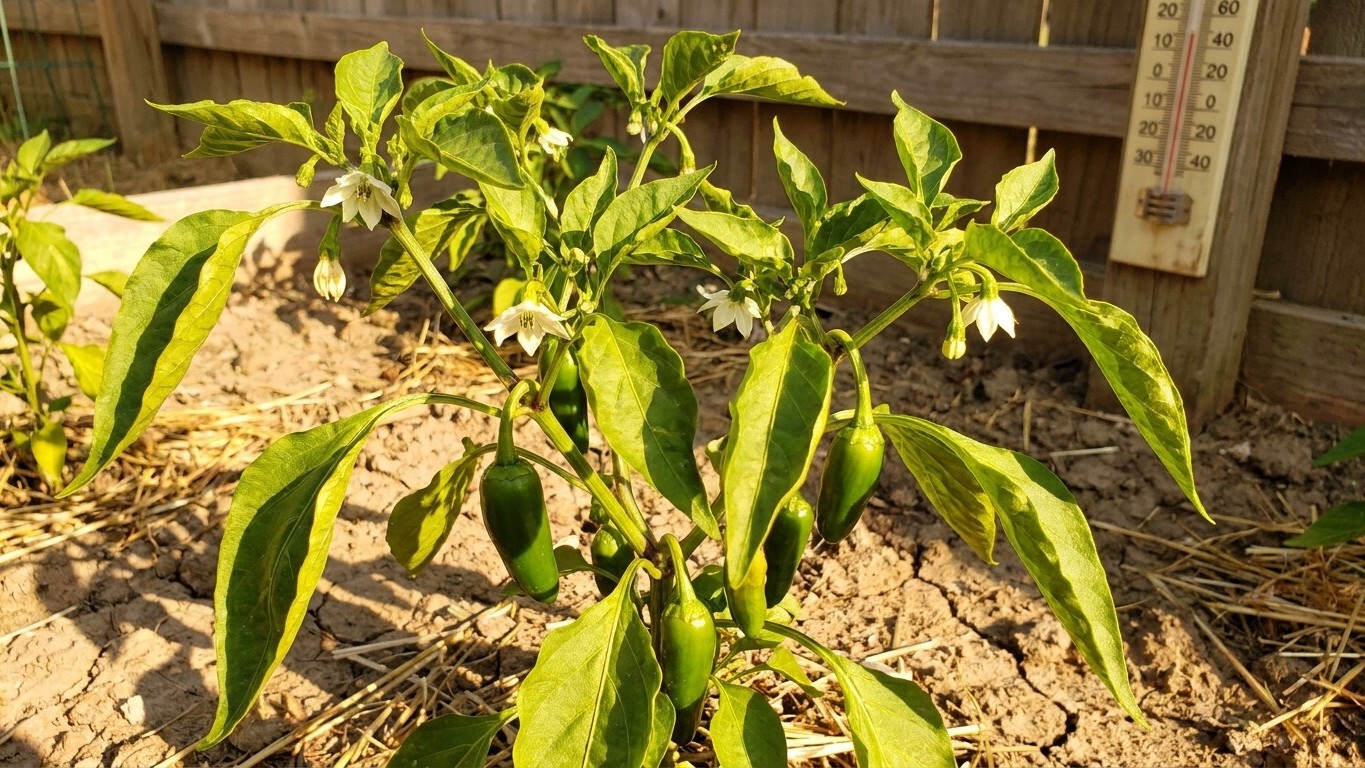

Indiana peppers face a narrow window. The state’s summer heat and its still-unpredictable spring frost mean fruit set can fail on either side of that window, and the fix has less to do with the calendar than with two temperature thresholds most gardeners never check.
The short answer

Indianapolis averages 14.6 days a year at or above 90 F, based on NOAA’s 1991-2020 Climate Normals. That’s not a record-heat number. It’s the ordinary summer load, the stretch of afternoons that push soil temperatures up, dry out containers by mid-day, and stress a plant that’s trying to hold onto its flowers. Why Peppers Fail to Set Fruit in Indiana starts to fail once daytime highs climb past 90 F, according to Utah State University Extension. The flowers open, but pollen turns sterile or doesn’t transfer, and the plant drops the bloom rather than waste energy on it. Fourteen and a half days doesn’t sound like much spread across a whole growing season, but peppers are especially sensitive during their flowering stretch, and a run of three or four 90-degree days back to back, which happens most Indiana summers in July, can wipe out a full flush of blossoms in one week.
That’s the hot end. The cool end matters just as much, and it’s the one gardeners tend to ignore because it doesn’t show up as dramatically. Fruit set also fails when nighttime lows drop below 55 F, the same USU Extension guidance notes. A single chilly night in late spring, the kind Indiana gets even after the last frost date has passed, can cause the same blossom drop as a heat spike. This site tracks days above 90 F for Indiana territories because that data exists in a consistent, comparable form from NOAA’s station records. It does not carry summer night minimum temperatures, and there’s a reason for that restraint: night lows vary block to block depending on elevation, tree cover, and how close a garden sits to pavement or open field, in ways that don’t reduce to a single state or county figure. A garden in a low-lying spot can run five degrees cooler at night than one two miles away on higher ground, and no published dataset captures that at a resolution useful to a home gardener.
The practical takeaway is that the days-above-90 count tells you when to watch for heat-driven blossom drop, but it can’t tell you the whole story. You need to pair it with your own observation of overnight lows, especially in that stretch from late May through June when nights can still dip into the 50s even as days warm quickly. Getting the timing right starts with When to Start Pepper Seed in Indiana, since a plant’s stage of growth when heat or cold hits changes how much damage it does. Choosing among Pepper Varieties That Ripen in a Indiana Season can also reduce your exposure to that risk. A cheap min-max thermometer left in the garden bed for two or three weeks in late spring will tell you more about your own risk of cool-night blossom drop than any regional average ever could.
When to start seed here
Working out a start date for pepper seed is really just counting backward from two fixed points: the last frost and the date the soil warms enough to hold heat. Here’s how that arithmetic runs for Indiana, and how to redo it for your own county.
- Start with the frost window. NOAA’s 1991-2020 Climate Normals put the last spring frost at the Indianapolis station (USW00093819) somewhere between April 9 and April 21, based on 32 F freeze probabilities. Purdue Extension adds a useful caution here: even after that published date, there remains roughly a 10% chance of a 32 F event, so anyone transplanting on the early edge of the window should have row cover or cloches ready.
- Adjust for where you are in the state. Indianapolis is the reference point, but southern Indiana warms up earlier in spring and cools down later in fall than the north, by two weeks or more in many years. A gardener near the Ohio River should expect to move their working frost date earlier; a gardener near the Michigan line should push it later.
- Wait for soil, not just air. USU Extension is specific on this: transplant peppers only after frost has passed and once the soil itself reaches 60 F. Air temperature can feel warm on a 65-degree spring day while the soil, still cold from winter, sits in the 40s. A basic soil thermometer, checked at a 2-inch depth in the morning, settles the question in a way that guessing from the air never will.
- Count back 8 to 10 weeks for indoor sowing. Once you know your realistic transplant date, whether that’s late April in the south or mid-May in the north, subtract 8 to 10 weeks to find your indoor seed-starting date. If your soil hits 60 F around the first week of May, for example, that puts seed-starting somewhere between late February and early March.
- Remember the flowering clock runs separately. Once transplants are in the ground and flowering, fruit typically follows 35 to 45 days after that first bloom, not from the original sowing date. That distinction matters if you’re trying to time a harvest around a specific week; count from when you actually see flowers, not from the seed packet’s germination date.
Redo this same sequence with your own county’s frost dates and you’ll have a start date that’s actually calibrated to where you garden, rather than a generic zone recommendation that assumes Indianapolis conditions apply everywhere.
What goes wrong here
Indiana’s climate produces a specific, repeatable set of pepper failures. None of them are mysterious once you know what to look for.
- Blossom drop during a hot spell. When daytime highs push past 90 F for several days running, which Indianapolis averages 14.6 times a year, flowers open and fall without setting fruit. There’s no fix for the heat itself, but afternoon shade cloth over the row, deep watering in the morning rather than midday, and mulch to keep root zones cooler all reduce the stress that triggers the drop.
- Blossom drop from a cool night. The same failure shows up when nights fall below 55 F, something this site doesn’t track by county but that any gardener can monitor with a simple thermometer left outside overnight in late spring. If cool nights are a recurring problem in a particular yard, delaying transplant by a week or two, or using a low tunnel to trap heat overnight, usually solves it.
- Sunscald on exposed fruit. Indiana summer sun is strong enough that peppers left uncovered by foliage, especially after a plant has been pruned hard or has thin leaf cover, develop pale, blistered patches on the side facing the sun. The remedy is simple: let the plant keep more of its natural leaf canopy rather than stripping it back, and avoid heavy pruning during the hottest stretch of summer.
- Blossom-end rot. This shows up as a sunken, leathery brown patch on the bottom of the fruit, and it’s a calcium-uptake problem tied to inconsistent watering rather than a soil deficiency in most cases. Even, regular watering, especially through the dry spells that often accompany those 90-degree stretches, prevents the swings in soil moisture that cause it.
Checking this against your own county
Everything above is built from Indianapolis station data and general USU Extension guidance on pepper physiology. Neither one replaces local knowledge. Soil types shift from sandy in some river valleys to heavy clay elsewhere in the state, drainage varies block to block, and microclimates around buildings or tree lines can shift both frost timing and summer heat load in ways no statewide figure captures.
Purdue Extension, the state’s land-grant university extension service, publishes county-level guidance, local frost records, and seasonal advisories that reflect these differences. Its office network covers every county in Indiana, and a call or visit to the office nearest your garden is the fastest way to confirm a planting date, get a soil test read correctly, or troubleshoot a specific plant problem with someone who knows your local conditions firsthand. Find the directory and local office contacts at extension.purdue.edu.
Common questions
Can I still get peppers to set fruit during a heat wave?
Not usually while the heat wave is happening. Once daytime highs regularly clear 90 F, flowers tend to drop rather than set. Plants typically resume setting fruit once temperatures moderate, so the goal during a heat spell is keeping the plant alive and healthy (through shade, watering, and mulch) rather than expecting fruit during that stretch.
Do I need to worry about both heat and cold in the same season?
Yes, and that’s the specific challenge in this climate. Early in the season, cool nights below 55 F can stall fruit set even after the danger of frost has passed. Later, summer heat above 90 F does the same thing from the other direction. Watching both matters more than watching just one.
How do I know when my soil has actually reached 60 F?
A basic soil thermometer inserted about 2 inches deep, checked in the morning before the sun warms the surface, gives the most reliable reading. Don’t rely on air temperature or the calendar alone; soil often lags several weeks behind warming air in spring.
Is there a hard-freeze date I should also plan around?
This site’s published frost figures cover the standard 32 F frost window from NOAA’s Climate Normals for the Indianapolis station. No separate hard-freeze threshold is published here, so don’t assume one; if you need that level of detail, check directly with Purdue Extension for local records.