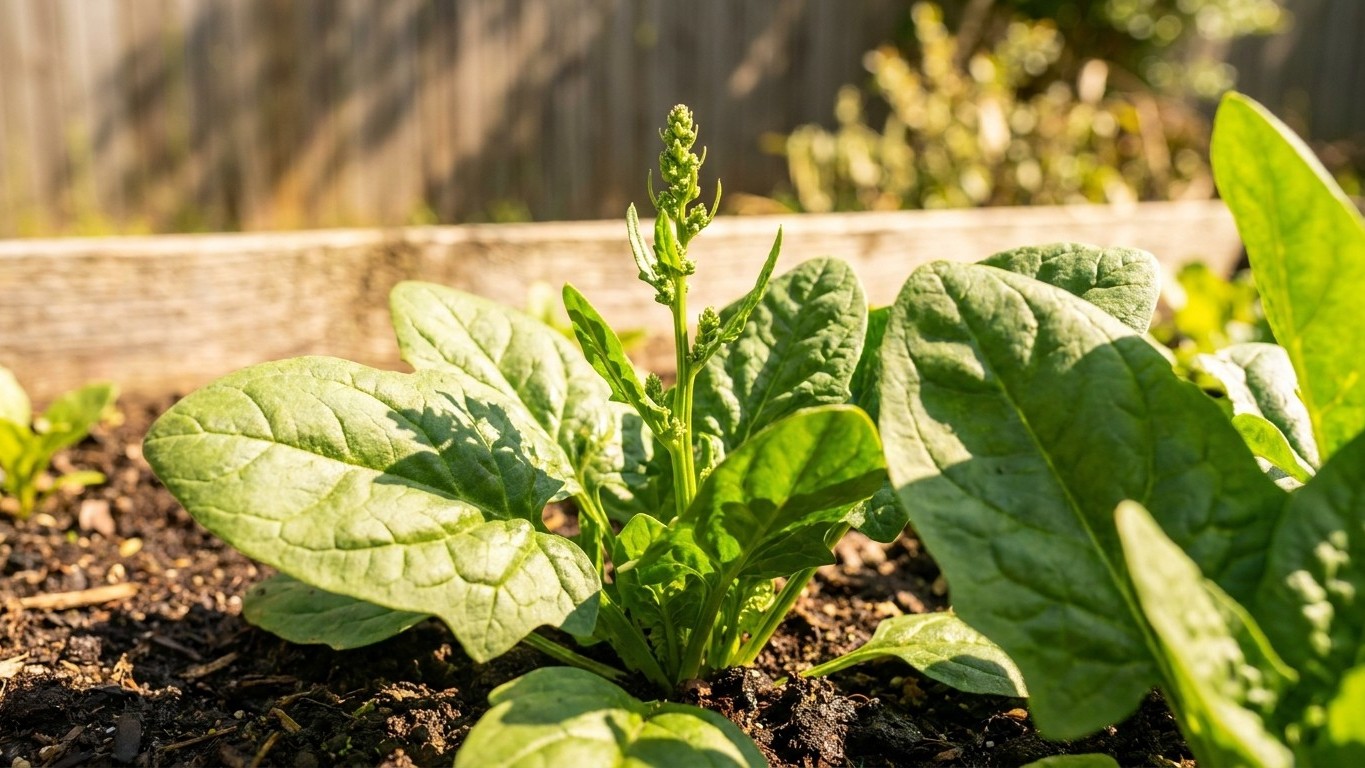

Yes, spinach will bolt early in Indiana most seasons. The state’s long summer daylight (14 hours 49 minutes on the longest day) triggers flowering regardless of temperature, and with 14.6 days a year climbing to 90°F or higher, heat piles on top of that signal. The real limit isn’t a lack of cold-hardiness; it’s a narrow calendar window on both ends of the year, squeezed by day length on one side and soil warmth on the other.
The short answer
Once daylight starts stretching past a certain point, spinach reads that as a signal to stop making leaves and start making seed. That’s the mechanism behind bolting, and it runs on its own clock no matter how mild the air feels. Indiana’s summer solstice delivers 14 hours and 49 minutes of daylight at the reference station, and that number alone is enough to push spinach toward flowering well before the calendar says summer is over. A cooler-than-average June doesn’t cancel that signal. The plant isn’t waiting for heat to bolt; it’s waiting for light.
Where Indiana adds a second squeeze is temperature. Spinach grows best when readings stay under 75°F, and that ceiling isn’t just a growth limit, it’s also the point where leaves start turning bitter and tough. The Indianapolis station averages 14.6 days a year at 90°F or above, which tells you how much heat load builds during a typical summer. Long before the thermometer hits 90°F, it’s already spent weeks above that 75°F mark, and spinach growing in that stretch is fighting on two fronts at once: the day is too long, and the air is too warm.
So the honest answer to whether the limit here is day length or heat is that it’s both, and they arrive at roughly the same time. Day length builds steadily toward the June solstice no matter what the weather does. Heat builds on its own schedule, often overlapping the same weeks. A gardener who thinks a mild June has bought extra time is usually wrong, because the daylight clock keeps running underneath the thermometer.
Utah State University Extension names four spinach varieties commonly grown in home gardens: Bloomsdale, Melody, Teton, and Olympia. That source doesn’t publish maturity dates or bolt-resistance ratings for any of them, so no comparison can be made here beyond the names themselves. Anyone shopping seed catalogs should treat those four as a starting point for research, not as an answer already worked out.
How long the spring window really is
Spinach in Indiana isn’t planted by guesswork. It’s planted by counting backward from a known frost date, then forward against two competing clocks. Here’s how that math plays out using the reference station’s numbers.
- Start with the last spring frost window at the reference station, which runs from April 9 to April 21. Spinach seed goes into the ground 2 to 3 weeks before that date, meaning a realistic sowing window falls somewhere between mid-March and early April, depending on how the season is running.
- Seedlings that go in during that window get several weeks of cool weather to establish before daylight becomes a problem. But the daylight clock never pauses. Every week between sowing and the June solstice adds minutes to the day, building steadily toward that 14-hour-49-minute peak.
- Temperature climbs on a separate but overlapping schedule. The 75°F growth ceiling gets crossed well before the solstice itself, and once it’s crossed, growth quality drops even if bolting hasn’t started yet. With 14.6 days a year reaching 90°F, the region’s heat load is substantial enough that mid-70s readings show up on a regular basis through late spring.
- Combine those two pressures and the usable spring window for Indiana spinach runs roughly from sowing in mid-March to early April, through to a bolt-driven end somewhere in mid-to-late May. That’s a working window of something like eight to nine weeks, not a full-summer crop.
- Because that window is short, most gardeners in the region harvest young leaves rather than waiting for full maturity, since neither day length nor heat is going to wait around for a slower harvest schedule.
The autumn crop, and when the soil lets you sow
Fall spinach in Indiana isn’t blocked by cold. It’s blocked by heat that lingers in the soil long after the air starts to feel like autumn, and then it’s ended by the season’s first hard frost. Two separate obstacles, and they don’t line up the way most gardeners expect.
Soil that’s still too warm to germinate
Utah State University Extension is specific on this point: spinach seed germination drops off once soil temperature climbs above 80°F. That’s not an air temperature reading, it’s a soil reading, and soil holds heat much longer than the air above it. With Indiana’s reference station logging 14.6 days a year above 90°F, the ground has plenty of time to bank heat through July and into August. Sowing too early into that warm soil means poor, patchy germination even if the calendar suggests fall planting should already be underway. The practical fix is to wait until soil temperature has actually dropped, not to sow by date alone.
The frost that ends the season
The first fall frost at the reference station arrives between October 21 and October 30. That date sets the outer boundary for a fall spinach crop. Utah State University Extension’s guidance for fall planting is to sow 50 to 75 days before the date you want to harvest, and no maturity figure beyond that range is published for any variety.
Working backward from an October 21 harvest target, 50 to 75 days lands sowing between roughly September 1 and August 7. Working backward from the later end of the frost window, October 30, the same math lands sowing between roughly September 10 and August 16. Put those two calculations together and the realistic fall sowing window for Indiana falls somewhere between early August and mid-September, depending on how close to first frost a gardener is willing to aim for harvest.
That window sits right on top of the period when soil is still shedding summer heat, which is why timing matters more for fall spinach than for spring. Sow too early into soil still running hot from August, and germination suffers. Sow too late, and the first frost arrives before the crop is worth harvesting. Indiana’s reference dates give a starting point, but southern parts of the state run earlier in spring and later in fall by two weeks or more, which shifts both ends of this math in the grower’s favor.
Common questions
Does a cool summer in Indiana delay spinach bolting?
Not reliably. Bolting is triggered by day length as much as by heat, and the daylight clock at 14 hours 49 minutes on the longest day runs regardless of temperature. A mild June can slow bitterness slightly, but it won’t stop the plant from reading long days as a signal to flower.
Why does warm soil stop fall spinach from coming up?
Utah State University Extension reports that germination drops once soil temperature climbs above 80°F. Indiana soil holds summer heat well into August, so seed sown too early into that warm ground often germinates poorly, independent of how the air temperature feels.
How many days before the first frost should fall spinach be sown?
Utah State University Extension’s guidance is 50 to 75 days before the intended harvest date. Using the reference station’s first fall frost window of October 21 to October 30, that math points to sowing somewhere between early August and mid-September.
Is there a maturity date published for spinach varieties like Bloomsdale or Melody?
No. Utah State University Extension names Bloomsdale, Melody, Teton, and Olympia as varieties grown in home gardens, but that source does not publish days-to-maturity or bolt-resistance data for any of them.