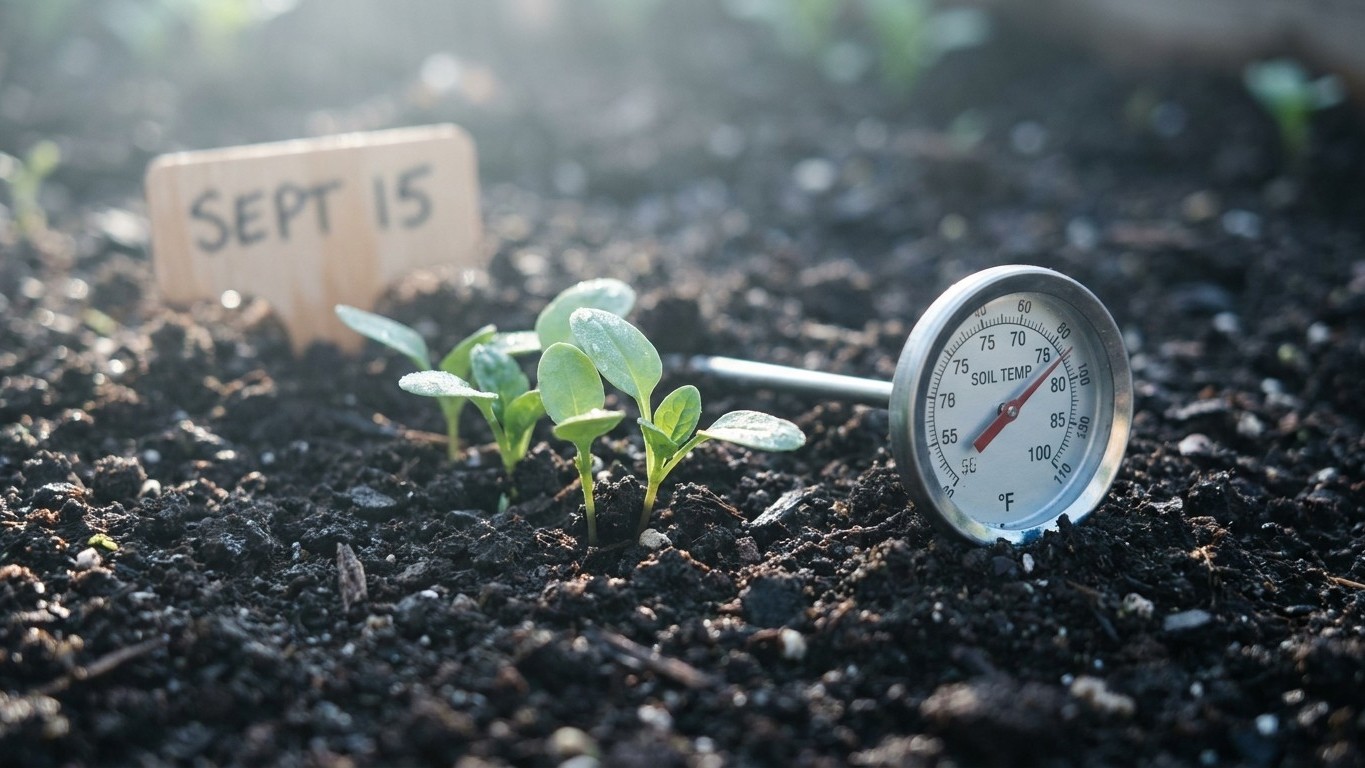

Sow Autumn Spinach in Indiana once the soil has cooled below that 80°F germination ceiling, counting back 50 to 75 days from the harvest date you want. Against the Indianapolis frost normals, that lands the sowing window somewhere between early August and mid-September, with soil temperature, not the calendar, deciding the exact day you can start.
The short answer
Indianapolis sees 14 hours and 49 minutes of daylight on the longest day of the year. That number matters more than most gardeners realize, because spinach bolts under long days and warm temperatures together. A cool summer does not rescue a spinach crop where the days stretch past 14 hours, and Indiana’s early-summer days sit well above that line for weeks on either side of the solstice. The plant reads day length as a signal to flower, and once it starts, the leaves turn bitter and thin no matter how carefully you water.
So the limit here is not one thing. It is both. Day length pushes the plant toward bolting starting in late spring, and heat finishes the job. Indianapolis averages 14.6 days a year at 90°F or hotter, a measure of how much sustained heat load the growing season carries. That’s not an average summer temperature, it’s a count of the days that push right past spinach’s comfort zone. Spinach grows best where temperatures stay under 75°F, and 75°F is doing double duty here: it’s the ceiling for good growth, and it’s the point where the leaves start turning bitter. Once Indiana’s spring days start stacking up both long daylight and afternoons near or above that mark, spinach is done for the season whether you meant to pull it or not.
This is why spinach behaves so differently from a crop like onions, where long days are exactly what the plant is waiting for. On this site’s onion pages, long summer days are the trigger that builds the bulb. For spinach, the same long days are what ends the crop early. Same variable, opposite result. Gardeners who move from one crop to the other sometimes assume a long Indiana summer day is always good news in the vegetable patch. For spinach it’s closer to a countdown clock.
None of this means Indiana can’t grow good spinach. It means the crop has to be timed around the two windows where day length and heat aren’t working against it: the cool stretch of early spring before the days lengthen too much, and the cool stretch of early autumn after the heat load drops and before frost shuts things down. Everything else on this page is about finding those two windows precisely.
How long the spring window really is
- Start with the frost date. The Indianapolis last spring frost falls between April 9 and April 21. Spinach seed goes in the ground 2 to 3 weeks before that date, which puts a realistic sowing window at roughly late March through early April, depending on how the season is running.
- Add the ten percent caution. There’s still about a 10% chance of a 32°F freeze after that published spring date, so anyone sowing on the early edge of the window should have row cover ready rather than assume the frost risk is fully over.
- Track how fast the days lengthen. From early April onward, daylight climbs quickly toward that 14-hour-49-minute peak in June, and spinach’s bolting trigger starts building well before the solstice actually arrives.
- Watch the 75°F ceiling. Indiana’s spring temperatures typically climb into the mid-70s and beyond by mid-to-late May, and once afternoons sit consistently at or above that mark, growth quality drops and bolting risk rises fast.
- Add it up. That gives a spring sowing-to-harvest window of roughly six to eight weeks, opening in late March or early April and effectively closing by mid to late May. It’s a real window, but it’s a short one, and it closes from both directions at once, rising heat and lengthening days arriving together.
The autumn crop, and when the soil lets you sow
Autumn spinach in Indiana isn’t limited by cold. It’s limited by heat, just from the other end of the calendar. The two obstacles that decide the sowing date are warm soil at the start of the window and the first hard frost at the end of it.
Warm soil blocks germination first
Spinach seed struggles to germinate once soil temperatures climb above 80°F, and Indiana’s late-summer soil routinely runs there through much of August. Sowing too early, while the ground is still holding summer heat, means poor or spotty germination even if the air temperature has started to ease. The practical fix is patience: wait until soil temperature has actually dropped, rather than sowing by the calendar alone. In a hot stretch, that can mean waiting into late August or even early September before the ground has cooled enough for reliable seedling emergence.
Counting back from the first fall frost
Once the soil has cooled, the second constraint takes over: the first fall frost, which arrives in Indianapolis between October 21 and October 30. For a fall crop, the guidance is to plant 50 to 75 days before the date you want to harvest. Counting back from that frost window puts the sowing date somewhere between early August and mid-September, with the exact day depending on which end of the frost range applies and how much growing time you want before harvest.
Southern Indiana runs earlier in spring and later in autumn than the northern part of the state, by two weeks or more, which shifts this whole window later for gardeners closer to the Ohio River and earlier for those near the Michigan line.
| Region | First fall frost tends to arrive | Practical sowing window |
|---|---|---|
| Northern Indiana | Earlier within the Oct 21–30 range | Earlier side of early Aug–mid Sept |
| Indianapolis (reference) | Oct 21–30 | Early August to mid-September |
| Southern Indiana | Later within, or beyond, the Oct 21–30 range | Later side of early Aug–mid Sept |
Four spinach varieties commonly come up in fall-planting discussions: Bloomsdale, Melody, Teton, and Olympia. No published data here breaks down days-to-maturity or performance differences between them for Indiana conditions, so treat variety choice as a separate decision from timing, not a substitute for watching soil temperature and counting back from your local frost date.
Common questions
Can I sow spinach in Indiana in mid-summer?
No. Mid-summer combines the two things spinach can’t handle at once: long daylight hours pushing toward bolting, and soil temperatures well above the 80°F germination ceiling. Seed sown in July is fighting both mechanisms simultaneously.
Does a cooler-than-average Indiana summer extend the spring spinach harvest?
Not by much. Bolting is triggered by day length as well as heat, so once daylight passes roughly 14 hours, the plant is moving toward flowering regardless of how mild the actual temperature happens to be that week.
How do I know when the soil has cooled enough for fall sowing?
The threshold is 80°F soil temperature; germination drops off above that point. A simple soil thermometer pushed a couple of inches into the bed gives a more reliable answer than guessing from the air temperature or the date on the calendar.
Is the frost date the same across Indiana?
No. The Indianapolis normals put the first fall frost between October 21 and October 30, but southern Indiana tends to see frost later and northern Indiana earlier, by two weeks or more in either direction.