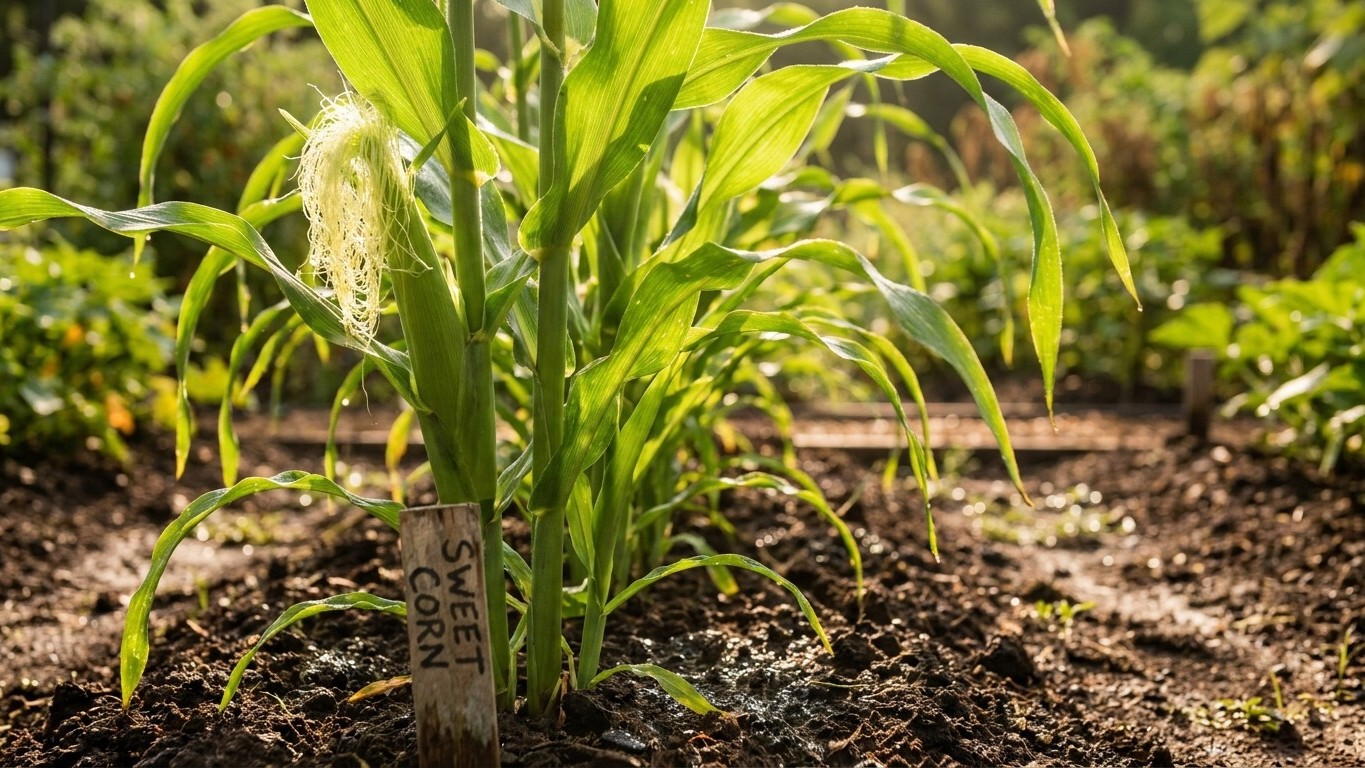

Sweet corn ripens in Indiana in most years, but not by simply counting from the last frost. Soil temperature is the gate, not the calendar date of last frost, and the true test is stacking the frost-free calendar against how many days a variety needs from planting to harvest. Indianapolis-area data show that gate closing later than gardeners expect, and opening again earlier than many assume once autumn approaches.
The short answer
Start with the number that trips up most Indiana gardeners: the soil needs to sit above 60°F before sweet corn seed will germinate reliably, and that threshold arrives well after the last spring frost, not on the same day. NOAA’s 1991-2020 climate normals for the Indianapolis reference station put the last spring frost somewhere between April 9 and April 21. Soil doesn’t warm at the same pace as the air, so gardeners who plant the week the frost risk clears are often planting into ground that’s still too cold for corn to sprout evenly. The seed sits, rots in wet spring soil, or germinates so unevenly that the stand ends up patchy all season.
That delay matters less than it sounds, because the other end of the season is generous. NOAA’s data put the first fall frost between October 21 and October 30 for the same reference station. Counting from the latest date in the spring frost range (April 21) to the earliest date in the fall frost range (October 21) gives roughly 183 days of frost-free calendar. Even allowing four to five extra weeks beyond the last frost for soil to climb past 60°F, which is a realistic lag in a cool, wet Indiana spring, there’s still comfortably more than 120 days of growing weather left before the first widely expected frost of autumn. Sweet corn needs 60 to 90 days from planting to reach harvest, so the arithmetic works in Indiana’s favor even with a slow start.
Heat is the other variable worth flagging, and it cuts the opposite direction from cold soil. The Indianapolis reference station averages 14.6 days a year at or above 90°F. That’s a meaningful heat load: it drives water demand higher through July and August, and it can stress silks right when pollination needs to happen cleanly. Corn planted so it tassels during the hottest stretch of summer can suffer poor kernel fill even if the calendar math otherwise checks out. None of that changes the basic answer. Given a reasonable planting window and a variety chosen with the season in mind, sweet corn ripens in Indiana with room to spare.
Does a late variety fit here?
The 183-day window between the outer edges of Indiana’s frost dates is wide enough that both an early and a later sweet corn timeline fit, though they fit differently and for different reasons.
A 60-day variety
A 60-day type is the low-risk choice, and the Indiana calendar barely tests it. Even planted late, well after soil has fully warmed past 60°F sometime in late spring, a 60-day corn maturing in two months lands with weeks to spare before the earliest fall frost date of October 21. This is the variety that forgives a slow, wet spring, a delayed planting, or a gardener who wants to plant twice for a longer harvest window. There’s little tension between this timeline and Indiana’s frost dates in either direction.
A 90-day variety
The longer-season type is where the math has to be checked instead of assumed, and here Indiana’s window holds up. Even factoring in a soil-warming lag of several weeks past the last spring frost, a 90-day variety still has more than enough runway before the earliest fall frost arrives in the back half of October. This is not one of the tighter Midwest climates where a full-season variety runs the risk of being caught by early autumn cold. In Indiana, a 90-day sweet corn fits the season with a real margin, not a razor’s edge. The bigger risk for the long-season type isn’t frost at either end. It’s the mid-summer heat load reflected in that 14.6-day average above 90°F, which can stress pollination during the exact weeks a slower-maturing variety is tasseling.
| Variety type | Days to maturity | Fits Indiana’s frost window? |
|---|---|---|
| 60-day | 60 | Yes, with wide margin |
| 90-day | 90 | Yes, with margin, but summer heat is the real stress point |
What goes wrong here
Indiana’s climate doesn’t make sweet corn hard to grow, but it does create three specific failure points, and only one of them is actually about weather.
- Soil sown too cold. Planting on the calendar instead of on soil temperature is the most common mistake here, since the last frost date (as early as April 9) tempts gardeners to plant well before the soil has caught up. Seed sitting in cold, wet ground germinates unevenly or rots outright. The fix is patience: wait until soil is reliably above 60°F, even if that means planting weeks after the last frost has passed.
- A variety too late for the season. Indiana’s window comfortably fits a 90-day type, but an unusually long specialty variety pushed past that range, or a planting delayed deep into summer, can run out of runway before the first fall frost arrives in late October. Check the days-to-maturity on the seed packet against the planting date actually used, not against the ideal calendar.
- Sweetness lost to tasseling timing. This one has nothing to do with Indiana’s climate. Sweet corn comes in su, se, and sh2 types, and if two different types tassel at the same time nearby, cross-pollination ruins the sweetness and texture of both. There’s no published isolation distance to rely on here. The fix is timing and layout: stagger plantings so different types don’t tassel together, or grow a single type, and always plant sweet corn in blocks of three or more rows rather than a single long row, since that shape is what makes pollination reliable in the first place.
Common questions
When should I plant sweet corn in Indiana?
Plant once the soil, not just the air, is reliably above 60°F, which comes after the last spring frost window of April 9 to April 21. Planting earlier because the frost risk has passed is the most common cause of poor germination in this region.
How do I know when sweet corn is ripe?
Ripeness is confirmed by three signs together, not by any one alone: the silks should be dry and brown, the husks should still be moist and green, and a punctured kernel should release milky juice. Silks typically emerge 17 to 24 days before the ear is ready, which is a separate clock from the 60- to 90-day span counted from planting to harvest.
Can I grow both sweet corn and field corn together?
Growing different corn types close enough that they tassel at the same time risks cross-pollination, which affects sweetness and texture. The safeguard is timing plantings so tasseling doesn’t overlap, or growing only one type in a given season.
Does the heat in Indiana summers affect sweet corn?
Yes. The reference station averages 14.6 days a year at or above 90°F, and that heat load raises water demand and can stress silks during pollination, particularly for later-maturing varieties whose tasseling window lands in the hottest part of summer.