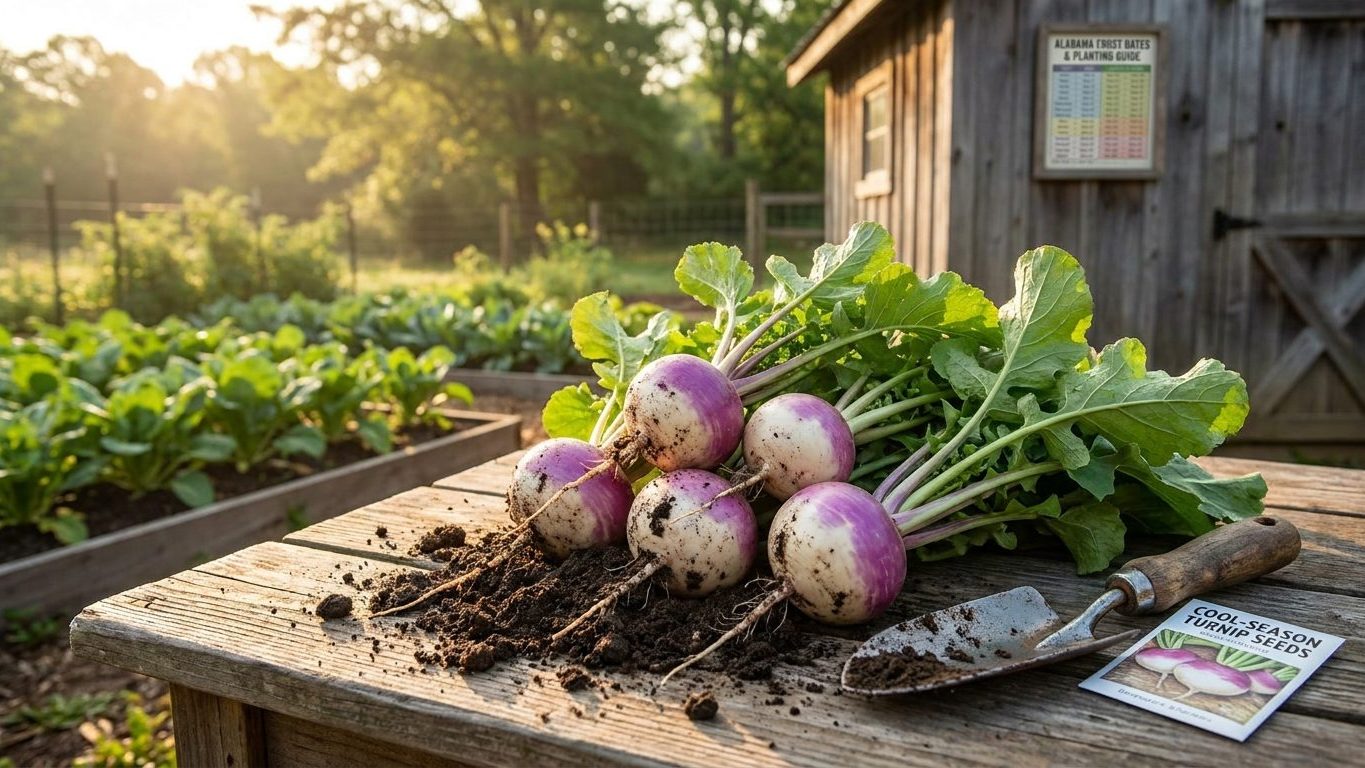

Turnips go into Indiana soil twice a year: a spring sowing from mid-March into early April, and a fall sowing in the first two weeks of September that most Hoosier gardeners actually prefer, since cool nights sweeten the roots. Both windows track off the Indianapolis frost dates, and both need adjusting once you leave central Indiana.
The short answer for Indiana
Turnips are a cool-season crop, and Indiana’s growing season gives you two real openings to grow them well. The spring window opens as soon as soil can be worked, typically two to three weeks ahead of the last spring frost, which at the Indianapolis reference station (USW00093819) falls between April 9 and April 21 based on 1991-2020 NOAA climate normals. That means direct-sowing turnip seed from late March through the second week of April is standard practice for a spring crop, since turnip seedlings shrug off a light frost that would kill tomatoes or peppers outright.
The fall window is where turnips actually shine in this state. Purdue’s own frost guidance notes that even the published spring frost date carries roughly a 10% chance of a freeze arriving late, which matters more for tender transplants than for turnips, but it’s a reminder that Indiana springs are not perfectly predictable. Fall sowing sidesteps that uncertainty entirely. Counting back from the first fall frost, which lands between October 21 and October 30 at Indianapolis, gives you a sowing target of the first two weeks of September for most turnip varieties, since roots typically need six to eight weeks to size up before the ground cools hard.
Why does the fall crop get preferred billing? Turnip roots convert starch to sugar once nighttime temperatures drop into the 40s, which is exactly what happens in Indiana through late September and October. A root that finishes bulking in early October, right as frost approaches, tends to taste milder and less woody than one rushed through a hot June. Spring turnips are perfectly workable, but they’re racing a clock: sow too late and the roots hit maturity right as early summer heat pushes them to bolt, turning the roots fibrous and the greens bitter.
If your goal is greens rather than roots, the calculus shifts. Turnip greens are ready for cutting in as little as three to four weeks, which means a spring sowing has plenty of time to deliver a harvest before summer heat arrives, and a second sowing in early September will keep producing tender leaves right up until a hard freeze ends the season.
What will not work here

Rutabaga is the crop that exposes the limits of this calendar. Unlike turnip, rutabaga typically needs closer to 90 days to size up properly, and that longer runway changes the math entirely. Counting back from the October 21-30 fall frost window, a rutabaga sown any later than mid-July is gambling against the calendar, since anything started after that risks hitting frost before the roots have finished bulking. Gardeners who treat rutabaga like turnip and sow it in September end up with small, tough roots that never really got there.
Summer sowing of either crop is the second trap. Indiana summers regularly push into the 80s and 90s, and turnip seed germinates poorly in soil that’s too warm and too dry between waterings. A gardener who sows in July and waters once a week, thinking it’s a garden task like beans, will often see spotty germination and roots that split or turn woody from uneven moisture. Turnips want the soil kept consistently damp until the seedlings are up, which in a hot Indiana July means watering closer to every two or three days, not once a week.
Winter survival in the ground is the third thing that doesn’t work without help. The coldest month at the Indianapolis reference station averages a daily minimum of 20.9°F, well below what an unprotected turnip root can tolerate sitting exposed through January. Some gardeners try to leave roots in place for a late harvest, and that’s fine through a light freeze or two, but leaving a bed unmulched through a full Indiana winter risks losing the crop to hard freezes rather than harvesting it on your own schedule.
Close spacing is the quieter failure. Indiana’s summer humidity, especially in the southern third of the state, creates conditions where turnip foliage sown too thickly stays damp long after morning dew should have burned off, inviting the leaf spot and downy mildew that spread fastest in still, humid air between crowded plants.
What changes across Indiana
Indiana is not one climate. The USDA Plant Hardiness Zone Map places the state across a spread of 5b to 7a, and that range alone tells you a single statewide sowing date doesn’t exist. A gardener in the far south, near the Ohio River, gardens in noticeably milder conditions than one near the Michigan border, and the practical effect shows up directly in frost timing.
Purdue’s own extension guidance flags this directly: southern Indiana runs earlier in spring and later in autumn than the north, by two weeks or more. That’s not a rounding error. It means a fall turnip sowing timed for the first two weeks of September in Indianapolis could reasonably shift into early September or even late August for a far-northern county, where the first frost arrives sooner, and could stretch into the third week of September for a southern county working with a longer fall.
Elevation plays a smaller role in Indiana than in mountain states, since the state’s terrain is comparatively flat, but local cold-air pooling in low-lying valleys can still produce a frost pocket that behaves like a zone colder than its official rating. A garden tucked into a creek bottom will often see frost days before a garden on a nearby ridge, even within the same county.
None of this means guessing. It means treating the Indianapolis-based dates in this article as a starting reference rather than a fixed rule, and checking where your own county actually falls before committing seed to soil. The right move isn’t to estimate your zone from a state map glanced at once, it’s to look it up directly and let that number, not a memory of it, guide your sowing date.
Where to check this for your own county
This page gives you Indiana’s statewide pattern, built on one reference station in Indianapolis. Your county may sow two weeks earlier or later than that pattern, and the only way to know for certain is to check locally rather than extrapolate.
Purdue Extension, reachable at extension.purdue.edu, maintains county-level offices across Indiana specifically for this kind of question. When you look them up, search for two things: the local planting calendar for cool-season vegetables, which will adjust the spring and fall sowing windows for your specific county’s frost history rather than Indianapolis alone, and the variety trial results for turnip and rutabaga, which tell you which cultivars have actually performed well in your region’s soil and summer conditions rather than in a seed catalog’s general description.
A county extension recommendation will beat a state-level article every time, because it’s built from local frost records and local trial plots rather than a single reference station averaged across a state that spans two hardiness zones. This page can tell you that fall sowing generally beats spring sowing in Indiana and that early September is a reasonable statewide target. It cannot tell you whether your particular county’s clay soil warms up faster or slower than average, or whether a late-May hailstorm is common enough locally to matter. That’s exactly the gap a county office fills.
Most Purdue county offices also run a master gardener hotline or a walk-in office during growing season, which is often the fastest way to get a direct answer if the online calendar doesn’t cover your exact question.
Checking this against your own garden
Every date on this page is a probability, not a promise, and your own garden will tell you more than any calendar once you know what to watch for. Three signs matter most, and none of them require a thermometer or a soil probe.
- Soil warmth by feel: press your bare hand into the top inch of soil in the morning. If it still feels cold and damp rather than merely cool, germination will be slow and patchy no matter what the calendar says; wait a few more days.
- Germination speed: turnip seed sown in properly warmed soil typically pokes through within about a week. If it takes noticeably longer than that, your particular bed is running cooler than the regional average, which is useful information for every future sowing in that spot.
- The first true leaves: the initial two seed leaves don’t tell you much, but the appearance of the first true, jagged-edged turnip leaf signals the plant has settled in and is growing steadily rather than just surviving.
If your fall-sown turnips are reaching their second set of true leaves within two to three weeks of sowing, your microclimate is tracking close to the Indianapolis average, and the rest of the calendar in this article should hold reasonably well for your garden.
If you follow the almanac, here is when to plant turnips by the moon. It is a tradition, not a proven method.