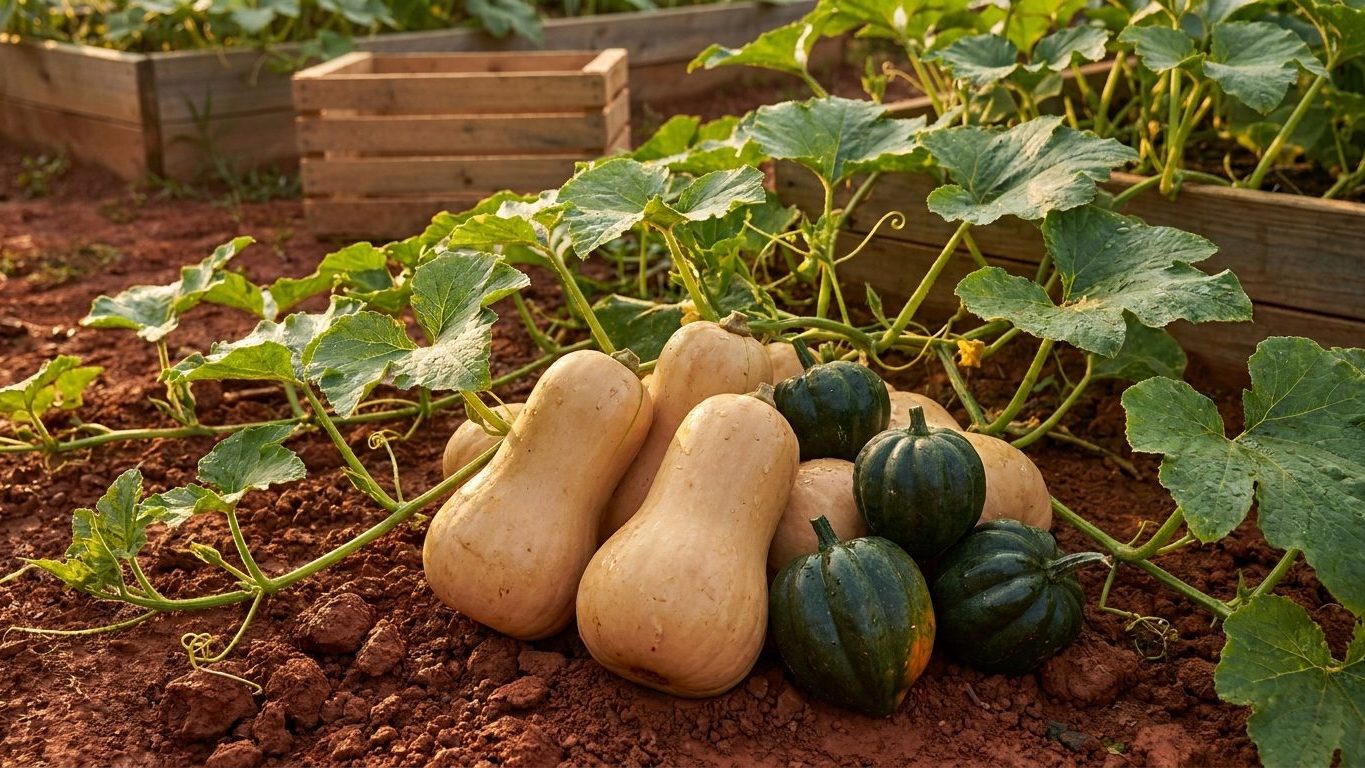

Winter Squash in Iowa comes down to matching maturity length to a season that looks generous on paper but shrinks fast once you use the county-level numbers instead of the airport ones. Medium-maturity types (acorn, delicata, butternut) are the safe statewide pick. Short-season varieties buy insurance up north. Long-season giants only pencil out in the warmer southern counties, and even there they need a head start.
The short answer for Iowa
Pick winter squash by days-to-maturity, not by name recognition, because Iowa’s frost-free window is not as wide as the raw station data suggests. The airport station behind these normals (NOAA NCEI 1991-2020) puts the last spring frost at April 12 to April 24 and the first fall frost at October 14 to October 25, a spread that could run as long as 196 days in a mild year. But Iowa State Extension’s own county figures, built from 1950 to 2021 records, run about 4 days later in spring and 10 days earlier in fall than that airport reading. Push both dates to their cautious end and the working season for a squash vine drops to roughly 159 days, last frost near April 28, first frost near October 4.
That 159-day floor is the number that should drive variety choice, because a winter squash has to size up, ripen its rind, and cure on the vine before that first fall frost, not just survive it.
| Squash type | Typical days to maturity | Fits the 159-day conservative window | Fits the up-to-196-day optimistic window |
|---|---|---|---|
| Delicata, acorn, spaghetti | 80-100 | Yes, with margin | Yes |
| Kabocha | 90-100 | Yes | Yes |
| Butternut, buttercup | 100-110 | Tight; start transplants indoors | Yes |
| Large hubbard, giant pumpkin-type squash | 110-130+ | Risky statewide | Only in a warm year or the state’s southern counties |
Heat load backs this up rather than fighting it. Des Moines averages 18.4 days a year at 90F or above, which is enough warmth to finish a 90 to 100-day squash properly without the vine stalling, but it is not the kind of long, blazing summer that pushes a 120-day giant across the finish line inside a 159-day frame. The heat is adequate for the medium group; it is the calendar, not the thermometer, that rules out the slow ones in most Iowa gardens.
What will not work here
The clearest failure mode is a long-season squash planted on faith that fall will be kind. A giant hubbard or a large pumpkin-type winter squash listed at 120 or 130 days needs almost the entire optimistic 196-day window just to mature and cure. Run into the conservative 159-day version of an Iowa season, which is the one built from the more reliable county data, and that same squash gets caught with unripe rind and thin flesh when the first hard frost hits in early October.
A weekly watering habit is the second trap, and it is a rainfall problem more than a soil one. Summer rain here averages about 13.2 inches across June, July, and August, but it is not spread evenly: June brings 5.26 inches, August 4.17 inches, and July, right in the middle of flowering and fruit set for most winter squash, drops to just 3.82 inches. Spread over a 31-day month that works out to under an inch a week, arriving at exactly the point in the season when 18.4 average days above 90F are pulling moisture out of the soil the fastest. A grower watering on a fixed weekly schedule, rather than checking the soil, is likely to hit a dry stretch in July precisely when the plant is setting fruit, and that is when squash abort blossoms or drop small fruit rather than sizing them up.
Tight spacing is the third failure, and it is a humidity problem, not a drought one. Thirteen-plus inches of summer rain combined with warm nights gives powdery mildew and other leaf fungus plenty of opportunity once foliage stays wet and airflow is blocked. Vines planted shoulder to shoulder, or crowded against a fence to save space, hold humidity around the leaves long after a rain or a dewy morning, and a squash plant with mildewed leaves by August cannot finish ripening the fruit it already set, regardless of how many days are left before frost.
What changes across Iowa
Iowa spans USDA hardiness zones 4b through 6a, and that is not a small range for a single state. The USDA system measures one thing only, the average annual extreme minimum winter temperature, so it does not directly measure growing-season length. But in practice the two track together here: the colder 4b pockets in the north tend to pair with the later spring frosts and earlier fall frosts in the ranges given above, while the warmer 6a areas toward the southern border tend to sit at the earlier, later ends of those same ranges.
That means there is no single frost-safe date or maturity cutoff for the whole state. A gardener working land near the northern edge of Iowa’s zone spread should lean hard on the 80 to 100-day group and treat anything past 100 days as a gamble worth hedging with transplants and black plastic mulch to add soil heat early. A gardener in the southern tier, closer to zone 6a, has more room to try a 100 to 110-day butternut or buttercup without extra help, and in a mild year even a 110-day type has a reasonable shot.
The USDA Plant Hardiness Zone Map is the tool for that, and it is worth checking the exact zone for a specific address before locking in a variety, rather than assuming from a county name or a nearby town.
Where to check this for your own county
Iowa State University Extension and Outreach is the source that turns this state-level picture into a county-level plan. Two things are worth looking for there specifically. The first is a county-adjusted planting calendar: since ISU’s own frost-date figures already run about 4 days later in spring and 10 days earlier in fall than the airport station, their calendar for a given county will trim the safe window further, and that trimmed number is the one to plant by.
The second is any local variety trial data for winter squash. ISU’s horticulture program periodically evaluates squash and pumpkin varieties for disease pressure, yield, and days to maturity under Iowa conditions rather than under a seed catalog’s test-plot climate, and a variety that has shown resistance to powdery mildew or vine problems in an Iowa trial is a better bet than one chosen on maturity days alone.
A county recommendation will always beat a state one, because it is built on a smaller, more specific slice of weather data and, often, on actual local trial results rather than a single reference station. Extension’s county material is where those numbers get corrected for a specific patch of ground.
Checking this against your own garden
No calendar date replaces what the plant and the soil are actually doing in a given year, and three simple checks tell a grower more than any frost-date table. The first is soil warmth by feel: winter squash seed sits and rots in cold soil rather than germinating, so a handful of soil that still feels cool and damp rather than faintly warm to the touch means the ground has not caught up to the calendar yet, whatever the average last-frost date says.
The second is the first flush of male flowers, which typically opens well before any female flower with a tiny fruit behind it. Seeing male blossoms early is a normal part of the plant’s cycle, not a problem, but it is a useful marker for timing: female flowers and real fruit set generally follow within a couple of weeks, which gives a grower a rough read on how the fruiting window is lining up against the local fall frost risk.
The third is the appearance of the first true leaves, the rougher, more deeply lobed leaves that follow the smooth seed leaves. Slow, pale true leaves point to soil that is still too cool or too wet for that spot, a sign specific to that garden’s own microclimate rather than to the county average. A garden tucked against a north-facing slope or shaded by a windbreak can run noticeably behind a neighbor’s plot even a mile away, and watching the plant itself is the only way to catch that difference.