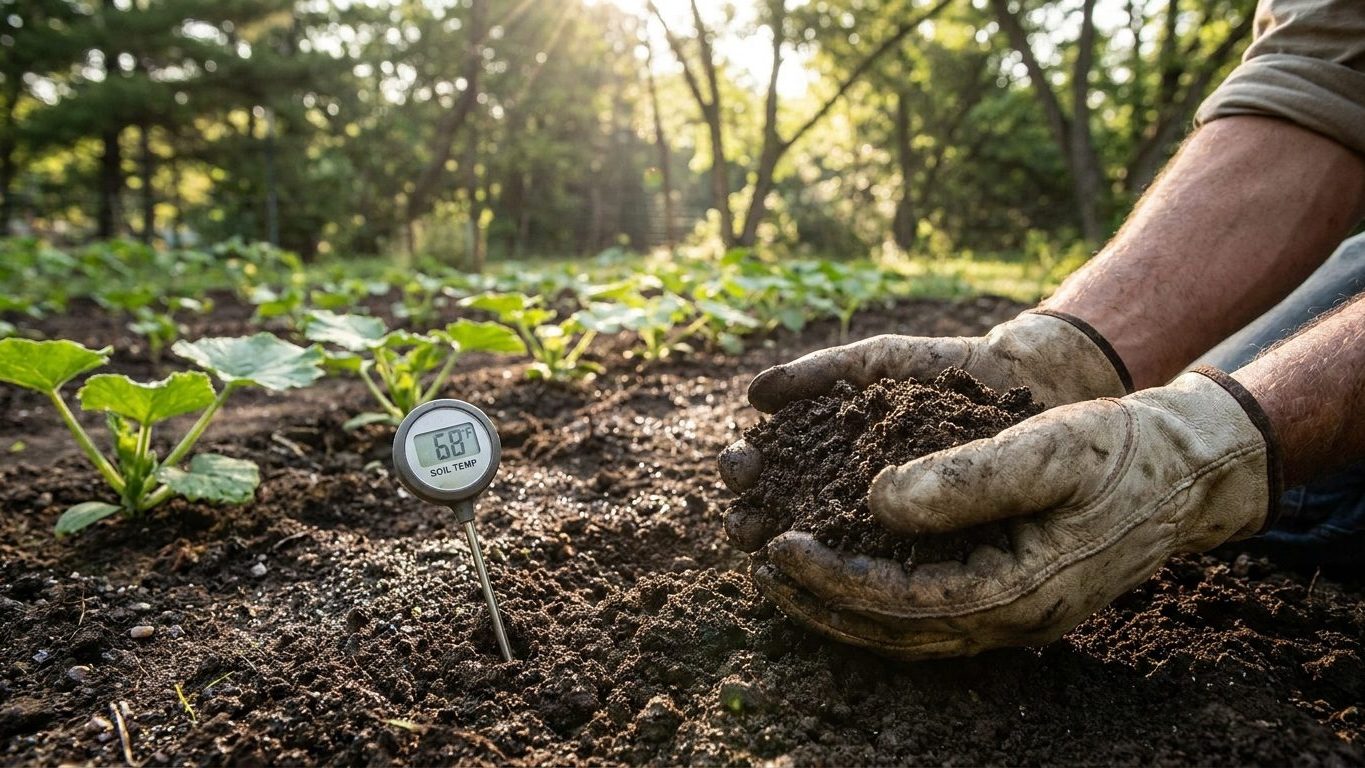

Winter squash goes into the ground in Iowa once the soil has warmed past the danger of a hard freeze, which lands roughly between mid-May and the first days of June depending on where in the state you garden. That window comes straight from the state’s spring frost data, not from a generic calendar date.
The short answer for Iowa
Iowa’s last spring frost falls somewhere between April 12 and April 24, according to NOAA’s 1991-2020 climate normals for the reference station used across these figures. That range is the 30 to 70 percent probability band for a 32°F freeze, meaning even after April 24 there’s still up to a 30 percent chance of frost in a given year at that station. It is not a guarantee, it’s a bet, and winter squash seed does not gamble well. Squash seed rots in cold, wet soil, so the practical rule is to wait until soil temperature is reliably above the mid-60s, which in Iowa usually lands two to three weeks after that spring frost band closes. That puts safe direct-seeding at roughly mid-May for the earliest ground and closer to the first week of June for cooler, heavier soils.
The other end of the season matters just as much. Iowa’s first fall frost runs from October 14 to October 25, same station, same method. Subtract the spring window from the fall one and the raw frost-free season stretches from about 173 to 196 days at the airport station the data comes from. But there’s a catch worth repeating: Iowa State Extension’s county-level figures, built from 1950-2021 records, run about four days later in spring and ten days earlier in fall than the airport numbers. That shaves the real frost-free season down closer to 159 to 182 days depending on location. Most winter squash need somewhere in the neighborhood of 80 to 110 days from seed to harvest, so the state has room to spare in most years, but that cushion gets thinner the further you push planting into June.
What will not work here
Waiting until the calendar says “safe” and then stalling is the most common way to lose the season. If a gardener direct-seeds in mid-June, hoping to dodge every last frost risk, they’re eating into a frost-free window that, on the conservative Extension numbers, may close as early as the first half of October in some counties. A 100-day squash seeded June 15 is cutting it to the wire against an October 5 frost, with zero room for a cool, cloudy stretch in August that slows fruit sizing. That’s not a hypothetical; Iowa summers regularly include a week or two of below-normal heat that pushes maturity back without anyone noticing until frost is on the forecast.
Watering on a fixed weekly schedule is another failure mode specific to this state’s rain pattern. Summer rainfall across June, July and August averages about 13.2 inches, but it isn’t evenly spread: July, the driest of the three, averages only 3.82 inches against June’s 5.26. Combine that dry July with an average of 18.4 days a year at or above 90°F, mostly falling in July and August, and a garden watered once a week on autopilot will be bone-dry by day four in the exact stretch when squash vines are setting fruit and need it most. A single thunderstorm dumping an inch in twenty minutes mostly runs off rather than soaking the root zone, so the rainfall total looks more generous on paper than it feels in the soil.
Planting the slowest-maturing hubbard or banana-type Winter Squash in the northern part of the state is a third way to come up short. Those varieties often need well over 100 days, and stacked against a conservative frost-free window that can run as short as 159 days in the north, there’s little margin left for a rough summer. Tight spacing compounds the risk: squash foliage that stays wet after those thunderstorm-style rains, packed close together with poor air movement, is an invitation for the fungal issues that show up on vine crops in humid, rain-then-heat cycles.
What changes across Iowa
Iowa spans USDA hardiness zones 4b to 6a, a range built on one measurement, the average annual extreme minimum winter temperature, and it tells you plenty about how differently the state behaves from north to south. Zone 4b, generally the colder end found toward the northern border, and zone 6a, the milder end near the southern edge, aren’t just a matter of winter survival for perennial plants. They track alongside real differences in when the ground warms in spring and when the first hard freeze lands in fall. A gardener working the zone 4b end of the state should expect both a later safe planting date and an earlier fall cutoff than one gardening near the zone 6a border, which can trim two to three weeks off the usable season on both ends combined.
There’s no single “Iowa planting date” that fits both ends of that spread. A reader in the colder north is better served starting winter squash indoors three to four weeks before the expected last frost and transplanting out, rather than direct-seeding and hoping the shortened season catches up. A reader near the warmer southern edge often has enough slack to direct-seed and still bring in a full-season variety without much worry. The right move is to check the current USDA Plant Hardiness Zone Map for the specific ZIP code before picking a variety or a start date, rather than assuming based on which part of the state feels colder.
Where to check this for your own county
Everything above is a state-level average, and Iowa is big enough that state averages smooth over real differences between, say, a river-bottom county in the south and a windswept county near the Minnesota line. The reliable next step is Iowa State University Extension. That’s the state’s land-grant extension service, and it’s where county-specific planting calendars and variety trial results actually live, rather than the airport-station averages used above.
Once there, two things are worth searching out specifically. First, the local planting calendar for the reader’s own county, which will reflect the extension’s longer 1950-2021 dataset rather than the shorter, warmer-leaning airport normals cited on this page. Second, any variety trial results for winter squash conducted at a research farm or demonstration garden near that county, since those trials show which specific varieties actually finished before frost in that local climate, not just which ones are marketed as short-season.
A county-level recommendation from that extension office will always beat a state-wide estimate like the one on this page, for the simple reason that it’s measured closer to the reader’s own soil and sky. This page describes Iowa in broad strokes; the county extension office describes one piece of it in detail. Treat the state figures here as a starting frame, not the final word, especially in a year that’s running unusually warm or unusually wet by the time planting decisions actually get made.
If you follow the almanac, here is when to plant winter squash by the moon. It is a tradition, not a proven method.
Checking this against your own garden
No date on this page, or on any extension calendar, beats what’s actually happening in a specific patch of ground. Three simple, no-equipment checks tell more than a calendar ever will. First, soil warmth by feel: squash seed wants soil that’s warm to the touch several inches down, not just on the surface, and a cold, clammy handful even in mid-May is a sign to wait regardless of what the frost tables say. Second, watch for the first flush of male flowers on any squash already growing nearby or from a prior year’s volunteer plants, since their timing reflects the actual accumulated heat of that specific yard, which can run ahead of or behind the regional average depending on sun exposure, wind shelter and how close the garden sits to pavement or a building that holds heat.
Third, the appearance of the first true leaves, the ones that show the plant’s actual leaf shape rather than the rounded seed leaves, marks the point where a seedling has moved past its most frost-vulnerable stage and started real growth. A garden that’s slow to reach that stage compared to a neighbor’s, even a few blocks away, is telling its owner something about a cooler microclimate, whether that’s a low spot where cold air pools, heavier clay soil that warms slower, or simply more shade than the open-field weather station ever accounts for.