
Kansas gardeners can grow all of the unusual roots, but the calendar splits them into groups. Kohlrabi, turnips and rutabaga suit spring and fall. Celeriac needs nearly the whole season. Horseradish and Jerusalem artichokes go in early and then stay for years. At the reference-city weather station, the last spring freeze falls between April 4 and April 18, and your own county will probably run later.
When the soil is warm enough in Kansas
The last spring freeze at the reference station falls between April 4 and April 18. That comes from the NOAA NCEI 1991-2020 Climate Normals, using the 32 F freeze probabilities (30-70% band) at an airport weather station. It is a band of dates, not a deadline, and a frost date is a probability, not a promise. Say it once and plan around it.
Those numbers describe an airport. Suburban and rural gardens typically see the last spring frost later, often by one to two weeks, and more at elevation. Add two weeks to April 18 and you land on May 2. Check the normals for your own county before you commit seed.
Why frost dates only get you partway
Frost is a proxy. These roots wait for warm soil, and soil warms after the frost risk ends, not with it. Air can turn mild on a sunny afternoon while the ground a few inches down is still cold and wet. Heavy clay lags behind sandy loam. Seed sitting in cold, soggy ground tends to rot or sulk, and celeriac transplants that meet a cold snap can stall.
A soil thermometer pushed to planting depth in the morning beats any calendar. K-State Research and Extension publishes the soil conditions each vegetable wants, and those thresholds are worth trusting over a rule of thumb. Quick roots like kohlrabi and turnips can go in as soon as the bed is workable. Celeriac waits for settled warmth.
Site the permanent ones first
Before you buy tubers, decide where Jerusalem artichokes will live, because they are effectively permanent once planted. Every fragment of tuber left in the soil regrows, and digging never gets them all. Give them a corner you are willing to dedicate, or a bed bounded by a lawn edge, a path or a wall, and keep them out of your vegetable rotation entirely. It is probably the most regretted planting in the whole vegetable garden.
Horseradish behaves the same way. Pieces of root left behind send up new crowns. Plant both in early spring once the ground is workable, well before the tender crops, and choose the spot as if you will never move them. You probably will not.
How long the season lasts here
Both dates come from the same NOAA normals. The first fall freeze at the reference station falls between October 23 and November 2. Pair the earliest spring date with the earliest fall date (April 4 to October 23) and you get 202 days. Pair the latest with the latest (April 18 to November 2) and you get 198. The extremes run from 188 days (April 18 to October 23) to 212 days (April 4 to November 2).
Rural gardens give some of that back. With a later spring freeze and an earlier fall one, each by a week or two, the window can shrink by two to four weeks. A farm garden in a cold hollow may sit near the short end of the range even if the airport sits near the long end.
What does a window of that length allow? A second sowing, for one thing. Kohlrabi and turnips can go in during spring and again in late summer, so they mature as nights cool. In a Kansas summer the fall crop often has the easier time, since quick roots left to mature in July heat tend to turn tough or bitter. A short window would make the first sowing the only one. Here it is an option, not a necessity. The succession sowing guide on this site lays out how to stagger the dates so you are not harvesting everything in the same week.
The window also settles the transplanting question. Taprooted crops resent root disturbance, so they are better sown where they will grow. Celeriac is the opposite case. It is the long one of the group, and it needs a head start indoors to finish at all. Across 188 to 212 days, starting it indoors and setting it out once nights are mild makes sense. In a territory with a season of 120 days it would not.
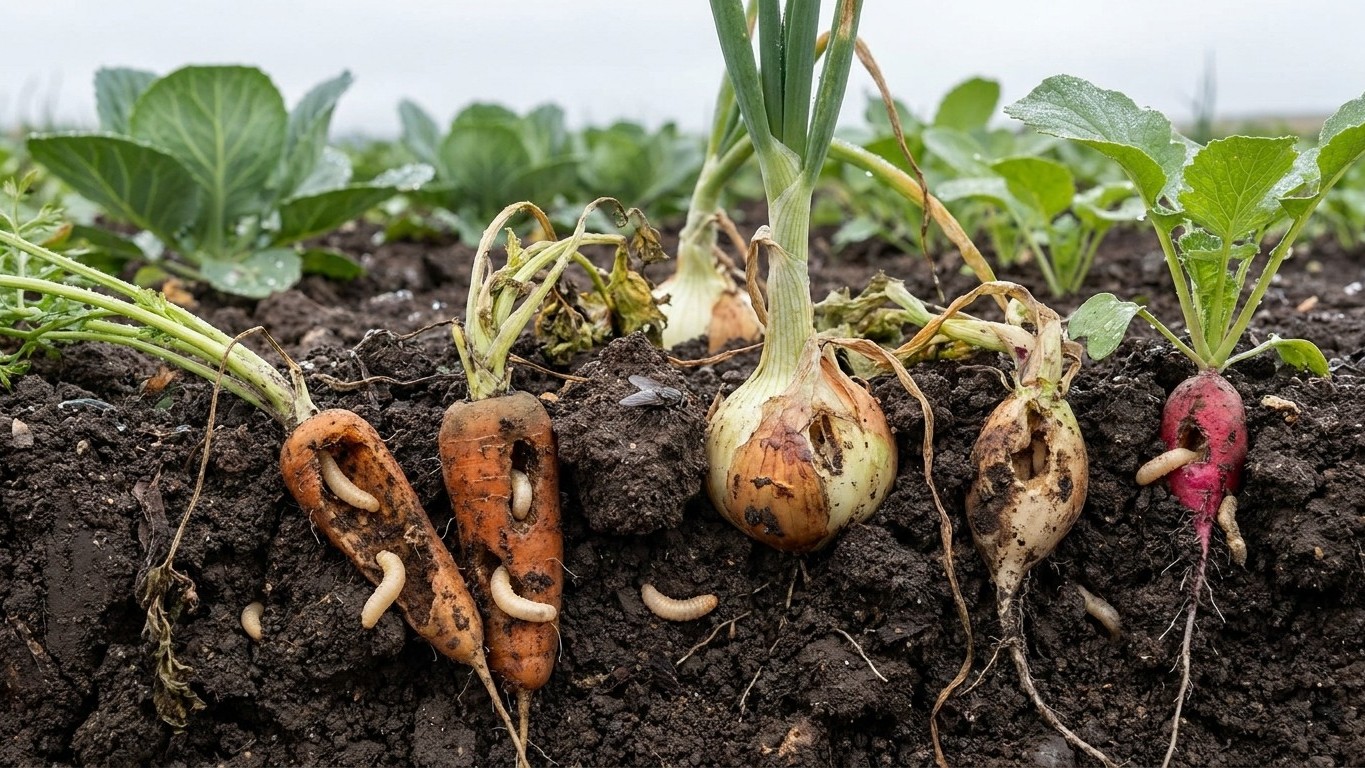
Turnips and rutabaga are brassicas. They share their troubles with cabbage, kale and mustard, so a second sowing in the same bed is fine for a season, but next year’s rotation must move them away from every other brassica. Putting turnips where cabbage grew rotates nothing. The crop rotation guide on this site explains the groupings.
Heat and water in Kansas
The verified figures for this page do not include a count of days above 90 F or a summer rainfall total, so none appears here. What can be said plainly is that Kansas summers are hot, and rain tends to arrive in bursts rather than as a steady supply. For the cool-season roots, summer heat is the bigger stress than frost. Your county extension office and NOAA’s local normals have the actual numbers.
The practical response does not depend on the exact count. Mulch shades the root zone and slows moisture swings. Even watering matters more than heavy watering, since a dry spell followed by a deluge splits roots and leaves kohlrabi woody. Celeriac is the thirstiest of the group and the least forgiving of dry spells. Spacing for airflow keeps foliage dry after storms, which helps against fungal trouble.
Season length decides whether celeriac can finish here at all. With 188 to 212 days at the reference station, it has room, provided it starts indoors and the bed stays mulched through July and August. Cut that window by a few weeks in a cold rural spot and the margin thins.
The winter low governs the rest. The mean daily minimum of the coldest month at Wichita is 22.5 F (NOAA NCEI Climate Normals 1991-2020). The USDA Plant Hardiness Zone Map (2023) puts the state at zones 5b to 7a. That system rests on a single variable, the average annual extreme minimum, and it is a range, so the north and the south of Kansas differ.
For most gardens in the state, horseradish and Jerusalem artichokes sit in the ground all winter without protection. Hardy roots can stay too, under a deep mulch, and be dug on mild days. But 22.5 F is an average. Individual nights go lower, so mulch generously. Celeriac is the one to lift before the soil freezes hard.
Anything you lift and store needs inspecting. Check each root for firmness and look closely at the crown. A soft patch, a weeping spot or a moldy crown ends the question: discard that root. A root that looks sound is not proof that it is safe, and no calendar promise about keeping time replaces looking at what is in the bin.
Which these root crops suit Kansas
The choice here comes down to type. A window of 188 to 212 days does not force you toward the very earliest types, but the heat points to roots that get airflow and shade at the base. A wet spring makes disease resistance the first thing to look for on a seed packet.
| Type | Fit for Kansas | What it needs |
|---|---|---|
| Kohlrabi and turnips | Good in spring and again in fall | Timing away from midsummer, even moisture |
| Rutabaga | Suited to a fall-maturing crop | Sowing timed so roots swell in cool weather |
| Celeriac | Possible, with a head start | Indoor start, mulch, steady water, lifting before hard freeze |
| Horseradish | Hardy across the state’s zones | A permanent, contained site |
| Jerusalem artichoke | Hardy, and then some | A dedicated bed it can never leave |
Kohlrabi, turnips and rutabaga are brassicas, so they inherit every disease and pest of cabbage and kale. Disease resistance matters most for them. Rotate them away from the whole family, not just from each other.
This page names no varieties, and that is deliberate. The only variety advice worth acting on is what has been trialled where you garden, and nothing here can source that. A cultivar that thrives in one county can fail in another, and a made-up name would be worse than none. K-State Research and Extension and your county office are the places to ask which types have done well locally.
Two kitchen notes. Grating fresh horseradish releases compounds that burn the eyes and airways. Work with good ventilation and keep your face away from the bowl. And Jerusalem artichokes store inulin instead of starch, which causes digestive discomfort in many people. A small first portion is the sensible way to find out where you stand.
For crop-by-crop growing detail, see Celeriac, Kohlrabi, Horseradish and Jerusalem Artichokes. To compare how another climate changes the plan, read Growing Unusual Root Crops in Kentucky or Growing Unusual Root Crops in Quebec.
Common questions
Can I plant on the last frost date?
Not for the tender ones. The reference station’s April 4 to April 18 band is a probability, and soil warms later than air. Quick roots like kohlrabi and turnips can go in earlier. Celeriac should wait for settled warmth.
Do horseradish and Jerusalem artichokes survive Kansas winters?
Both are hardy through the state’s zones (5b to 7a on the USDA 2023 map). Wichita’s coldest-month mean daily minimum is 22.5 F. A layer of mulch is cheap insurance on colder nights.
Can I plant turnips where cabbage grew?
No. Turnips and rutabaga are brassicas and share diseases and pests with cabbage, kale and mustard. Rotate them away from the whole family.
How do I tell if a stored root has gone bad?
Check each one for firmness and examine the crown. A soft patch, a weeping spot or a moldy crown means discard it. Looking sound is not proof of safety.