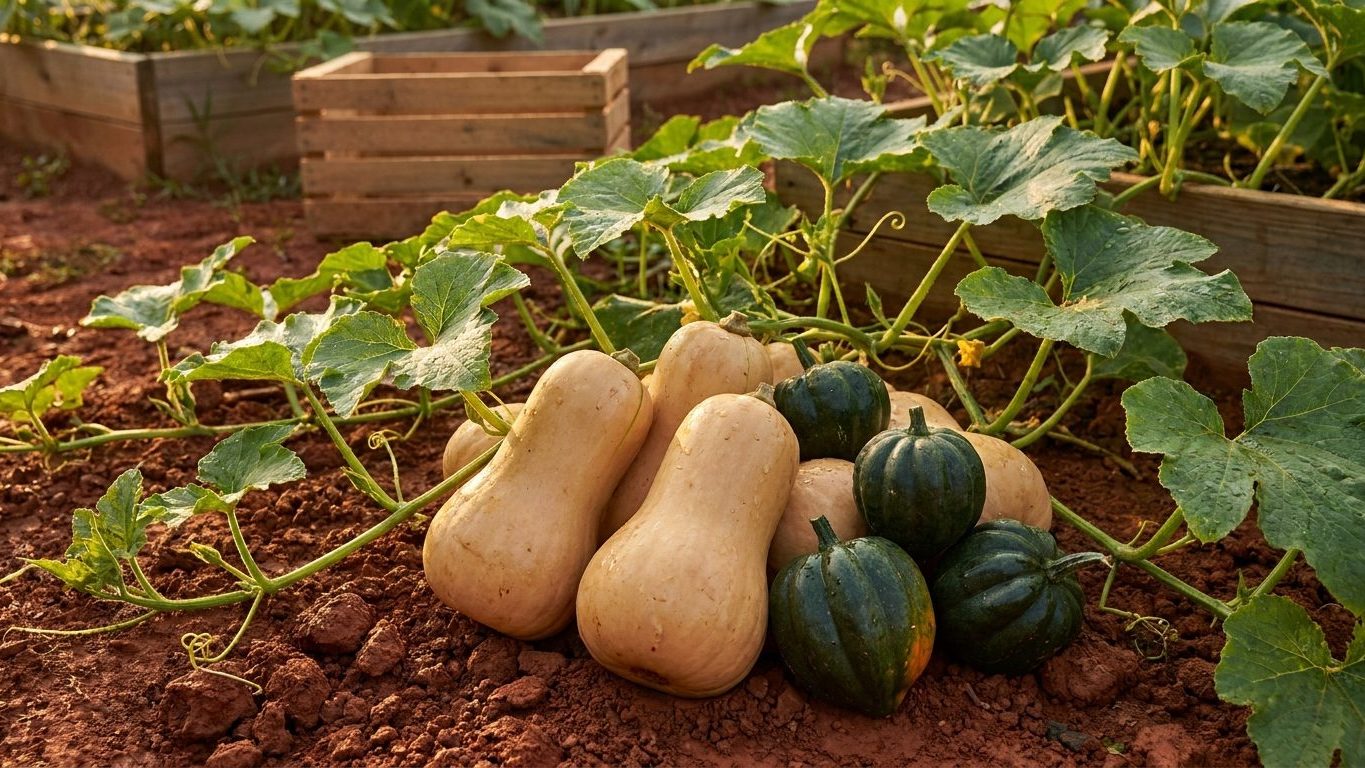

For Kansas gardens, the growing season is long enough to finish almost any winter squash on the calendar, so the real choice isn’t about time, it’s about heat and dry midsummer stretches. Butternut, kabocha and spaghetti squash handle both better than delicate, thin-skinned types, which makes them the safer bet across most of the state.
The short answer for Kansas
Start with the math, not the seed catalog. NOAA’s 1991-2020 climate normals put the last spring frost in the reference station’s window between April 4 and April 18, and the first fall frost between October 23 and November 2. Stack those two windows against each other and the frost-free season runs somewhere between 188 and 212 days, depending on where the actual dates fall within that band in a given year. That’s a wide margin. Even a slow Hubbard squash needing 110 to 120 days to mature has room to spare, with weeks left over for curing on the vine before frost.
So season length isn’t what should drive the variety choice here. Heat is. The same station averages 57.6 days a year at 90F or hotter, and that heat load lands squarely in June, July and August, the exact stretch when winter squash is setting blossoms and sizing fruit. Add a summer rainfall total of about 13.2 inches across those three months, with July running driest at just 3.98 inches, and the picture shifts from “how much time do I have” to “how much stress will this plant tolerate while it’s trying to flower.”
Which types hold up
Butternut squash tends to shrug off heat stretches better than most, setting fruit even when afternoons climb past 90F for days in a row. Kabocha and spaghetti squash follow close behind, with thicker vines and a deeper root system that rides out a dry July more comfortably than thinner-vined types. Acorn squash sits in the middle: reliable, but happier with a bit more consistent moisture than butternut demands.
| Type | Typical days to maturity | Fit for Kansas heat and dry July |
|---|---|---|
| Butternut | 90-110 | Strong |
| Kabocha | 90-100 | Strong |
| Spaghetti | 90-100 | Good |
| Acorn | 80-95 | Moderate, wants steadier moisture |
| Delicata | 80-100 | Weaker without irrigation |
| Hubbard | 100-120 | Good, but needs the full season |
None of these numbers come close to bumping against the 188-day floor of the state’s growing season. That’s the point: in Kansas, maturity days aren’t the deciding factor. Water demand under heat is.
What will not work here
The season-length failure mode that trips up gardeners in short-summer states doesn’t really apply in Kansas. With 188 to 212 frost-free days on the table, there’s no winter squash sold in a home garden catalog that runs out of time here, including the slowest Hubbard strains. If a squash fails in a Kansas garden, the cause is almost never “it needed more days than the calendar gave it.”
What actually fails is anything bred for a cool, damp coastal growing season and asked to bloom through 57.6 days a year at 90F or above. Blossom drop is the tell: flowers open, look fine for a day, then wither without setting fruit. That’s heat stress on the pollen, not a pest or disease problem, and it hits hardest in varieties selected for mild-summer regions rather than the Plains. A squash that sails through a Pacific Northwest July can stall out completely during a Kansas heat run in late June.
The dry-July trap
The second failure point is watering on a schedule instead of watching the soil. With only 3.98 inches of rain landing in July on average, a squash plant watered once a week on a fixed routine is running a moisture deficit through the exact weeks it’s trying to size fruit. Thin-skinned, shallow-rooted types feel this first: fruit stays small, skins toughen early, or vines wilt hard by midafternoon even when the morning looked fine. This isn’t a soil problem so much as a mismatch between a fixed watering habit and a summer that front-loads its rain into June (4.93 inches) and pulls back sharply by July.
Varieties marketed as needing “consistent, even moisture” are the ones most likely to disappoint under this rainfall pattern unless a gardener is prepared to irrigate deliberately rather than casually. Deep, infrequent watering that reaches the root zone beats a light daily sprinkle every time in a July this dry, because a light sprinkle mostly wets the surface and evaporates before it does the plant any good, especially with 90-degree afternoons pulling moisture straight back out of the soil.
What changes across Kansas
Kansas isn’t one climate wearing a single state line. The USDA Plant Hardiness Zone Map, built on average annual extreme minimum temperatures, places the state across a 5b-7a range. That’s a meaningful spread: 5b marks a colder extreme minimum than 7a, and the gap between them shows up in more than just winter survival numbers. It shifts the practical planting calendar too, since colder zones tend to run later last-frost dates and earlier first-frost dates than warmer ones, which squeezes the frost-free window described above.
A gardener working land closer to the 5b end of that range, generally the state’s higher-elevation and more northern and western pockets, should expect the frost-free season to run shorter than the 188-to-212-day range calculated from the reference station’s normals. Someone gardening closer to the 7a end can generally expect that window to run longer, sometimes comfortably past it. Neither end changes which squash type suits Kansas’s heat and dry-July pattern, since that reasoning holds statewide, but it does change how much buffer a gardener has for a slow-finishing Hubbard or a delayed transplant.
The USDA’s zone map is built for exactly that lookup, using location data far more granular than a state-level summary can offer.
The practical takeaway: treat the 188-to-212-day season range as a starting estimate, not a guarantee, and lean toward the shorter end of that range when planning a squash that needs the full 110-plus days to mature, unless local experience says otherwise.
Where to check this for your own county
Every number here comes from a single reference weather station, and Kansas is too large and too varied for one station to speak for every county. That’s what K-State Research and Extension exists to fix. Their site publishes county-level guidance built from local data rather than a single airport station’s 30-year average.
Two things are worth hunting down there specifically. First, the local planting calendar for the reader’s own county, which accounts for microclimate differences: elevation, proximity to a river valley, urban heat retention, or a colder low spot that collects frost longer than the surrounding land. Second, the variety trial results for winter squash conducted in or near that county, since K-State’s horticulture programs run field trials that test how specific cultivars perform under Kansas conditions rather than under a seed catalog’s marketing copy.
Why the county beats the state
A state-level page like this one is built to be true across a wide range of conditions, which necessarily means it can’t be precise about any single one of them. It reasons from a hardiness zone spread of 5b to 7a and a single reference station’s frost dates. A county extension recommendation reasons from soil surveys, local trial plots and years of grower feedback specific to that patch of ground. When the two disagree, even slightly, the county source should win.
NOAA’s climate normals and USDA’s hardiness zone data are solid, sourced, and current through the 2020 update. But they’re built for regional planning, not for deciding whether a particular garden three counties over from Wichita should push planting a week earlier or later than the state-level window suggests. The extension office closes that gap.
Checking this against your own garden
Every date and average describes a reference station, not a specific backyard. The plant itself is a better instrument than any calendar, and it doesn’t need a thermometer to prove the point.
Three signs are worth tracking before trusting any planting date over what’s actually happening in the dirt:
- Soil warmth by feel: winter squash seed germinates poorly in cold soil regardless of what the frost-date calendar says. Push a bare hand two inches down in the morning; soil that still feels cold to the touch, even after a warm afternoon the day before, isn’t ready yet.
- First flush of male flowers: male blossoms typically open days to a couple of weeks before the females that actually set fruit. Their appearance is a reliable sign the plant considers conditions warm enough to start reproducing, regardless of the calendar date.
- First true leaves: the rounded seed leaves that emerge first don’t tell much. The next set, the ones shaped like the mature plant’s leaves, signal the plant has moved past the fragile seedling stage and into active growth, a useful marker for judging whether this particular spring ran warmer or cooler than the reference station’s average.
A garden that hits these markers noticeably earlier or later than the state-level windows described above isn’t wrong. It’s just telling the truth about its own microclimate, whether that’s a warm south-facing slope running ahead of the reference station or a low, shaded spot running behind it. That local read, taken season after season, ends up more useful than any single date.