
Winter Squash in Kansas grows best when gardeners work backward from the state’s real limiting factor: not the calendar, but the combination of a moderate frost-free window, strong summer heat, and rainfall that dries up right when the vines need it most. Get the timing and water right, and most types will mature before the first fall frost.
When the soil is warm enough in Kansas

The question every gardener asks first is “when do I plant?” For Kansas, the honest answer starts with the last spring frost recorded at the state’s reference weather station: April 4 to April 18, according to NOAA’s 1991-2020 Climate Normals (32°F freeze probability, 30-70% band, station USW00003928). That’s a two-week spread, not a single date, because frost risk is a probability curve, not a switch that flips on one morning.
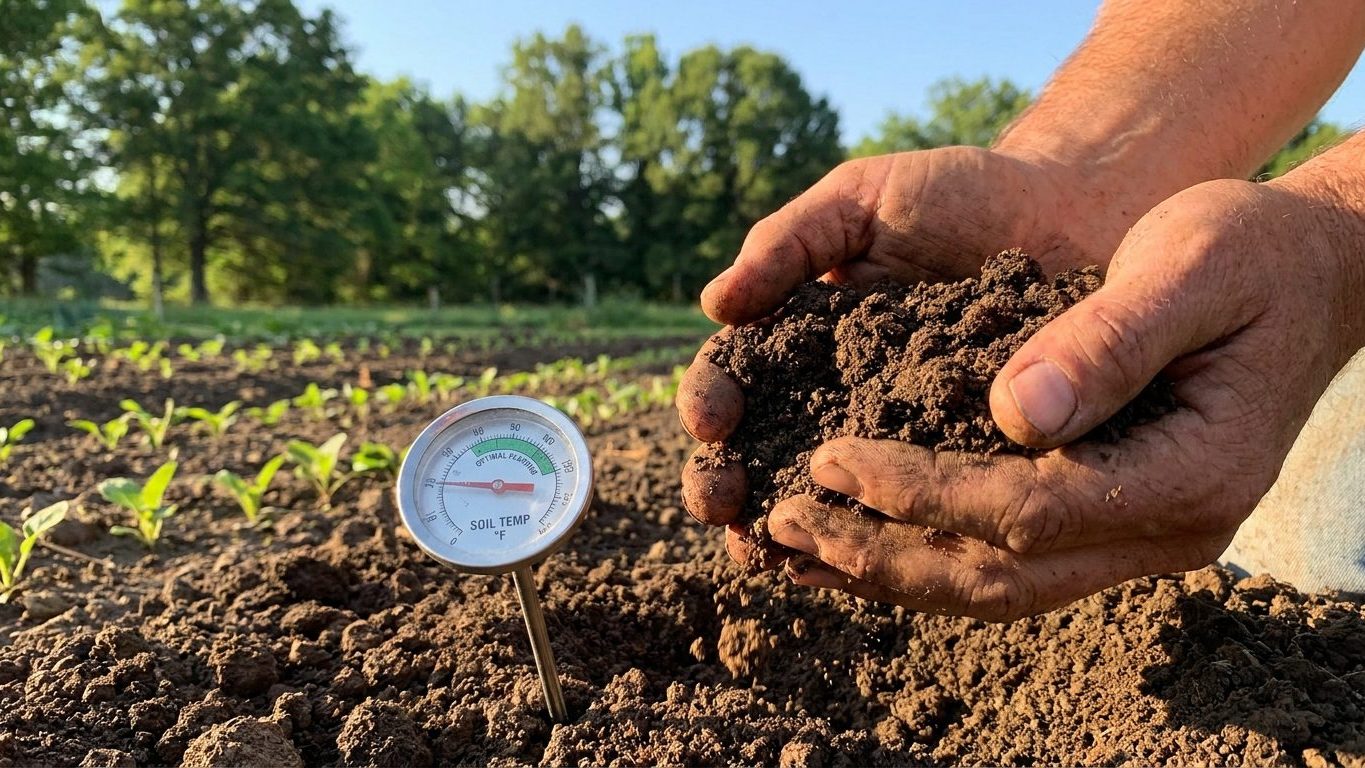
Here’s the part that trips people up: frost date and planting date are not the same thing. Winter squash seed doesn’t care whether the air went below freezing last week. It cares whether the soil itself has warmed enough to germinate without rotting in cold, wet ground. Squash is a warm-season crop through and through, and cold soil slows germination to a crawl or kills the seed outright before it ever breaks the surface. So the frost date matters only as a floor: it tells you the earliest point at which a young squash plant would even survive a cold night. The soil usually needs another one to two weeks of warming after that before direct-seeding winter squash makes sense.
There’s also a gap between what the weather station measures and what happens in an actual backyard. The April 4-18 window comes from an airport-based station, and suburban and rural gardens across Kansas typically see their last frost land later than that, sometimes by one to two weeks, more if the garden sits at higher elevation or in a low spot where cold air pools. Treat the state figure as a reference point, not a guarantee, and track your own county’s frost history before committing seed to the ground.
Kansas sits across USDA Hardiness Zones 5b to 7a, according to the USDA Plant Hardiness Zone Map (2023, built on 1991-2020 normals). That range matters more for perennials than for an annual crop like squash, but it’s a useful reminder that a recommendation dialed in for the reference city won’t automatically fit a garden two hours away in a colder or warmer pocket of the state. When in doubt, lean later rather than earlier. Winter squash rarely loses much by going in a week after the soil is genuinely warm, but it can lose the whole planting to a cold, slow start if it goes in too soon.
How long the season lasts here
Subtract the two frost windows and you get the frost-free season, though because both dates come as ranges rather than single days, the honest answer is itself a range. Using the most conservative combination, the latest likely spring frost (April 18) to the earliest likely fall frost (October 23), gives roughly 188 frost-free days. Stretch it to the outer edges of both windows, the earliest spring frost (April 4) to the latest fall frost (November 2), and the window opens to about 212 days. Either way, that’s a genuinely long growing season by national standards, and it’s the single biggest advantage a Kansas gardener has with winter squash.
A window that long changes the math on how you plant. Winter squash generally needs a long run of warm weeks to go from seed to a mature, cured fruit, and a season pushing 190 to 210 days gives real breathing room. It means a first sowing that gets delayed by a cold, wet spring, or knocked back by an early pest problem, still has time to recover and finish. It also opens the door to a second, later sowing of a fast-maturing type as a backup or a staggered harvest, something gardeners in shorter-season states simply can’t risk.
That said, a long window doesn’t erase the value of starting some plants indoors. Transplanting winter squash is a judgment call everywhere, because the crop resents root disturbance more than most garden vegetables. With a season this generous, direct-seeding once the soil has warmed is usually the simpler, lower-risk path, and transplants become more of an insurance policy for gardeners who want an earlier harvest or who lost a first direct-seeded round to a slug or cutworm problem. If you’re weighing a second planting or want the full mechanics of staggering sowings through a long Kansas season, the succession sowing guide on this site walks through the spacing and timing in detail.
Heat and water in Kansas

Kansas earns its reputation for summer heat honestly. The reference station (Wichita) logs an average of 57.6 days a year at or above 90°F, per NOAA’s 1991-2020 Climate Normals. That’s not a description of every square mile of the state, since local heat load shifts with elevation, tree cover and soil, but it’s a solid signal: this is a hot-summer territory where water demand climbs fast once the vines are running and the fruit is filling out.
Rainfall doesn’t fully keep pace with that heat. Summer rain across June, July and August averages about 13.2 inches at the same reference station, out of 34.3 inches for the year, with July running driest at just 3.98 inches (June brings 4.93, August 4.3). July is exactly the month when winter squash fruit is often sizing up and needs the most consistent moisture to fill out properly. A dry July stacked on a run of 90-degree days is the classic setup for stalled fruit growth and stressed vines.
This is where the crop’s core rule shows up: a winter squash fruit that doesn’t fully mature on the vine before frost won’t cure properly in storage, and it won’t keep. Unlike a lot of garden vegetables, there’s no picking it early and letting it “finish” indoors. That makes irrigation the practical lever in a hot, seasonally dry state like Kansas, not because the whole summer is short on rain, but because the driest month often lands during the exact stretch when fruit is filling. Deep, infrequent watering that reaches the root zone, plus mulch to slow evaporation off the soil surface, does more here than frequent light sprinkling, especially through a July dry spell layered onto a run of 90-degree afternoons. A single summer thunderstorm dumping half an inch in twenty minutes mostly runs off rather than soaking in, so a rain gauge on your own plot tells you far more than the seasonal average ever will.
Which winter squash suit Kansas
Given a season that regularly runs 188 to 212 frost-free days, most winter squash types have enough time to mature fully in Kansas, which shifts the real decision toward heat tolerance and airflow rather than speed. Acorn and delicata types tend to finish earlier and can work well as a hedge against an unusually cool, late spring or as a second sowing. Butternut types generally want the full length of a long season and reward it with fruit that stores especially well. Hubbard and other large-vine types need room to sprawl and benefit from being planted where afternoon shade or good air movement can offset the stretch of 90-plus-degree days.
Given how many days a Kansas summer spends above 90°F, root-zone shading through mulch and a planting layout that avoids crowding, which traps heat and humidity, does more for a vine’s staying power than any single input choice. Good airflow between plants also matters more here than it would in a cooler, drier state, since heat stress alone can knock back fruit set even before disease enters the picture.
What this page won’t do is hand you a variety name. The types above describe families with real differences in vine size, days to maturity and heat handling, but naming a specific cultivar without knowing how it performed in Kansas trials would be a guess dressed up as advice. That’s exactly the gap the Kansas State University Research and Extension service is built to fill: local trial data on which specific varieties within each type actually held up through Kansas heat and dry spells, tested on Kansas soil, not a national average. A gardener choosing between two acorn varieties or three butternut strains deserves an answer built on that local record, not a name pulled from a page that has never seen their county’s soil or summer.