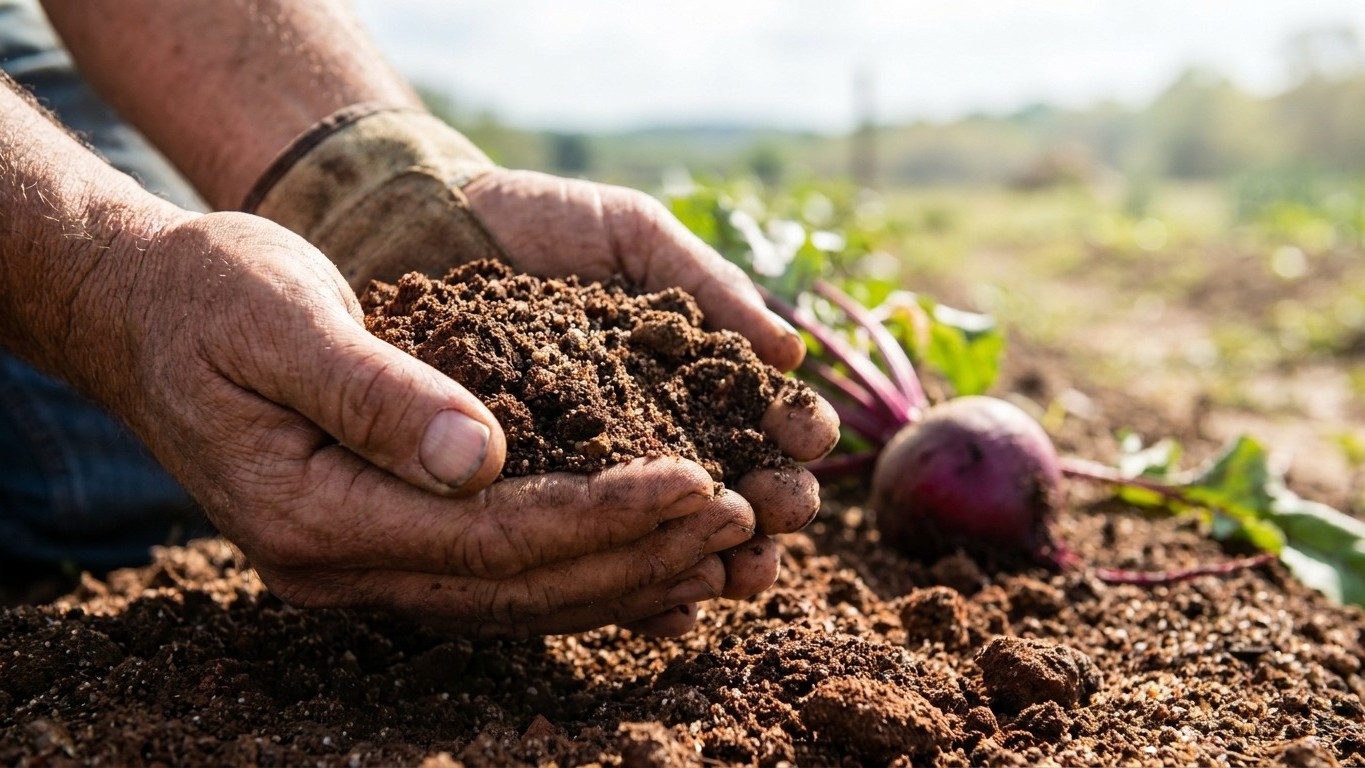

Kentucky’s own state soil, the Crider series, is a well-drained silt loam built for trees, not row crops, and that matters more to a beet than most gardeners realize. The real trouble for beets here isn’t the ground at planting time. It’s the six weeks right after the seed goes in, when a Kentucky spring can swing from mud to drought and back before the first true leaves show.
The short answer
Kentucky’s official state soil, named by state law in 1990 and tracked by the USDA NRCS State Soils program, is the Crider series. It’s an Alfisol, the kind of forest soil that formed under hardwoods and holds nutrients at a moderate level rather than a rich one. The surface horizon runs slightly acid, with a pH around 6.2, and it’s textured as a silt loam: about 5 percent sand, 19 percent clay, and 76 percent silt. Organic matter sits around 3.0 percent, and drainage is classified as well drained.
For a beet, that texture cuts both ways. Utah State University Extension describes the ideal beet bed as deep, sandy, and well-drained, rich in organic matter. Crider clears the drainage bar easily but misses the sand target by a wide margin. A soil that’s three-quarters silt tends to pack down after a hard rain, forming a thin crust on top that a beet seedling, one of the weaker emergers in the vegetable garden, can struggle to punch through. The 3.0 percent organic matter figure is workable but not generous, which is why USU’s guidance caps amendment at 1 inch of composted organic matter per 100 square feet rather than calling for heavier feeding.
There’s no published figure here for how many days a year the Louisville reference station spends above 90 F, so that specific count won’t be stated as fact. What is documented is the threshold that actually matters for beet quality: once air temperatures push past 85 F while the plant is also short on water, the root turns woody. Kentucky summers reliably reach and hold above that 85 F mark for extended stretches, which puts the burden on soil moisture management through the hot months, not on any particular day count.
None of this describes any single backyard. Kentucky spans hundreds of mapped soil series, and a garden in river bottomland, on a hillside, or on ground a builder scraped and refilled can behave nothing like Crider. Treat these numbers as a regional starting point, then pull an actual soil test for the bed in question before amending anything.
The six weeks that decide it here
NOAA’s 1991-2020 climate normals put the last spring frost for the Louisville reference station between March 24 and April 4, based on the 30 to 70 percent freeze-probability band. Sowing beets 2 to 3 weeks ahead of that date, which is standard practice for a cold-tolerant root crop, lands the seed in the ground in mid to late March and pushes the first six weeks of growth, the window Utah State University Extension flags as the critical one for water stress, straight through the most unsettled stretch of the Kentucky calendar.
That stretch doesn’t run one direction. Kentucky spring is known for swinging hard between soaked and dry within the same month, sometimes within the same week, rather than settling into a steady wet or steady dry pattern the way some regions do. A cold front can drop an inch of rain and then hand off to ten days of drying wind, and it’s that second half, the dry swing, that lines up with the exact window USU identifies for bolting risk. Beets under water stress in those first six weeks don’t just slow down, they read the stress as a signal to skip straight to flowering, and a bolted beet stops building the root the gardener actually wants.
The Louisville station itself carries a caveat worth taking seriously. The National Weather Service office covering that area has noted that this urban station runs later in spring and earlier in fall than the surrounding rural Jefferson County, meaning a rural garden should plan for a tighter frost-free window than the March 24 to April 4 range suggests. For a crop where the entire risk period is set by the sowing date relative to last frost, that gap between urban station and rural garden is not a rounding error, it’s the difference between week one and week three of the six-week clock.
The practical takeaway is that irrigation planning for a Kentucky beet bed needs to start at seeding, not after the seedlings are up. A soil that crusts easily under silt-heavy conditions already makes germination harder; adding a dry spell on top of that during the exact window when bolting risk is highest is where a lot of Kentucky beet crops go sideways before summer even starts.
What goes wrong here
- Surface crusting blocks germination. Crider’s 76 percent silt content means a hard spring rain followed by sun can bake a crust over newly sown beet seed. Keep the top inch loose with a light scratching before sowing, and consider a thin layer of fine mulch or vermiculite over the row to break the force of rain rather than working the bed while it’s still wet, which makes silt soils compact worse.
- Early dry spells trigger bolting. Because the first six weeks after seeding fall inside Kentucky’s variable spring, a run of dry, windy days during that exact window causes water stress that pushes beets to bolt instead of bulking a root. Watering on a set schedule through germination and the following month, rather than waiting for visible wilting, closes this gap.
- Summer heat above 85 F turns roots woody. This is a separate failure from bolting, caused later in the season once the root is already forming. Mulching to hold soil moisture and watering deeply during hot stretches keeps the root from toughening, even after the bolting risk window has passed.
- Over-amending a moderate-fertility soil. Crider’s 3.0 percent organic matter is workable, and piling on more compost than USU’s guidance of 1 inch per 100 square feet can push nutrient balance the wrong way for root development. A soil test before amending avoids guessing.
- Trusting an urban frost date on a rural plot. Sowing by the Louisville station’s March 24 to April 4 window when the actual garden sits in surrounding rural Jefferson County risks planting into a frost the field still gets. Build in a few extra days of buffer on both ends for any garden outside the immediate urban area.
Common questions
Does Kentucky’s Crider soil need heavy amendment before planting beets?
Not necessarily. At about 3.0 percent organic matter, Crider is workable for beets as mapped, and Utah State University Extension’s guidance of no more than 1 inch of composted organic matter per 100 square feet applies here as anywhere else. A soil test on the actual bed is the only way to know if more is warranted.
When should beets go in the ground in Kentucky?
Based on the Louisville reference station’s 1991-2020 last-frost window of March 24 to April 4, sowing 2 to 3 weeks ahead of that date is the standard approach for beets. Rural gardens outside the immediate urban area should build in extra buffer, since the station is documented to run later in spring than surrounding Jefferson County.
Is bolting the same problem as woody roots?
No, and treating them as one issue is the most common mistake. Bolting comes from water stress in the first six weeks after seeding and causes the plant to flower instead of building a root. Woodiness comes later, when temperatures exceed 85 F while the plant is also short on water. They need different responses at different points in the season.
Is the Crider series the soil in every Kentucky garden?
No. It’s the state’s official representative soil, useful as a baseline for texture, drainage, and pH tendencies across the region, but Kentucky maps hundreds of distinct soil series. River bottoms, hillsides, and disturbed urban lots can differ entirely from Crider, which is why a direct soil test of the actual garden bed remains the only reliable number to plant by.