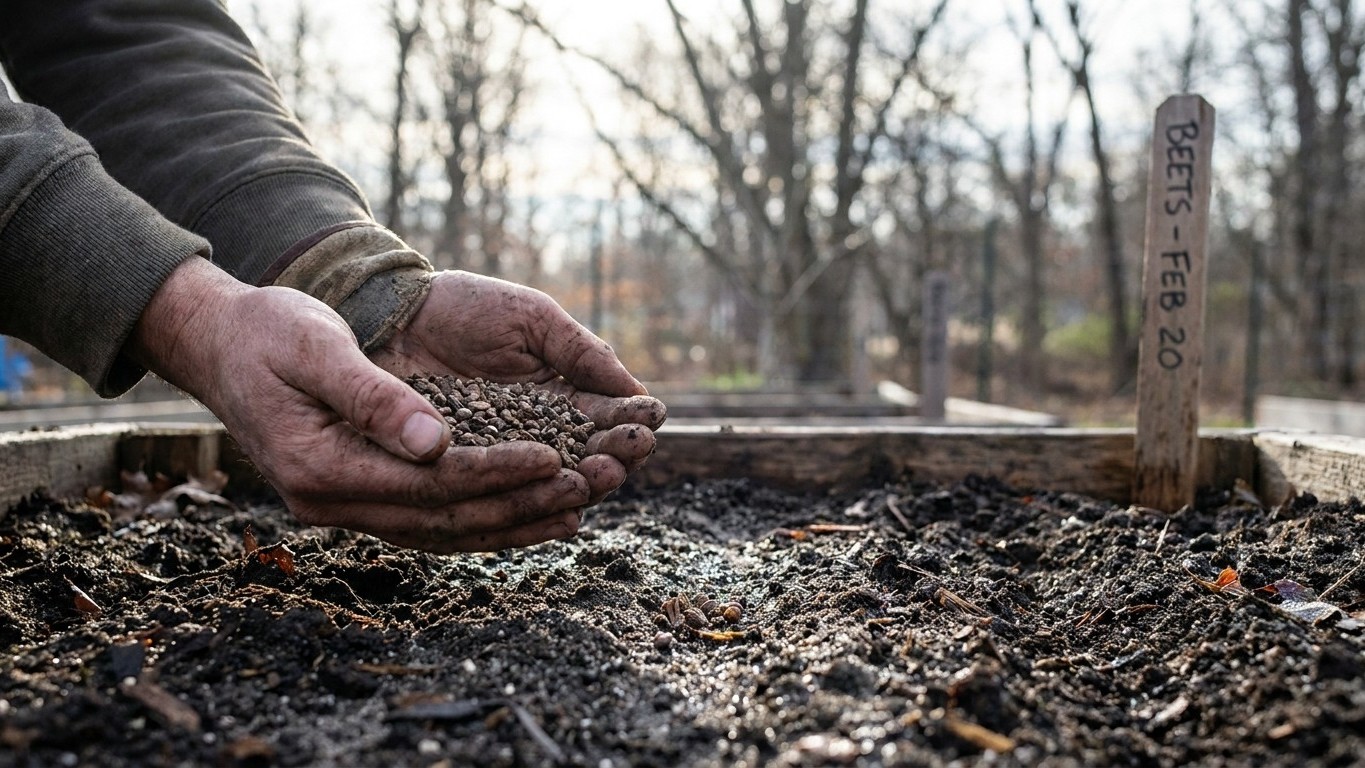

Kentucky gardeners get a workable window: sow beet seed directly in the ground two to three weeks before the last spring frost, which NOAA’s 1991-2020 climate data puts between March 24 and April 4 for the Louisville reference station. That lands direct-seeding somewhere around the first week of March through roughly March 21. The exact date matters less than what happens after it goes in the ground, because the first six weeks of a beet’s life are where the season is won or lost.
The short answer
Kentucky’s official state soil, named by state law, is the Crider series, an Alfisol formed under forest and classed as moderately fertile. The surface horizon runs slightly acid at a pH near 6.2, with a texture of about 5 percent sand, 19 percent clay and 76 percent silt, which puts it in silt loam territory. Organic matter sits around 3.0 percent, and drainage is rated well drained. That’s a lot of silt and not much sand, and it’s worth sitting with that fact before you plant.
Utah State University Extension, the only source cited on this page for beet growing requirements, describes what the crop actually wants: deep, sandy, well-drained ground rich in organic matter, with amendments capped at roughly 1 inch of composted material per 100 square feet. Line that up against Crider’s numbers and you get a partial match. The drainage class is right. The sand content is not, and a silt-heavy surface like this one can seal into a crust after a hard rain, which is exactly the kind of surface a germinating beet seed struggles to punch through.
Here’s a quick side-by-side of what the crop is asking for against what the state’s representative soil actually offers:
| What beets want | What the Crider series offers |
|---|---|
| Sandy, loose texture | Silt loam, 76% silt, only 5% sand |
| Rich in organic matter | About 3.0% organic matter, moderate |
| Well-drained | Well drained (by soil survey class) |
| Amended lightly, up to 1 in/100 sq ft compost | No native amendment; gardener adds this |
On heat, Utah State University Extension is specific about the mechanism: temperatures above 85 F combined with water stress are what turn a beet root woody rather than tender. This page does not have a published count of how many days the reference city spends above 90 F in a typical year, so that number isn’t offered here. What matters practically is that Kentucky summers do reach that threshold, and a beet crop that’s still sizing up a root when the heat arrives is at risk regardless of the exact day count.
None of this is a diagnosis of your own backyard. Kentucky spans hundreds of mapped soil series, and the Crider series is a statewide representative figure, not a measurement of a cultivated bed. River bottoms run sandier and drain faster. Hill ground and anything a builder has cut or filled can behave nothing like the survey numbers above. A soil test from your county extension office is the only way to know what you’re actually working with.
The six weeks that decide it here
Sowing two to three weeks ahead of the March 24 to April 4 frost window means the first six weeks of a Kentucky beet crop’s life fall somewhere in the stretch running from early March into late April, maybe into early May depending on when the seed actually went in. That stretch is where Kentucky spring does what it usually does: swing. Warm runs pull the soil dry fast, then a cold, wet system rolls through and saturates the same bed within days. Neither extreme sitting alone would be much of a problem. The whipsaw between them is what catches gardeners off guard.
That swing is exactly the mechanism Utah State University Extension flags as the trigger for premature flowering, or bolting, in beets: water stress during those first six weeks. A young beet doesn’t need a drought to bolt. It just needs a few days of a dried-out top few inches of soil at the wrong point in its early growth, and on a silt-heavy surface like the Crider series, that dry-out can happen faster than the deeper soil profile would suggest, because a crusted, silt-rich surface sheds a light rain rather than absorbing it evenly.
The NWS Louisville station used for the NOAA frost dates above is explicitly flagged as running warmer, later in spring and earlier in fall, than the surrounding rural Jefferson County. A garden outside the urban core should expect a tighter frost window than the March 24 to April 4 band, not a looser one. That has a direct effect on the six-week clock: a rural sowing timed off the urban date risks starting that clock a touch early relative to the local ground still being cold, or a touch late relative to how quickly a country garden warms.
The practical takeaway for this stretch of the year isn’t a single watering rule. It’s attention. Check the top two inches of the seedbed every few days through those six weeks rather than watering on a fixed schedule, because a Kentucky spring that swings between dry spells and heavy rain won’t respect a calendar-based watering plan either.
What goes wrong here
- Crusted seedbed surface. The Crider series runs 76 percent silt at the surface, and silt-heavy ground can seal into a hard crust after a rain followed by sun, trapping germinating beet seedlings underneath. Keep the top inch of the seedbed lightly moist with a light daily sprinkle until germination, or cover the row with a thin layer of straw to break the crust before it forms.
- Forked or misshapen roots from compaction. Nineteen percent clay in the representative surface horizon means the ground can compact under foot traffic or a heavy spring downpour, and a compacted layer deflects a growing beet root sideways. Work beds only when the soil crumbles in your hand rather than balling up, and stay off wet beds entirely.
- Bolting from a dry stretch in the first six weeks. A Kentucky spring’s swing between wet and dry systems can dry the surface fast even when subsoil moisture is fine. Water consistently through the seedling stage rather than reacting only after leaves wilt, since the trigger for bolting is water stress, not visible drought stress.
- Woody roots from a late heat run. Once temperatures push past 85 F, any accompanying water stress is what coarsens the root’s texture, per Utah State University Extension. A thin mulch layer laid down before the first hot week, paired with a deep watering rather than frequent shallow ones, keeps root moisture steadier through a heat spell.
- Waterlogged roots despite a “well drained” soil rating. The well-drained class describes the mapped series as a whole, not every microsite within a yard. Low spots, compacted paths and anywhere water visibly pools after rain will drown beet roots regardless of what the county soil survey says. Raised beds or added drainage fix a site the survey class can’t predict.
Common questions
Can I sow beets earlier than the two-to-three-week window before Kentucky’s last frost?
Beet seed tolerates cool soil better than many garden crops, but sowing well ahead of the frost window pushes germination into colder, wetter ground where the crusting and compaction risks on silt-heavy soils are worse, not better. The two-to-three-week guideline balances an earlier start against a seedbed that’s actually workable.
If my soil matches the Crider series, do I still need a soil test?
Yes. The Crider figures are representative values for the surface horizon of mapped components across the state, not a reading from your bed. A soil test tells you your actual pH, and whether your organic matter is anywhere near that 3.0 percent figure, which matters directly for how much compost you should or shouldn’t add.
Is a bolted beet the same problem as a woody beet?
No, and treating them the same is the most common mistake. Bolting is premature flowering triggered by water stress in the first six weeks after sowing, and it happens regardless of temperature. Woodiness is a texture problem in the root caused by heat above 85 F combined with water stress later in the season. Different cause, different timing, different fix.
How much compost should I work into a Crider-type bed before sowing?
Utah State University Extension caps composted organic matter at roughly 1 inch per 100 square feet. Given that the representative Crider surface already carries about 3.0 percent organic matter naturally, staying at or under that limit rather than assuming a heavily silty soil needs a heavier hand is the safer call.