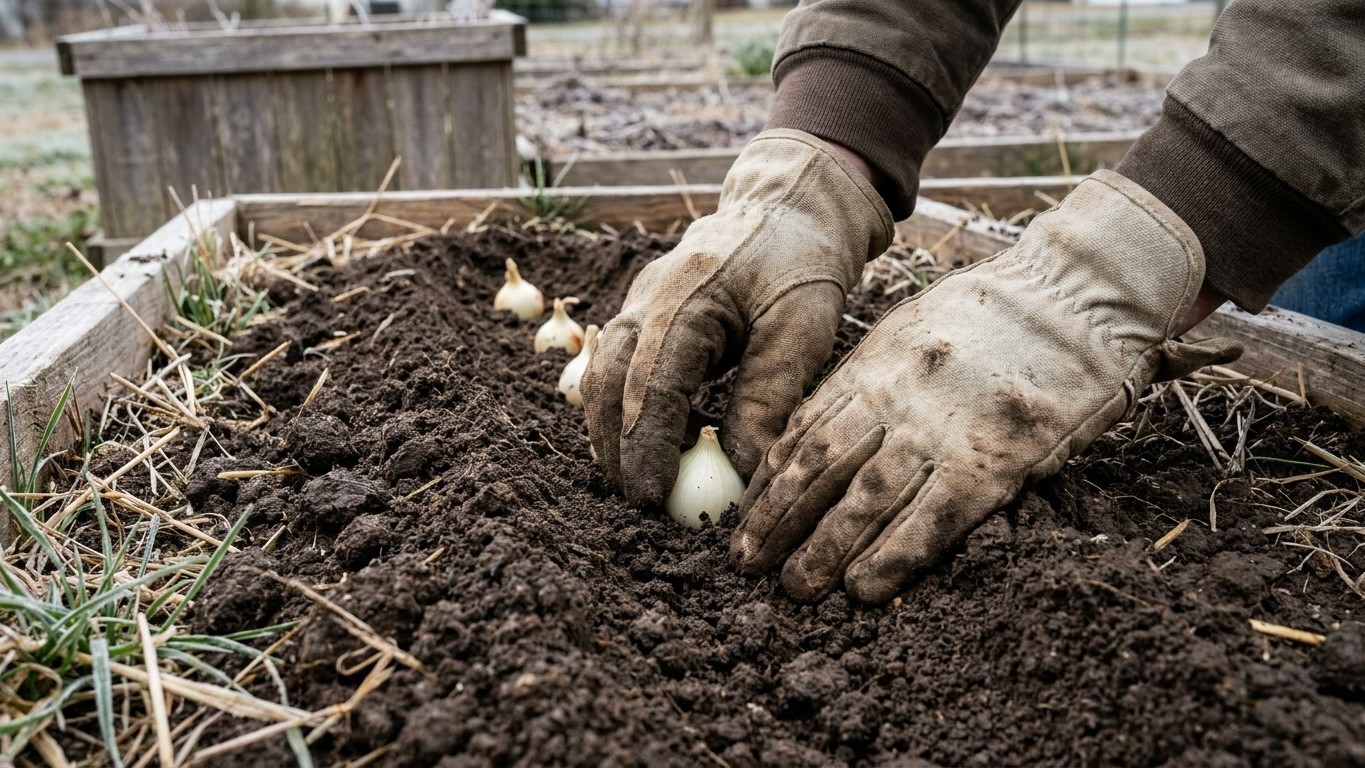

Kentucky gardeners plant onions in late winter to early spring, not fall. At 38.18°N, the reference latitude for this page, the longest day of the year brings 14 hours and 39 minutes of daylight, enough to trigger bulbing in intermediate-day and many long-day varieties, but the state’s winters are too cold to let fall-set transplants survive the way they do in the Deep South.
The short answer for Kentucky

The planting window in Kentucky runs from late February through late March, with sets and transplants going into the ground as soon as the soil can be worked and a hard freeze is no longer a daily risk. That’s a spring crop, not a fall one. In states with genuinely mild winters, gardeners plant onions in October or November and let the young plants sit through winter as small, dormant seedlings before they take off with the lengthening days of spring. Kentucky’s winters don’t cooperate with that plan. Repeated hard freezes kill young onion transplants outright, so the safer and more reliable path here is a spring planting timed to the last frost rather than a gamble on an overwintering crop.
The 14-hour-39-minute daylight figure at the summer solstice is the number that actually decides what happens next in the garden, more than any date on a calendar. Onions don’t bulb because the weather warms up. They bulb because the day gets long enough, and each variety has its own threshold for that. Short-day types switch over at around 12 hours of daylight, intermediate-day types wait until somewhere in the 12-to-14-hour range, and long-day types hold off until the day is pushing 14 to 16 hours. At 38.18°N, Kentucky sits right in the zone where intermediate-day varieties bulb reliably and many long-day varieties do too, since the summer day here comfortably clears their trigger point.
That’s also why the advice changes as you move across the country. A gardener in southern Georgia plants short-day onions in the fall because the day there never gets long enough to satisfy a long-day variety, and the mild winter lets fall-planted onions survive. A gardener in Minnesota plants long-day onions in spring because the summer day up there stretches past 15 hours, which a short-day onion would never need and would bulb far too early to use. Kentucky lands in between: winters cold enough to rule out fall planting, but a summer day long enough to grow intermediate and long-day varieties well. The date on the calendar matters less than getting the variety and the season to match the latitude.
What will not work here
Here’s the part that trips up a lot of Kentucky gardeners: planting an onion late doesn’t push the harvest back a few weeks. It shrinks the bulb. An onion plant bulbs the moment day length crosses its threshold, regardless of how big or small that plant happens to be at the time. Plant in March and the onion has two extra months of leaf growth behind it before the solstice trips the switch. Plant in May, on the same latitude, on the same soil, and the switch trips at the exact same calendar point, except the plant is smaller when it happens. The result is a smaller bulb, permanently. There’s no catching up once bulbing starts.
The same logic rules certain varieties out of Kentucky entirely, and it has nothing to do with skill or soil. Some onions are bred for day lengths this state simply doesn’t offer, in either direction:
- Gabriella — a short-day variety bred for 20-35°N; this far north it bulbs while the plant is still tiny, giving undersized onions no matter how well it’s fed.
- Madalyn — same short-day category, same 20-35°N range, same problem: bulbing triggers too early for the plant to have built any size.
- Red Rock — a short-day type for 30-36°N; Kentucky’s latitude pushes bulbing forward before the leaves can support a decent bulb.
- Frontier — a long-day variety built for 40-50°N; Kentucky’s summer day never reaches its trigger, so the plant makes leaves all season and rots without ever forming a bulb.
- Powell — long-day, 43-47°N; the same failure, no bulb at all, not a small one.
- Red Carpet — long-day, 40-45°N; too far north’s day length required, never met here.
- Redwing — long-day, 43-65°N; needs a summer day well beyond what Kentucky’s latitude provides.
- Safrane — long-day, 42-50°N; same shortfall in day length.
- Talon — long-day, 42-50°N; plant it in Kentucky and you get greens, not onions.
One variety sits right at the edge rather than clearly outside it: White Castle, a short-day type published for 30-38°N. Kentucky’s 38.18°N latitude falls just past the upper edge of that range, so it may bulb here, but a gardener trying it should treat it as a test row rather than the backbone of the crop.
What changes across Kentucky
Kentucky isn’t one latitude, it’s a strip of land running roughly from 36.5°N at the Tennessee line up to about 39.1°N along the Ohio River, a spread of more than two and a half degrees. The 38.18°N figure used above belongs to Louisville, whose long-term climate record is the reference point for the daylight math on this page. A gardener near Bowling Green or Middlesboro, close to the state’s southern edge, sits at a noticeably lower latitude than Louisville, while one near Covington or Ashland, up against the Ohio River, sits noticeably higher.
That spread matters because day length shifts with it, even over a couple of degrees. The northern edge of the state gets a slightly longer day at the summer solstice than Louisville does; the southern edge gets a slightly shorter one. It’s not enough of a difference to flip Kentucky into a different variety category outright, but it’s enough that a long-day variety planted near the Ohio River will bulb a touch more comfortably than the same variety near the Tennessee line, and a gardener at the southern edge may want to lean more heavily on intermediate-day types rather than long-day ones.
| Region | Approximate latitude | What it changes |
|---|---|---|
| Northern KY (Ohio River) | ~39.1°N | Slightly longer summer day; long-day varieties bulb with a bit more margin |
| Reference city (Louisville) | 38.18°N | 14 h 39 min on the longest day; baseline for intermediate and long-day varieties |
| Southern KY (TN line) | ~36.5°N | Slightly shorter summer day; lean toward intermediate-day varieties, plant a little earlier |
Frost dates shift across this spread too, generally arriving later in spring and earlier in fall as you move toward the northern counties. A planting date that works well in Louisville can be a week or two off for a garden near the Ohio River or the Tennessee border, which is exactly the kind of gap a local extension office is set up to close.
Sweet now, or onions that last
Kentucky’s spot on the map hands gardeners a real trade-off, and it’s not a matter of taste so much as chemistry. The compounds that make an onion sharp and eye-watering are volatile sulfur compounds, and those same compounds are what protect the bulb once it’s in storage. An onion with fewer of them tastes milder and sweeter fresh out of the garden, but it also breaks down faster on the shelf. According to University of Missouri Extension, “as a rule, ‘sweet’ onions do not store as well as the more pungent types,” and that’s not a marketing quirk, it’s the direct result of pungency and shelf life sharing the same chemical source.
This lines up with day length too. Short-day and many intermediate-day varieties tend to run sweeter and store for a shorter window, while long-day varieties tend to run sharper and hold up longer in a cool, dry pantry. Since Kentucky’s summer daylight sits comfortably in range for both intermediate-day and long-day types, a gardener here actually gets to choose which side of that trade-off to land on, rather than being locked into one by latitude alone.
A Kentucky garden planted with intermediate-day types like Candy, Scout, or Sierra Blanca gives sweeter onions meant to be eaten within a couple months of harvest, not tucked away for winter. A garden planted with long-day types like Bridger, Patterson, or Ailsa Craig trades some of that sweetness for onions that hold in a cool, dark spot well into the colder months. If the pantry needs to still have onions in March, the long-day side of that list is where to plant.
Checking this against your own garden
Every figure on this page comes from one reference point, Louisville at 38.18°N, and a state that stretches across more than two and a half degrees of latitude won’t behave identically end to end. Before locking in a planting date or a variety, it’s worth confirming a few things specific to your own address rather than trusting a single statewide number.
- Look up your own latitude if you’re near the Tennessee border or the Ohio River, since either edge shifts the daylight math slightly away from the Louisville figure.
- Check your local average last-spring-frost and first-fall-frost dates, which vary by one to two weeks across the state’s counties.
- Confirm your USDA hardiness zone, since Kentucky spans zones that affect how early sets or transplants can safely go into the ground.
- Call or visit your county extension office, which keeps localized planting calendars built around your specific soil and microclimate rather than a statewide average.
- Test any borderline variety, like a short-day type near its upper latitude limit, in a small trial row before committing a full bed to it.