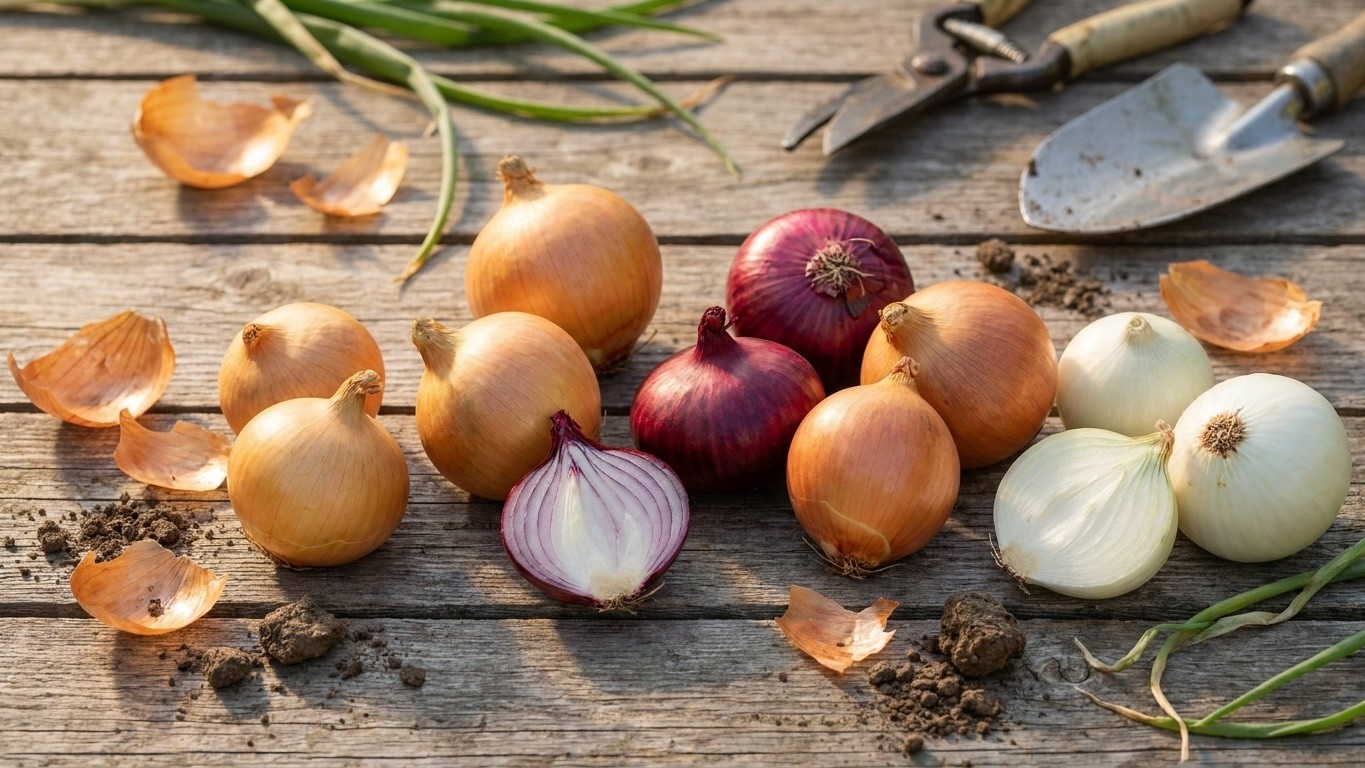

Kentucky sits at a latitude where both long-day and intermediate-day onions can size up properly, but the state’s daylight ceiling of 14 hours 39 minutes on the summer solstice rules out several varieties entirely. Eighteen of the twenty-eight varieties documented on this site are built for this exact range. Nine are not, and planting the wrong ones costs you the whole crop, not just a smaller one.
The short answer for Kentucky

Louisville, Kentucky sits at 38.18 degrees north latitude, and on the longest day of the year it gets 14 hours and 39 minutes of daylight. That single figure decides which onions will actually form bulbs in a Kentucky garden, because bulbing isn’t triggered by heat or soil temperature. It’s triggered by day length. An onion variety is bred to start converting its leaves into a bulb once the days reach a specific threshold, and 14 hours 39 minutes is long enough to satisfy both the intermediate-day group (which needs roughly 12 to 14 hours) and the long-day group (which needs 14 to 16 hours).
That puts Kentucky squarely in the overlap zone between the two groups, which is a good place to garden from. It means a Kentucky grower isn’t locked into one type the way a grower in south Texas or northern Minnesota would be.
Among the varieties whose published latitude range covers 38.18 degrees north, the intermediate-day group includes:
- Candy
- Cabernet
- Calibra
- Elsye
- Expression
- Monastrell
- Red Long of Florence
- Red Long of Tropea
- Scout
- Sierra Blanca
And the long-day group, also within range here, includes:
- Ailsa Craig
- Barolo
- Blush
- Bridger
- New York Early
- Patterson
- Rossa di Milano
- Walla Walla Sweet
Any of these eighteen will bulb in a typical Kentucky garden. The variety choice from here comes down to flavor, storage life, and color, not day length.
What will not work here
Short-day onions are the mistake Kentucky gardeners make most often, usually because seed racks don’t sort by latitude and a bag of short-day sets looks the same as anything else. Short-day varieties are built for latitudes well south of Kentucky, where the day length hits their 12-hour bulbing trigger while the plant is still small. Bring one north and the same thing happens here, just at the wrong time: the plant hits its trigger point too early, before it has built enough leaf mass, and you get a bulb the size of a golf ball instead of the size of a fist.
On the other end, several long-day varieties are bred for latitudes north of Kentucky, where summer days stretch out well past 15 hours. Plant one of those here and the day never gets long enough to flip the switch. The plant doesn’t know to stop making leaves. It keeps growing top growth all season, produces no bulb worth harvesting, and eventually rots in the ground or in storage. That’s not a smaller harvest. That’s no harvest.
The excluded varieties, and why each one fails in a Kentucky garden:
- Gabriella (short-day, published for 20-35N), bulbs too early here, giving a tiny onion instead of a full-sized one.
- Madalyn (short-day, published for 20-35N), same early-bulbing problem; the plant never gets the chance to build size.
- Red Rock (short-day, published for 30-36N), still too far south for Kentucky’s day length; triggers before the plant is ready.
- Frontier (long-day, published for 40-50N), the day here never reaches its threshold; leaves all season, no bulb, eventual rot.
- Powell (long-day, published for 43-47N), needs longer summer days than Kentucky provides; same failure pattern.
- Red Carpet (long-day, published for 40-45N), bred for a northern day length Kentucky doesn’t reach.
- Redwing (long-day, published for 43-65N), one of the most northern-adapted varieties on this list; badly mismatched here.
- Safrane (long-day, published for 42-50N), will not see a long enough day in a Kentucky summer.
- Talon (long-day, published for 42-50N), same problem as Safrane; plant it and expect leaves, not bulbs.
One variety, White Castle (short-day, published for 30-38N), falls just outside the documented range but close enough to call it a genuine edge case. It may bulb in the warmest, most southern corners of Kentucky, but it’s a gamble rather than a safe bet, and a gardener trying it should treat it as an experiment, not a main crop.
What changes across Kentucky
Louisville’s 38.18 degrees north is a reference point, not a statewide constant. Kentucky stretches from around 36.5 degrees north at its southern border with Tennessee up to roughly 39.1 degrees north along the Ohio River near Cincinnati, a span of close to three degrees of latitude. That’s enough distance to shift daylight hours and, with them, which onion groups make the most sense.
| Location | Approximate latitude | What it changes |
|---|---|---|
| Southern Kentucky (near Tennessee border) | ~36.5N | Slightly less summer daylight than Louisville; intermediate-day varieties still perform well, and short-day types get marginally closer to workable, though still a risk given the reasons above. |
| Louisville (reference city) | 38.18N | 14 hours 39 minutes on the longest day; the balance point between intermediate-day and long-day groups. |
| Northern Kentucky (Ohio River, near Cincinnati) | ~39.1N | A bit more summer daylight than Louisville; long-day varieties bulb slightly more reliably, and the coldest long-day types edge closer to workable, though most on the excluded list still fall short. |
A gardener in Bowling Green or Pikeville isn’t gardening under the same sky as one in Covington. The practical takeaway isn’t to abandon the guidance above, but to lean toward long-day varieties if you’re near the northern edge of the state, and to lean toward intermediate-day varieties if you’re near the southern edge, rather than treating every Kentucky county as identical to Louisville.
Sweet now, or onions that last
Every onion variety leans one way or the other on a trade-off that has nothing to do with luck and everything to do with chemistry. The bite in a pungent onion comes from volatile sulfur compounds, and those same compounds are what protect the bulb during long storage. According to University of Missouri Extension, “as a rule, ‘sweet’ onions do not store as well as the more pungent types.” A sweet onion simply has fewer of those protective compounds. It tastes better raw in July. It won’t make it to Christmas in a mesh bag on a shelf.
This lines up with the day-length split that already applies to Kentucky. Intermediate-day varieties in this range, Candy among them, tend to run milder and sweeter, which makes them the pick for a gardener who wants onions for salads and grilling through late summer. Long-day varieties in Kentucky’s range, including Patterson and Ailsa Craig, generally hold their pungency longer in storage, which is exactly what a pantry needs in the dead of winter.
A Kentucky garden can grow both, and that’s the real advantage of sitting in the overlap zone. Plant a run of intermediate-day onions for the kitchen table this season, and a separate run of long-day onions destined for the root cellar or a cool, dark closet. Come March, the sweet ones will be long gone, eaten fresh months earlier, while the sharper long-day bulbs are the ones still holding firm, still usable in a soup or a roast, because their sulfur content did exactly the job it was bred to do.
Checking this against your own garden
Every figure above is anchored to Louisville. If your garden sits closer to the Tennessee line or the Ohio River, the numbers shift enough to matter, and it’s worth confirming a few things before you commit a season to a variety.
- Look up your own latitude if you’re gardening more than an hour’s drive from Louisville, since even one degree changes daylight hours on the solstice.
- Check your local average last spring frost date and first fall frost date, since onion sets and transplants both need timing around those, separate from the day-length question.
- Call your county extension office, part of the University of Kentucky Cooperative Extension Service, for planting windows specific to your soil and microclimate.
- Note whether your garden sits in a low frost pocket or on higher ground, since local topography can shift effective planting dates by a week or two even within the same county.
- Re-check any variety near the edge of its published range, like White Castle here, against your own conditions before planting it as a main crop rather than a trial row.