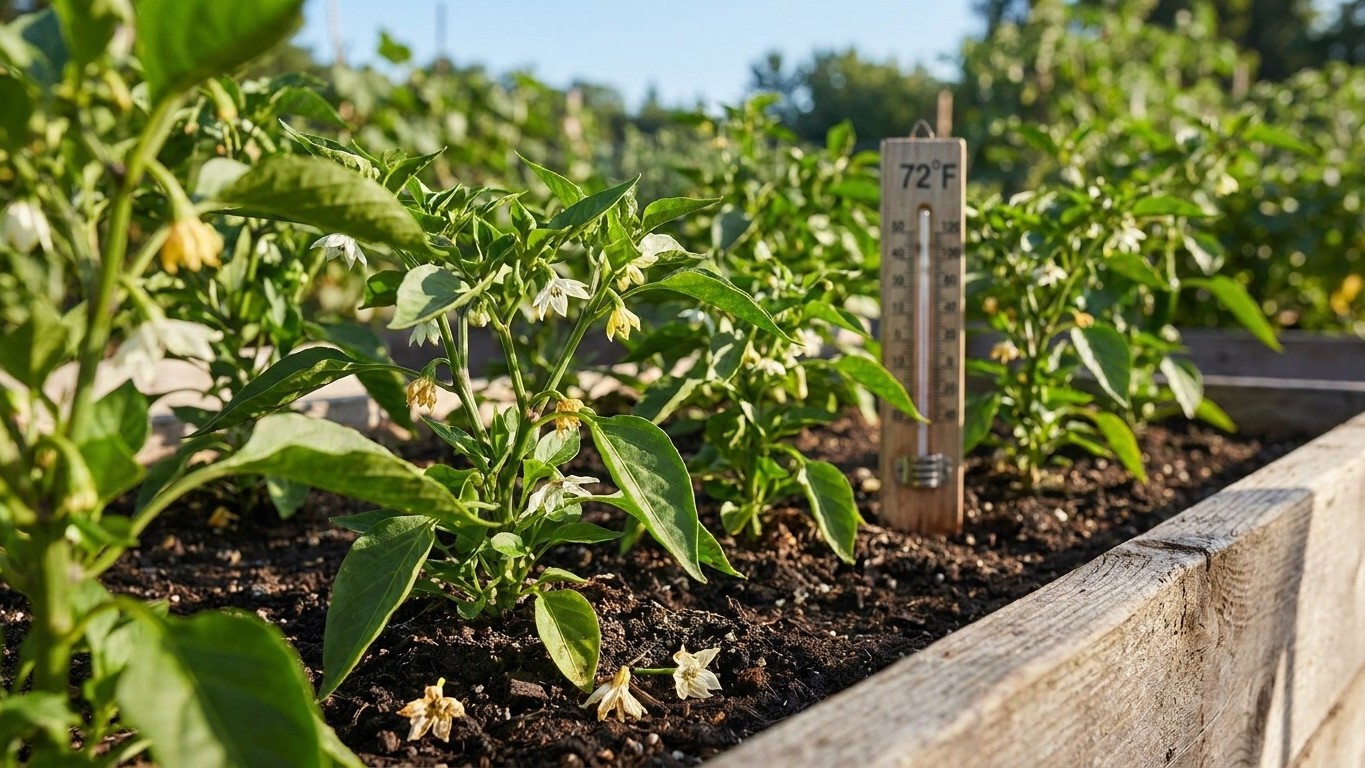

In Kentucky, the target window for starting pepper seed indoors is mid-January through early February, counting back 8 to 10 weeks from a transplant date that falls after the last spring frost and once soil has warmed to 60°F. That frost date lands between March 24 and April 4 for most of the state, though the exact week shifts by county.
The short answer
Kentucky averages 37.2 days a year at or above 90°F, based on NOAA climate normals from the Louisville reference station. That number matters more than most gardeners realize, because pepper fruit set has a hard ceiling built into the plant’s biology. Once daytime temperatures push past 90°F for a stretch, flowers abort before they ever become fruit. The plant isn’t damaged in any way you can see. Leaves stay green, stems stay upright. But the blossoms drop, and a week or two of production simply vanishes. With 37 days a year crossing that line in Kentucky, spread mostly across July and August, a pepper crop that flowers during the hottest stretch of summer can hit a stall that has nothing to do with watering or fertilizer.
The other end of the failure range is just as real, and it’s the one gardeners tend to forget. Pepper fruit set also fails when nights drop below 55°F. A string of cool nights in early spring or a late-season chill in September can knock blossoms off a plant just as effectively as a heat wave. Utah State University Extension, which publishes the growing guidance behind this figure, is blunt about it: peppers fail at both ends of the temperature scale, not just the hot one.
Here’s where this gets specific to your own yard rather than the state as a whole. This site tracks daytime heat, meaning the 90°F count above is solid ground. It does not track summer night minima. Kentucky’s nights vary by valley, elevation, and how close you are to a river or a paved lot that holds heat overnight, and none of that shows up in a statewide or even a county-level average. A garden tucked into a low spot along a creek bottom can run several degrees cooler at 2 a.m. than one on a ridge two miles away. So the hot-end risk here is measured and real: 37.2 days a year. The cool-end risk is just as real, but you’ll need to watch your own thermometer for it, ideally with a min-max reading left outside overnight during the shoulder seasons in spring and early fall. Don’t guess at it from a map or a latitude line. Local terrain moves night temperatures around more than most people expect.
When to start seed here
The math behind a pepper sowing date is simple once you break it into pieces, and it works the same way whether you garden in Louisville, Bowling Green, or a hollow in eastern Kentucky. Here’s the sequence, in order.
- Start with the frost date. NOAA’s 1991-2020 climate normals put the 32°F freeze probability window at March 24 to April 4 for the reference station used in this data. That’s your earliest safe outdoor transplant date, assuming nothing else is holding you back.
- Check soil temperature, not just the calendar. Utah State University Extension is specific on this point: peppers should go in the ground once soil reaches 60°F, after frost risk has passed. Air temperature can feel warm on a sunny March afternoon while the soil six inches down is still cold from winter. A simple soil thermometer pushed into the bed, checked in the morning before the sun warms the surface, tells you more than a weather app ever will.
- Count backward 8 to 10 weeks from that transplant date. If soil in your yard typically hits 60°F around the third week of April, work backward: 10 weeks earlier lands you in mid-February, 8 weeks earlier lands you in early March. Split the difference and most Kentucky gardeners land somewhere between late January and mid-February for sowing indoors.
- Adjust for your own microclimate. NWS Louisville has noted that the urban station itself runs later in spring and earlier in fall than the surrounding rural Jefferson County. If you’re gardening outside the city, rural exposure often means an earlier effective frost-free date, and a tighter window than the metro numbers suggest. Gardeners further east, in cooler mountain hollows, may need to push both the sowing date and the transplant date later rather than earlier.
- Build in a buffer for a slow spring. Peppers started too early just sit indoors, getting leggy and rootbound under grow lights, waiting for soil to warm. There’s no advantage to starting seed in December for a plant that can’t go outside until late April. If anything, err toward the 8-week mark rather than 10 if your spring tends to run cool and wet.
What goes wrong here
- Blossom drop during a July or August hot spell. With 37.2 days a year at or above 90°F concentrated in midsummer, plants that flower during that stretch can drop blossoms for days at a time. There’s no fix for the heat itself, but shifting transplant timing earlier in the season, so the bulk of flowering happens in June rather than late July, sidesteps the worst of it. Afternoon shade cloth over the row during a heat spike can also reduce blossom loss.
- Blossom drop from a cool snap in spring or early fall. Nights under 55°F stop fruit set just as effectively as heat does, and this site does not track those overnight lows for Kentucky, so the fix starts with watching your own thermometer during the shoulder seasons. If a cold night is forecast while plants are flowering, a floating row cover pulled over the bed overnight can hold enough ground warmth to protect the blossoms.
- Sunscald on exposed fruit. Kentucky’s summer sun is strong enough, especially paired with those 37-plus days of 90°F-plus heat, to blister the skin of peppers that lose their leaf cover. This usually happens after aggressive pruning or when a storm strips foliage. Leaving the plant’s own canopy intact to shade the fruit is the simplest prevention; a light shade cloth over exposed rows during the hottest weeks works as a backup.
- Blossom-end rot on the first fruit of the season. This shows up as a flat, leathery brown patch on the bottom of the pepper, usually tied to uneven watering rather than a soil calcium shortage outright. Kentucky’s swing between soggy spring soil and dry midsummer stretches makes this a common early-season problem. Consistent watering, mulch to even out soil moisture, and avoiding a big gap between waterings during fruit set all reduce it.
Common questions
Can I Start Pepper Seed too early in Kentucky?
Yes. Starting much earlier than 10 weeks before your transplant date usually just means leggy, rootbound seedlings sitting indoors waiting for soil to hit 60°F. There’s no yield benefit to a December or early January start for a plant that can’t safely go outside until roughly late March at the earliest, and later than that in cooler pockets of the state.
What soil temperature should I wait for before transplanting?
Utah State University Extension puts the mark at 60°F, checked after frost risk has passed. Air temperature alone isn’t a reliable stand-in for this, since soil warms more slowly than the air above it, particularly in a bed that’s still shaded or holding spring moisture.
Does Kentucky’s heat actually stop peppers from setting fruit?
It can. Days at or above 90°F, which happen an average of 37.2 times a year at the Louisville reference station, are the point at which pepper blossoms tend to abort rather than set fruit. It’s a temporary stall tied to the weather, not permanent plant damage, and fruit set typically resumes once temperatures ease.
Why does my area’s frost date seem different from what I’ve read?
NOAA’s freeze probability data for the reference station in this dataset runs March 24 to April 4, but NWS Louisville has pointed out that this urban station reads later in spring and earlier in fall than surrounding rural Jefferson County. If you garden outside a city, expect a tighter, earlier window than the metro figures suggest, and adjust your sowing math accordingly.