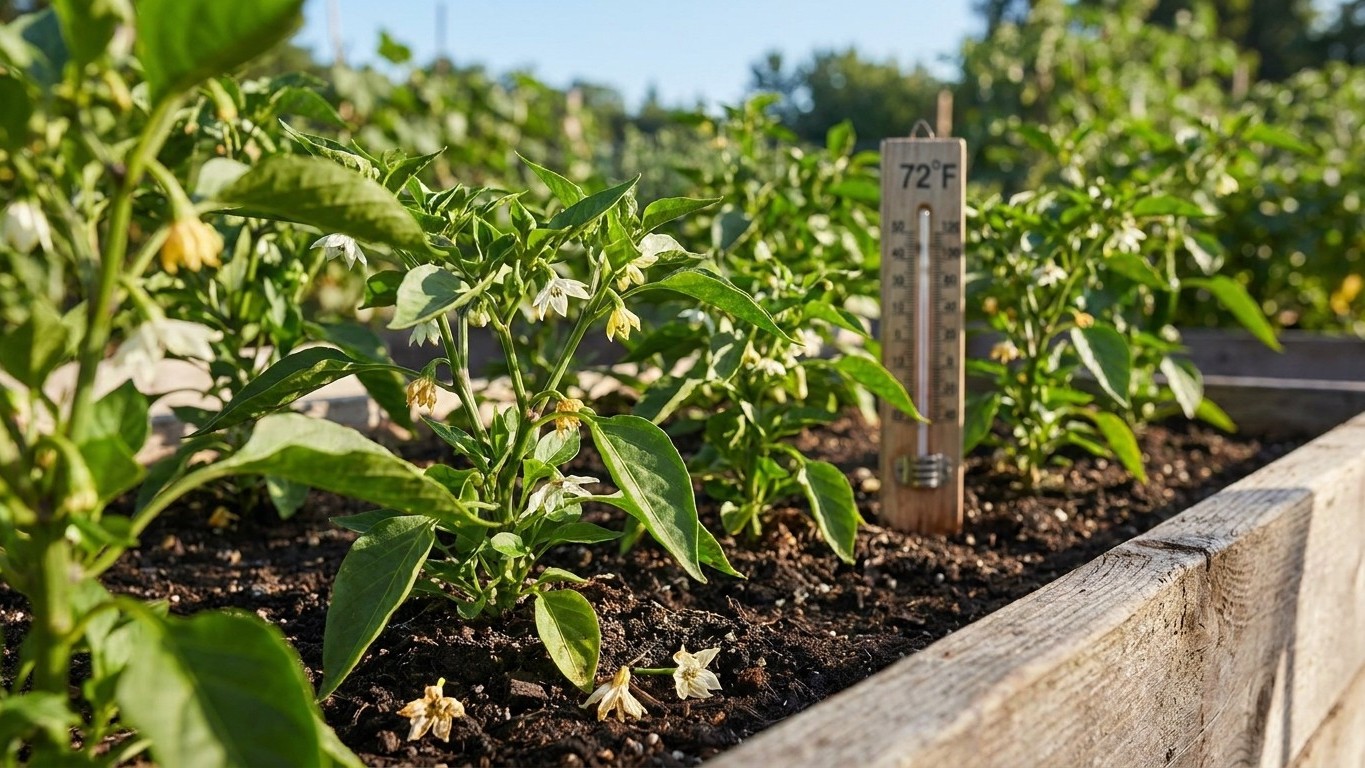

Massachusetts gardeners get one real shot at pepper season, and it starts on a windowsill, not in the garden bed. Sow pepper seed indoors from mid-March through early April, counting 8 to 10 weeks back from a transplant date that lands once soil hits 60°F and frost risk has cleared, usually late May into mid-June depending on how close you sit to the coast. Wait for that soil number, not the calendar, and the plants set fruit far more reliably.
The short answer
Boston’s reference station logs a mean of 10.2 days a year at or above 90°F, according to NOAA NCEI Climate Normals covering 1991 to 2020. That’s a modest heat load compared with the Mid-Atlantic or the Deep South, but it isn’t zero, and pepper plants notice every one of those days. Fruit set on pepper blossoms breaks down once daytime highs push past 90°F for a stretch, according to Utah State University Extension. The flower drops before it ever sets fruit, and a plant that looked loaded with blooms in July can look strangely bare by mid-August.
Ten days scattered across a Massachusetts summer usually means a handful of short heat spikes rather than one long punishing run, and that matters for how you manage the crop. A single 92°F afternoon rarely does lasting damage. A stretch of five or six days above 90°F back to back, the kind that sometimes lands in mid-July, is what stalls blossom set for a week or two until temperatures ease. Coastal spots near Boston Harbor and Buzzards Bay tend to catch an ocean breeze that clips the worst of these spikes; inland valleys and the stretch along the Connecticut River tend to hold heat longer into the evening, which is worth watching if your garden sits away from open water.
The other failure point sits at the opposite end of the thermometer, and it’s just as real. Fruit set also fails when nights drop below 55°F, per the same Utah State University Extension guidance, because the plant needs warm nights to hold its blossoms through to fruit. This site doesn’t carry summer night minima for Massachusetts, so there’s no local figure to hand you here. That’s not a gap to guess around by assuming your latitude or the coldest month tells you anything useful about a July or August night. Elevation, tree cover, and distance from open water all shift how far a given yard’s overnight low sits below the daytime high, and none of that shows up in a state-level average.
The practical move is to track your own thermometer once plants are in the ground, particularly in June when nights can still run cooler than the calendar suggests, and again in September as fall approaches. If blossoms are forming but nothing is turning into a small green fruit, check the two ends first: a heat stretch above 90°F, or a run of nights that have quietly slipped under 55°F. That single check saves a lot of second-guessing over fertilizer or watering when temperature is the actual cause.
When to start seed here
The countdown for pepper seed always runs backward from a transplant date, never forward from a page on a calendar. Here’s how to build that countdown for your own yard.
- Find your local last spring frost date. NOAA NCEI’s 1991-2020 Climate Normals put Boston’s window at April 1 to April 8, based on 32°F freeze probabilities at the Logan Airport reference station. Logan sits right on the water, which makes it the mildest spot in the state. If you garden inland, in the Worcester hills, the Pioneer Valley, or the Berkshires, your last frost typically lands later than that Boston window, sometimes by a few weeks, so treat April 1-8 as a coastal starting point rather than a statewide date.
- Don’t stop at the frost date. Peppers need frost-free air and warm soil at the same time, and frost passing is only half of that requirement.
- Watch the soil, not just the air. Push a soil thermometer four inches deep into the bed where the peppers will go. Utah State University Extension’s guidance is to transplant once that soil reads 60°F, and only after frost risk has passed. Soil warms slower than air, so this date almost always falls after your local frost window, sometimes well after it, especially in a cool, wet spring or in an in-ground row rather than a raised bed.
- Mark whatever date the soil hits 60°F, after frost, as your real transplant target. That date, not the frost date, is what the rest of the schedule gets built around.
- Count back 8 to 10 weeks from that target for indoor sowing, which is the window Utah State University Extension recommends for starting pepper seed indoors before transplant. If your soil typically reaches 60°F in late May, 8 to 10 weeks back lands sowing in mid-March to early April. If your soil runs cooler and doesn’t hit 60°F until closer to mid-June, the same 8 to 10 week count pushes sowing into late March through mid-April instead.
- Redo the math every year off your own soil reading rather than last year’s date. A warm, dry spring can pull the 60°F mark forward by two or three weeks compared with a cold, wet one, and pepper seed started too early just sits pot-bound in a tray, waiting on a transplant date that hasn’t arrived yet.
What goes wrong here
- Blossom drop during a hot spell. When daytime highs push past 90°F, sometimes for several days running in mid-summer, pepper flowers abort before they set fruit, according to Utah State University Extension. Boston’s reference station averages 10.2 such days a year, and inland gardens often feel more of that heat stress than the coast does. The fix is shade cloth (30 to 40 percent shade) pulled over the row during a forecast heat spike, morning watering rather than midday watering, and patience, since plants usually resume setting fruit once temperatures ease back down.
- Blossom drop on a cool night. The same failure shows up at the opposite extreme, when nights fall below 55°F, and it can catch gardeners off guard in early June or again in September. This site doesn’t carry summer night minimum data for Massachusetts, so there’s no local average to lean on here; track your own overnight lows with a simple outdoor thermometer, especially in low-lying yards or gardens set back from the coast, where nights often run cooler than they do in town. Floating row cover pulled over plants on a night the forecast calls for a dip under 55°F, and pulled off again once temperatures climb, is the practical fix.
- Sunscald on exposed fruit. Direct, strong summer sun can bleach or blister the skin on pepper fruit that sits unprotected, particularly on plants that have lost lower leaves to disease or heavy pruning. Leaving the plant’s natural leaf canopy in place, and staking or caging so fruit stays tucked under foliage instead of hanging exposed on the sunniest side of the row, prevents most of it.
- Blossom-end rot. Fruit develops a sunken, leathery brown patch at the blossom end, usually tied to inconsistent watering that disrupts calcium uptake rather than an actual calcium shortage in the soil. Even, steady watering on a schedule rather than letting the bed dry out and then soaking it, plus a two to three inch mulch layer to hold soil moisture through a hot, dry stretch, keeps this one from showing up.
Common questions
Can I skip starting seed indoors and just sow pepper seed outside in Massachusetts?
Direct-sowing isn’t the practical route here. Peppers need 8 to 10 weeks indoors before they’re ready to transplant, per Utah State University Extension, and Massachusetts’s frost-free window generally isn’t long enough for a direct-sown pepper seed to catch up and still mature a full crop before fall.
What if my soil isn’t at 60°F yet by the time I planned to transplant?
Wait. Transplanting pepper starts into cold soil, even after frost has passed, sets the plants back rather than moving them forward, since root growth stalls below that 60°F mark. A soil thermometer read a few days in a row, rather than one quick check, gives a more reliable answer than guessing off the air temperature.
Does the 8 to 10 week indoor window include the time from flowering to harvest?
No. The days-to-maturity figure on a seed packet is counted from when the plant flowers, not from the day you started seed indoors or the day you transplanted it outside. Add flowering time on top of the indoor window when you’re working out a rough harvest date.
Do certain pepper varieties handle Massachusetts summers better than others?
Utah State University Extension’s guidance names several pepper varieties but doesn’t assign a heat tolerance rating, a maturity length, or a size to any of them. Without that data attached to specific names, the more reliable approach is tracking which varieties have actually set fruit well in your own yard through a hot July, rather than picking by name alone.