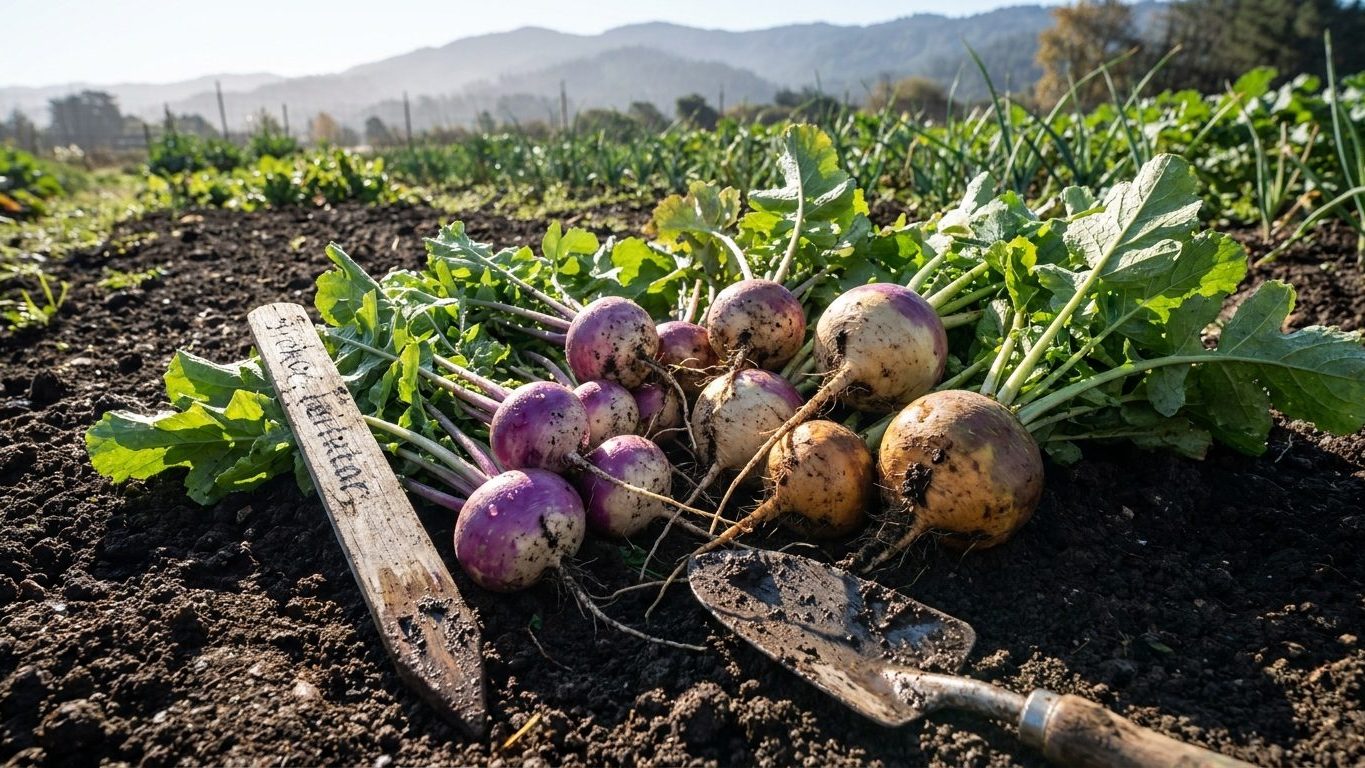

Best varieties turnips Kentucky planting means splitting the crop into two jobs. Fast turnips like Purple Top White Globe or Tokyo Cross work as both a spring and fall crop, while rutabaga only fits one window: a fall harvest timed against the first freeze, not a spring one.
The short answer for Kentucky
Kentucky’s growing season runs from a last spring frost of March 24 to April 4 out to a first fall frost of November 2 to November 12, based on the Louisville reference station. That’s a long enough window for two turnip crops but only one real shot at rutabaga, and the reason comes down to how each root handles the state’s hot, humid mid-summer stretch.
Turnips in the 45 to 55 day range, Purple Top White Globe, Tokyo Cross, Hakurei, can go in the ground right after that spring frost date and be pulled before the worst of July heat pushes them to bolt. A second sowing in late summer catches the cooling temperatures on the way into that November frost window and usually produces the sweeter, more tender roots gardeners actually prefer.
Rutabaga is a different animal. It needs 90 to 100 days of steady, cool growth to bulk up properly, and it does better when a light frost hits right before harvest, since the cold converts starches to sugar and improves flavor. Planted in spring, it runs straight into Kentucky’s summer heat and humidity before it’s finished, and the roots turn woody and bitter. The only reliable play is a fall crop, sown so it matures right around that first frost window rather than fighting through August.
That means counting backward from the earliest expected frost date, November 2, and subtracting the maturity length of whatever rutabaga variety you’re growing. For a 90-day variety, that puts the sowing date around late July, not the classic spring planting date most seed packets assume. Get that timing wrong in either direction, too early and the plant sits in summer heat too long, too late and it doesn’t finish before a hard freeze, and the crop underperforms no matter how good the variety is.
What will not work here

Long-season, slow-bulbing turnip varieties bred for cooler, shorter-summer climates struggle in Kentucky if planted in spring. They’re still building root mass when the heat and humidity of a Kentucky June and July arrive, and the plant’s response to that stress is to bolt, sending up a flower stalk and diverting energy away from the root entirely. A variety that needs 65 or 70 days to mature is a much tougher fit for a spring planting here than a 45-day type, simply because it spends more of its life cycle exposed to rising temperatures.
Rutabaga planted on a spring schedule runs into the same wall, but with less margin for error, since its maturity window is roughly double that of a fast turnip. Gardeners who treat rutabaga like a typical root vegetable and sow it in April are setting it up to spend its entire growing period in progressively worse heat, and the payoff is small, cracked, bitter roots rather than the dense, sweet ones the crop is known for.
Overwintering rutabaga in the ground past the fall harvest window is another risk specific to this territory. The coldest month here averages a daily minimum of 27.8°F, which sits close to the edge of what an unmulched rutabaga root can tolerate through repeated freeze-thaw cycles. A single hard freeze rarely kills the crop outright, but weeks of alternating freezing nights and warmer days without protective mulch will break down root tissue and invite rot, so leaving the harvest “for later” through a Kentucky winter is a bigger gamble than it would be in a milder zone.
Tight spacing recommendations lifted from drier-climate growing guides also tend to backfire. Kentucky’s summer humidity creates ideal conditions for foliar diseases like downy mildew, and crowding turnip or rutabaga rows cuts off the airflow that would otherwise dry leaves out between rain events. A spacing chart written for the arid West doesn’t account for how much longer wet foliage stays wet here, and closer rows in this climate usually mean more disease pressure, not just more yield.
What changes across Kentucky
Kentucky spans USDA hardiness zones 6a to 7a, and that spread matters more for timing than it does for variety choice. This is not a state with one growing calendar; it’s a state where the western lowlands and the higher elevations toward the southeast can be a full zone apart, which shifts both the last spring frost and the first fall frost by a week or more in either direction.
The reference figures on this page, drawn from the Louisville station, sit closer to the warmer end of that range. Gardeners at higher elevation or farther into the state’s cooler pockets should expect their own first fall frost to arrive earlier than November 2, which pulls the whole rutabaga sowing calculation forward. If the local frost date lands even a week earlier, that late-July sowing target needs to move up by roughly the same amount, or a 100-day variety needs to be swapped for something closer to 85 days to still finish in time.
The reverse is true toward the warmer, lower-elevation parts of the state, where the growing season stretches a bit longer on both ends. That extra cushion gives more room for a second turnip planting or a slightly later rutabaga sowing without much added risk, but it’s not a guarantee, since a single early cold snap can still catch an unfinished crop off guard.
None of this replaces knowing your own zone. The USDA Plant Hardiness Zone Map is the tool built for that exact question, and it’s worth checking against the state’s actual range rather than assuming the Louisville-based dates in this article apply exactly to a specific county.
Where to check this for your own county
This page describes Kentucky as a whole, built around Louisville’s climate data, and that’s useful for a general sense of timing but not a substitute for what your own county’s extension office has on file. The University of Kentucky Cooperative Extension Service is the state’s land-grant extension system, and it publishes planting calendars and variety trial results at the county level, which is exactly the resolution this state-wide page can’t offer.
When you get there, look for two specific things. First, the local planting calendar for cool-season vegetables, which will translate the general frost-date ranges used here into dates adjusted for your specific county’s climate station rather than Louisville’s. Second, look for any variety trial results or extension bulletins naming turnip and rutabaga cultivars that have actually performed well in university or county demonstration plots in Kentucky conditions, since those recommendations reflect real outcomes rather than generic seed catalog descriptions.
A county-level recommendation will always beat a state-wide one, because it accounts for local elevation, soil type, and microclimate effects that a statewide average can’t capture. This page is intentionally the broad version, the one that gets you oriented before you narrow things down. Your county extension office is where that narrowing happens, and a phone call or visit there is one of the few genuinely free resources available to home gardeners in the state.
Checking this against your own garden
Every date on this page is a regional average, and your own garden will tell you more than any calendar once the season actually starts. Three signals are worth tracking, and none of them require anything beyond your own hands and eyes.
Start with soil warmth by feel. Reach a few inches down in the bed where you plan to sow, and if the soil still feels cold and damp rather than merely cool, root crops will sit and sulk rather than germinate promptly, regardless of what the calendar says. This is a faster read on your specific microclimate than any frost date, since a south-facing raised bed and a shaded low spot in the same yard can differ by more than a week in soil warm-up.
Second, watch for the first true leaves after germination. Turnip and rutabaga seedlings put out a set of rounded seed leaves first, followed by the more deeply lobed true leaves that actually start photosynthesizing at full capacity. If those true leaves are slow to appear compared to what the seed packet’s germination timeline suggests, that’s a sign your spot is running cooler or shadier than the regional average, and maturity dates should be pushed back accordingly.
Third, keep an eye out for early bolting, especially on a spring turnip crop. If you see a flower stalk forming well before the plant has bulked up a decent root, that’s your garden telling you the heat arrived faster than the regional average this year, and it’s worth noting the date for next season’s planning, since that kind of on-the-ground observation will always outrank a printed frost date.